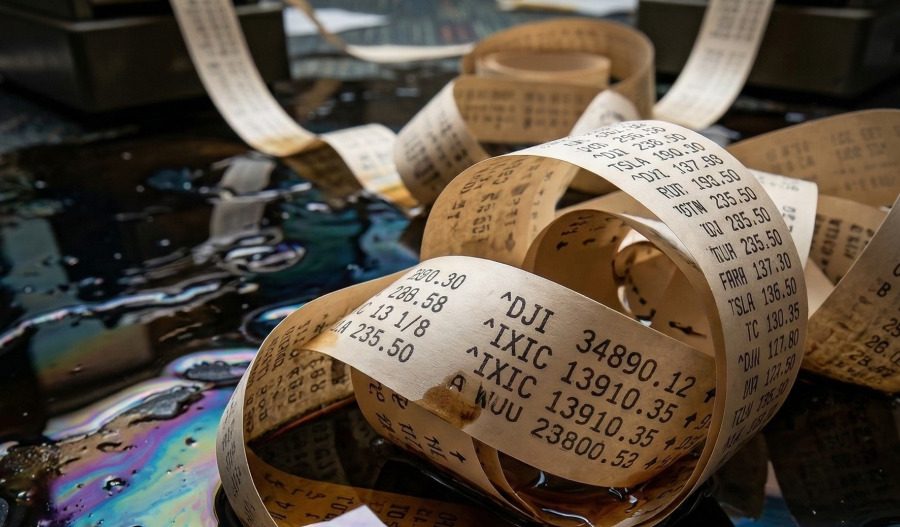

Iran launched missiles at Qatar's largest LNG hub and UAE energy infrastructure, Brent crude surged past US$111 a barrel, the RBA hiked rates, the Fed held firm, BHP named its next CEO, Meta prepared to axe 16,000 jobs, and Nvidia projected $1 trillion in revenue by 2027. Normal week, right?
All the top moves, shakes, and castrates from Azzet's editorial team are right here in your weekly business wrap every Friday (20 March 2026).
Monday
The week opened with a familiar cocktail: A weakening United States consumer, an escalating Gulf conflict, and the largest miner on the ASX getting ready to shuffle the C-suite.
The latest GDP read showed U.S. growth slumping amid a government shutdown that took a measurable bite out of activity - a result that reinforced the growing evidence the American economy was cooling before the oil shock even arrived.
A separate release showed job openings coming in sluggish while consumer sentiment fell further, a pairing that usually gets the attention of Fed watchers and duly did.
On the geopolitical front, Washington moved to secure allied naval escorts for tankers transiting the Strait of Hormuz - a request that would be tested repeatedly later in the week.
The Pentagon signalled it was weighing strikes on oil facilities at Iran's Kharg Island, the chokepoint through which roughly 90% of Iran's crude exports flow.
The week's biggest corporate story landed from Menlo Park, where Meta revealed plans to cut roughly 16,000 positions - about 20% of its workforce - as the social media group looks to bankroll an AI infrastructure programme with capex guidance of $115 billion to $135 billion for 2026, nearly double last year.
The layoffs are the headcount trade-off for that buildout, though whether the AI models are pulling their weight remains an open question.
The software giant reached a $150 million lawsuit settlement at Adobe, and the New Zealand dairy cooperative kicked off a leadership search after Fonterra's CEO resigned.
Bain Capital picked up Perpetual's wealth management arm, continuing private equity's appetite for Australian financial services businesses.
A US$6.5 billion bid from Tilman Fertitta landed on Caesars Entertainment's doorstep, while ASIC slapped Macquarie with a A$35 million fine for misreporting short sales - an administrative headache the millionaires' factory would rather have avoided.
This week's Mission Critical column examined copper's shifting demand drivers, as the red metal's long-term thesis moved further from construction toward electrification, data centres, and defence.
The ASX rate tracker was pricing a 58% probability of a rate hike ahead of Tuesday's RBA meeting.
The war's inflationary tail was the swing factor.
Chinese e-commerce group JD.com launched operations in Europe, adding another front to Beijing's consumer technology export push.

Tuesday
The RBA pulled the trigger.
The Reserve Bank lifted the cash rate by 25 basis points to 4.10%, its second consecutive hike, citing inflationary pressures that had picked up materially in the second half of 2025.
The decision was tight - five votes to four - with the board agreeing on direction even if the timing drew a split among members.
Governor Bullock pointed to the Middle East conflict as a substantial risk in both directions: a longer or more severe war would push up energy prices and near-term inflation, while the uncertainty could drag on growth across Australia's major trading partners.
On the Gulf, Beijing's decision to choose trade stability over Tehran tells you everything about where China's economic priorities sit right now.
Washington's call for Hormuz escort vessels was rebuffed by U.S. allies, leaving the Americans increasingly isolated in their naval posture in the strait.
The AI industry provided the week's counterweight to the war headlines.
Nvidia CEO Jensen Huang used the company's GTC event to project US$1 trillion in cumulative hardware revenue by 2027 - double the $500 billion opportunity the chipmaker had flagged on its previous earnings call.
The number covers Blackwell and Rubin GPU sales and is the clearest signal yet that Nvidia expects to hold its grip on the AI silicon market.
Europe's neoclouds landed $30 billion in Mag 7 deals, extending the chipmaker's pattern of strategic investment in infrastructure players positioned to absorb its GPUs at scale.
A separate datapoint showed U.S. credit applications jumping to a post-pandemic high - a reading that signals either consumer confidence or desperation, depending on which side of the argument you sit.
The White House requested a delay to Trump's meeting with China, a diplomatic punt that keeps the tariff timeline uncertain.
The president also declared he expected to have the "honour" of taking Cuba, a statement that generated headlines without generating policy.
The Italian lender continued its European banking consolidation push, with UniCredit bidding to raise its Commerzbank stake above 30%.
Elsewhere on Tuesday: Apple acquired video editing company MotionVFX, major tech firms ramped up their spending on carbon credits, and the NAHB survey showed U.S. homebuilder sentiment edging up slightly in March - a modest positive in an otherwise difficult housing environment.
Micron announced it would build a second manufacturing facility in Taiwan, deepening its production footprint on the island.
British Airways resumed Melbourne flights after a 21-year hiatus. Better late than never.
Wednesday
The war escalated in a direction few had modelled for.
Iranian missiles struck UAE energy infrastructure at the Habshan gas facilities and Bab oil field, where falling debris from intercepted projectiles disrupted operations.
The UAE had maintained a careful neutrality throughout the conflict; that posture became considerably harder to sustain after Wednesday.
The oil market got a brief reprieve when an Iraq-Kurdistan export deal lifted supply expectations, though the relief proved short-lived in what has been a one-directional market.
The president criticised NATO allies refusing to join the Iran campaign, while a senior U.S. counterterrorism official resigned over the direction of the war - the kind of departure that typically draws more attention in Washington than it does on trading desks.
The Emirates reopened its airspace following Wednesday's shutdown, though flight routes across the Gulf remain subject to change with minimal notice.
The world's largest listed miner named Brandon Craig as its next CEO, effective 1 July.
Craig, a 25-year BHP veteran who currently runs the Americas division, was selected over several publicly tipped candidates including CFO Vandita Pant and Australian operations chief Geraldine Slattery.
The appointment locks in continuity on the Big Australian's copper-heavy growth strategy - Craig has overseen the Escondida expansion and advanced the Vicuña copper-gold joint venture in Argentina - though his first major test will be resolving the ongoing iron ore standoff with China's CMRG.
The e-commerce giant revealed its ultrafast delivery push would come with a price tag: paid one-hour and three-hour tiers rolling out across the U.S., charging Prime members US$9.99 and $4.99 per order respectively.
Amazon spent two decades training consumers to expect speed for free. Now it wants them to pay extra for it.
The cloud arm separately projected its revenue doubling over the next decade, a forecast that reflects structural demand for compute capacity even as the macro backdrop deteriorates.
The athleisure retailer offered weak guidance for fiscal 2026 at Lululemon, another discretionary consumer name flagging caution.
February's pending home sales data showed a rise, but analysts warned the improvement was unlikely to hold as mortgage rates remain elevated.
The income splitting debate returned to Australian tax policy, Japan's tourism sector held up despite a notable drop in Chinese visitors, Washington boosted funding for space-based missile tracking, and Lycra - the fabric company, not the fashion choice - filed for bankruptcy.
Thursday
Thursday was the day the conflict's geographic scope redefined itself.
Iranian missiles struck Qatar's Ras Laffan Industrial City, the largest LNG production facility in the world, causing what QatarEnergy described as "extensive damage."
Qatar's foreign ministry called the attack a dangerous escalation and a violation of state sovereignty - language that stops just short of a threat but leaves the door firmly open.
Brent crude surged 3.8% to US$111.48 a barrel, with WTI trading at its widest discount to the global benchmark in more than a decade.
The divergence reflects U.S. strategic reserve releases and higher freight costs, while Middle Eastern infrastructure damage continued to prop up Brent.
Saudi Arabia intercepted four ballistic missiles launched toward Riyadh - a development that, in a quieter week, would have been the lead story everywhere.
The Federal Reserve held its benchmark rate steady in a 3.5%-3.75% range, as expected.
The dot plot signalled one cut this year and another in 2027, though seven of 19 officials now expect no changes at all in 2026.
Chair Powell acknowledged that near-term inflation expectations had risen, likely reflecting the oil price spike, and that it was "too soon to know" the full economic impact of the conflict.
The White House waived the Jones Act shipping law to ease the domestic oil logistics crunch, while Paris refused to commit to immediate action on the Strait of Hormuz - the second rebuff from a major European ally in seven days.
February's wholesale prices data showed U.S. producer costs surging beyond forecasts, adding to the pre-war inflation picture, while mid-March mortgage applications plunged.
The February jobs data showed Australia's unemployment rate rising unexpectedly, complicating the RBA's calculus barely 48 hours after its rate hike.
The memory chipmaker rode the AI squeeze to a 3x revenue beat at Micron, validating the investment case for high-bandwidth memory.
Samsung and AMD signed an MOU on AI memory, further cementing the convergence between chipmakers and memory producers in the AI stack.
Economists took stock of what comes next
Friday
The week closed with the true cost of Thursday's Ras Laffan strike becoming clear - and it was worse than the initial reports suggested.
QatarEnergy CEO Saad al-Kaabi confirmed that Iranian missiles had knocked out 17% of Qatar's LNG export capacity, disabling two of the nation's 14 liquefaction trains and one gas-to-liquids facility.
Around 12.8 million tonnes of LNG per year will be offline for three to five years during repairs, representing roughly US$20 billion in lost revenue.
QatarEnergy declared force majeure on all LNG exports and flagged that long-term contracts supplying China and South Korea could face the same treatment for up to half a decade.
Brent crude traded 1.2% higher at $108.70 on Friday morning, easing slightly from Thursday's $111.48 peak but holding well above pre-war levels.
In a notable shift of tone, the president urged Israel to pull back from targeting energy infrastructure, telling reporters he had spoken directly with Netanyahu and that Israeli strikes on oil and gas assets were off the table.
Iran's foreign minister issued a blunt counter, warning of "zero restraint" if the country's energy facilities are hit again.
The diplomatic picture grew marginally more cooperative on Friday, with the UK, France, Germany, Italy, the Netherlands, Japan and Canada issuing a joint statement on the Strait of Hormuz - condemning Iranian attacks on commercial shipping and expressing readiness to contribute to efforts securing safe passage through the waterway.
The language stopped well short of a military commitment, though the willingness to publish a joint text at all represents a step beyond where those nations sat at the start of the week.
On the corporate front, the ride-hailing group committed $1.25 billion to Rivian at Uber, sealing a deal to deploy 10,000 autonomous R2 electric SUVs as robotaxis across U.S. cities from 2028, with an option to scale to 50,000 vehicles by 2031.
Rivian shares climbed 3.8% on the news; Uber dipped 1.7%.
The logistics bellwether lifted Q3 profits 18% and raised its full-year forecast at FedEx, posting diluted EPS of $4.41 on revenue up 8% to $24 billion.
Shares surged nearly 9% in after-hours trading.
The delivery giant guided FY26 revenue growth of 6% to 6.5%, above its prior range, and confirmed the planned spin-off of FedEx Freight remains on track for 1 June.
Census Bureau data confirmed the U.S. housing slump deepened further, with newly built home sales dropping 17.6% month-on-month in January to a seasonally adjusted annual rate of 587,000 units - the lowest level since October 2022.
The median sale price fell 6.8% year-on-year to $400,500 as builders resorted to price cuts and below-market mortgage rate incentives to coax buyers off the sidelines.
Google Labs launched Stitch, a free AI-powered design tool, and the market promptly punished its closest competitor - the cloud-based design platform Figma shed 4.1% on the news, extending a 36% decline over the past year.
The timing was particularly awkward given Figma had just expanded its own partnership with Google to integrate more of the search giant's generative AI into its platform.
Closer to home, Perth-based defence drone maker Innovareo signalled a potential ASX listing by mid-year, with Euroz Hartleys exploring the IPO at its annual Rottnest conference.
The company builds loitering munitions and counter-drone systems for the Australian Defence Force and allied militaries - a sector where ASX-listed peers DroneShield and Electro Optic Systems have delivered multi-bagger returns over the past twelve months, though not without some shareholder trust issues along the way.
The week ends with 17% of Qatar's LNG capacity offline for years, Brent still north of $108, the Fed and the RBA both hemmed in by inflation they did not choose, BHP handing the corner office to a copper man at the exact moment its iron ore relationship with China is under the most strain in a decade, and Trump personally intervening to halt Israeli energy strikes - a sentence nobody had on their 2026 bingo card.