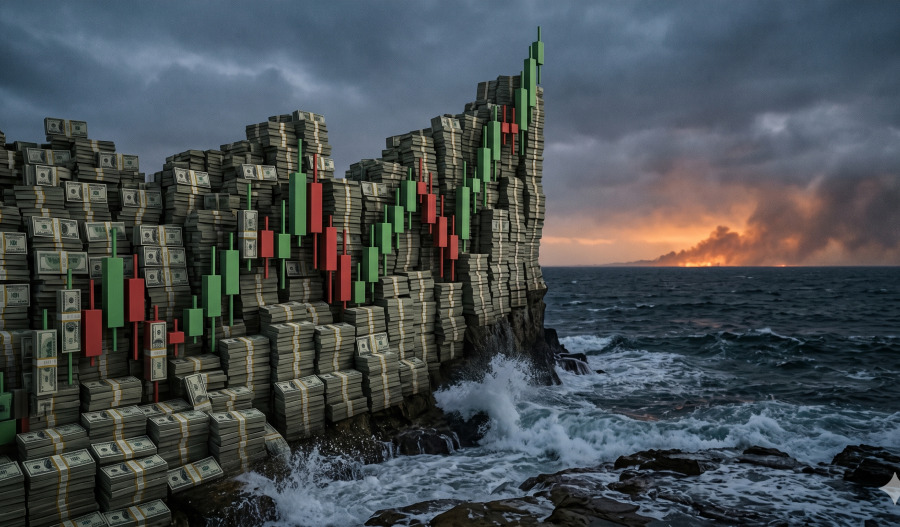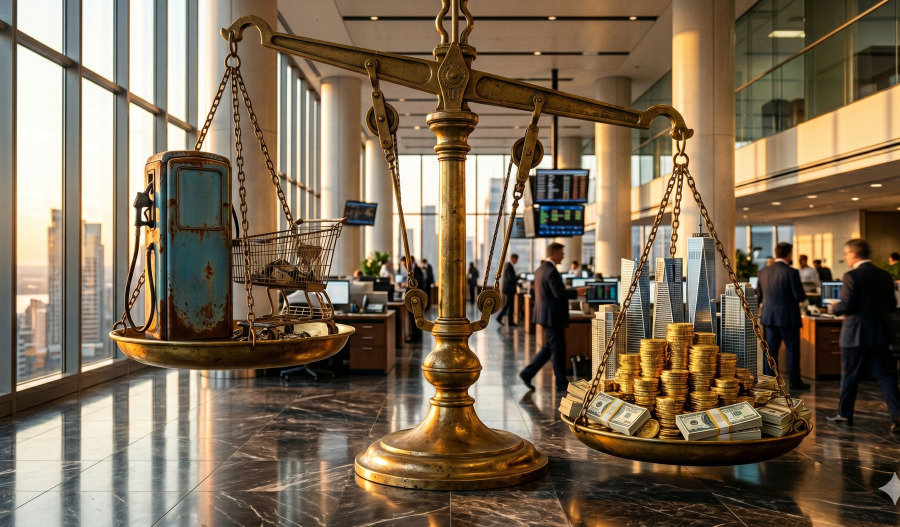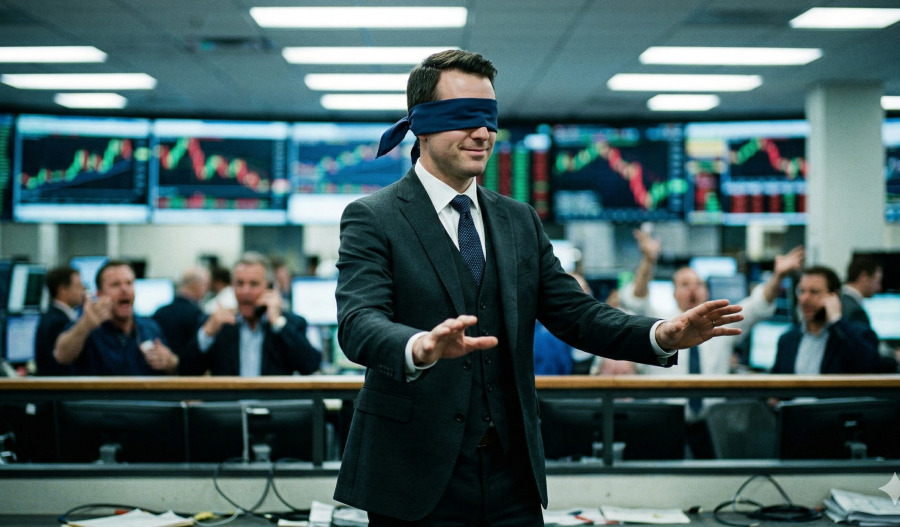

The four magnificent United States hyperscalers blueprinted roughly US$695 billion (A$1.06 trillion) of 2026 AI capex, the Federal Reserve split 8-4 in its deepest dissent since 1992, Brent crude punched above $114 a barrel on reports the White House was being briefed on Iran strike options - and Wall Street still managed to print fresh closing records on Friday because Apple, Alphabet and Eli Lilly all cleared consensus - and that, evidently, was all that mattered.
The week's record hikes, spikes, and worker strikes from Azzet's editorial team, every Friday (1 May 2026).
It's about to get hairy.
Monday
The week opened with the U.S. President cancelling envoy travel to Islamabad after Iran's chief negotiator left Pakistan having met only local officials, with Trump telling reporters Tehran had subsequently submitted a "much better" offer within ten minutes - negotiation theatre that has stopped surprising anyone watching on for more than a fortnight.
Investor sentiment held up briefly as the S&P 500 and Nasdaq closed at fresh records on Friday's New York session, with semiconductor strength carrying the tape and Intel surging 23.65% on a stronger-than-expected Q2 revenue forecast.
UK Prime Minister Keir Starmer used a call with Trump to press for reopening the Strait of Hormuz, citing the cost-of-living impact already feeding through Britain - which is what tends to happen when 20% of global oil and gas stops moving.
The Justice Department closed its criminal investigation into Federal Reserve Chair Jerome Powell over building cost overruns, clearing the path for Kevin Warsh's nomination to advance through the Senate Banking Committee on Wednesday.
Disclosures from the U.S. Office of Government Ethics confirmed Trump had purchased up to $161 million in bonds during March, with municipal debt dominating the 175 transactions and select corporate names including NVIDIA, Microsoft, Goldman Sachs and Boeing in the mix - a portfolio that bears a striking resemblance to the working list of policy beneficiaries.
The University of Michigan Surveys of Consumers reported headline sentiment at 49.8 - the lowest reading on record - with director of surveys Joanne Hsu noting that consumers expect gas and energy prices to worsen before they improve.
Israel's military continued striking Hezbollah targets inside southern Lebanon despite the U.S.-brokered ceasefire, killing 14 in a single day according to the Lebanese health ministry, while global leaders condemned a shooting at the White House Correspondents' Dinner that briefly forced the Trumps and Cabinet members to evacuate.
Northern Japan was hit by a 6.1-magnitude earthquake in Hokkaido as authorities ordered roughly a third of Otsuchi's residents to evacuate the path of mountain wildfires that had already burned 1,373 hectares.
The U.S. State Department circulated a cable warning foreign counterparts about alleged distillation of American AI models by China-based DeepSeek, Moonshot and MiniMax - the latest escalation in a decoupling that the current diplomatic silence on Taiwan has done absolutely nothing to slow.
The Michael Jackson biopic Michael smashed biopic box office records with a $217 million opening weekend, surpassing both Oppenheimer and Bohemian Rhapsody despite a reported $50 million in late-stage reshoots required to navigate a 1994 settlement clause that bars the Jackson estate from naming a particular accuser.
Atlas Arteria (ASX: ALX) closed up 13.4% after IFM Investors lobbed an A$6.9 billion takeover bid at $4.75 per security - a 10% premium that the Atlas board declined to dignify with a counter and IFM dressed up as best-and-final, in that order.

Tuesday
President Trump met his national security team over Tehran's revised proposal, which would phase nuclear talks behind a ceasefire formalisation and a Hormuz reopening, while Secretary of State Marco Rubio publicly dismissed Iran's framing that the Strait would only reopen "as long as you coordinate with Iran".
Shell (LON: SHEL) confirmed its $16.4 billion acquisition of Canadian producer ARC Resources in its largest deal in nearly a decade, adding 370,000 barrels of oil equivalent per day and roughly 2 billion barrels of reserves while reinforcing the LNG Canada export channel into Asia.
The deal terms imply a 20% premium to ARC's recent average and lift Shell's compound annual production growth target from 1% to 4% through the decade - a return-to-hydrocarbons commitment that would have been politically unpalatable in 2023 and is now considered prudent risk management.
London-based AI start-up Ineffable Intelligence, founded by former Google DeepMind researcher David Silver, closed a record US$1.1 billion seed round co-led by Sequoia Capital and Lightspeed at a $5.1 billion valuation, with Sequoia describing the goal as making "first contact with superintelligence" - which is what venture pitch decks now look like.
Domino's Pizza (NASDAQ: DPZ) tumbled 8.84% after U.S. same-store sales grew just 0.9% against 2.3% consensus, with chief executive Russell Weiner conceding "we're not happy with it" and flagging that more fast-food chains were likely to print similar headwinds tied to weak consumer sentiment - the canary the bull camp would prefer to ignore for another week.
Cotality data showed the federal government's expanded first-home-buyer deposit guarantee scheme was actively distorting price growth at the lower end of the Australian housing market, with sub-cap dwellings up 6.7% versus 3.6% above the cap, and Sydney recording the widest spread - which is what housing schemes do when supply is the actual problem.
Wednesday
TF International Securities analyst Ming-Chi Kuo reported that Qualcomm and MediaTek would build processors for an OpenAI smartphone co-designed with Apple supplier Luxshare, sending Qualcomm (NASDAQ: QCOM) up 7% intraday before settling 1% higher, with mass production targeted for 2028.
Paramount Skydance filed with the Federal Communications Commission for approval of foreign investments backing its Warner Bros Discovery takeover, with Saudi Arabia's PIF, the UAE sovereign wealth fund and the Qatar Investment Authority together holding 38.5% of the merged group's equity but no voting rights.
Beijing blocked Meta's US$2 billion acquisition of Manus, with the National Development and Reform Commission demanding the parties withdraw the transaction - a reminder that "Singapore-relocated" stops being a regulatory firewall the moment Beijing wants it to.
Memory chip stocks ran further on Melius Research's call that the memory super-cycle could persist through 2030, with analyst Ben Reitzes lifting his Micron (NASDAQ: MU) two-year price target to $1,350 - and memory prices having risen 80–90% in January alone.
Rabobank's mid-year fertiliser outlook warned that global affordability had moved into negative territory, with Middle East granular urea prices up 94% year-to-date and modelling from La Trobe University academics Sean Arisian and Phil Brewer pointing to 10–25% yield penalties for Australian winter cereals on reduced application rates.
The Conference Board's headline Consumer Confidence Index ticked up 0.6 points to 92.8, beating expectations of 89 - a sharp divergence from the University of Michigan reading and another data point in this cycle's increasingly long list of consumer signals that flatly contradict each other.
JPMorgan Chase chief executive Jamie Dimon used a Norges Bank Investment Management address to warn that rising global government debt was setting the table for a bond market crisis, with U.S. federal debt approaching US$39 trillion and Dimon's preferred phrasing being that "the die may have been cast".
UPS (NYSE: UPS) beat Q1 estimates but shares fell around 4% as revenue declined 1.4% year-over-year and management held full-year guidance at $89.7 billion, with chief executive Carol Tomé conceding it was too early to assess the full impact of the Iran war on operations.
Starbucks (NASDAQ: SBUX) cleared estimates and raised its full-year guidance on a 6.2% comparable store sales lift, with chair and chief executive Brian Niccol calling it the turn in the company's turnaround as North American comps printed 7.1%.
Spotify (NYSE: SPOT) shares slumped 12.43% despite a revenue beat and 12% MAU growth to 761 million, after second-quarter operating income guidance of €630 million came in below FactSet's €680 million consensus - the kind of consumer-discretionary streaming sell-off that says more about positioning than fundamentals.
U.S. airline ticket prices climbed 21% year-over-year for domestic economy seats and 17% for premium, according to Airlines Reporting Corp, as the Iran war added more than US$6 billion in industry costs and consumers continued booking through the price hikes - the demand resilience the airline CEOs would happily talk about all day if jet fuel were not also up sharply.
BP (LON: BP) profits more than doubled to US$3.20 billion, well above $2.63 billion consensus, on what new chief executive Meg O'Neill credited to high plant reliability, refining margin strength and "exceptional" oil trading - the integrated-major hedge against the supply shock playing out next door, working exactly as intended.
The CBI Distributive Trades survey put UK retail sales volumes at -68, the lowest reading since 1983, with 77% of firms reporting sales lower than a year ago and CBI lead economist Martin Sartorius citing high costs and muted post-Iran-war demand.
Australian inflation rose to 4.6% year-over-year in March, the highest since September 2023, after automotive fuel prices jumped 32.8% month-on-month - the biggest monthly increase in the series since 2017 - and the ASX 30-Day Interbank Cash Rate Futures contract began pricing a 76% probability of an RBA hike to 4.35% at the next meeting.
General Motors (NYSE: GM) beat estimates on a $500 million expected tariff refund following the Supreme Court ruling that struck down IEEPA-imposed duties, with chief executive Mary Barra raising full-year EPS guidance to $11.50–13.50 and lowering gross tariff cost expectations to $2.5–3.5 billion.
Coca-Cola (NYSE: KO) cleared consensus and lifted guidance on 12% revenue growth across all regions, with Coca-Cola Zero Sugar volumes up 13% and operating income climbing 19% to $4.36 billion - the durable global brand resilience the consumer-discretionary names would prefer to claim themselves.
Senior Business Writer Garry West's Super Nation column walked through how UniSuper, AustralianSuper, ART, MLC and Chant West are managing the Iran-driven volatility, with UniSuper chief investment officer John Pearce reminding members that the recovery since 23 March demonstrates time in the market beats timing the market - a message the funds deliver every cycle, with varying degrees of patience.
Thursday
ARK Invest released its analysis of the potential $1.75 trillion SpaceX IPO targeting a Nasdaq listing as early as June, with a 95-times revenue multiple resting on Starlink's $20 billion projected annual revenue, 165 orbital launches in 2025, and the more speculative orbital data centre thesis from the February xAI merger.
The Federal Reserve held rates steady at 3.5–3.75% in what may be Powell's final FOMC meeting, with the 8–4 vote marking the highest dissent since October 1992 - Governor Stephen Miran wanted a cut, while Beth Hammack, Neel Kashkari and Lorie Logan opposed easing-bias language, leaving a committee unable to agree even on direction.
Powell separately confirmed he would remain on the Board of Governors for an unspecified period after his chair term ends on 15 May, citing the building-cost investigation - a decision that materially limits the President's ability to secure an immediate majority among his appointees and which the White House will not be writing thank-you notes about.
Alphabet (NASDAQ: GOOG) printed Q1 revenue of $109.9 billion against $107.2 billion consensus, with Google Cloud up 63% to $20.2 billion and backlog nearly doubling quarter-on-quarter to over $460 billion, sending shares 6.46% higher after-hours and lifting full-year capex guidance to $180–190 billion.
Microsoft (NASDAQ: MSFT) delivered $82.89 billion in revenue on 18% growth, with Azure rising 40% and Microsoft Cloud commercial RPO up 99% to $627 billion, and the headline shock came in capex guidance at $190 billion for calendar 2026 - more than $35 billion above StreetAccount estimates of $154.6 billion.
Amazon (NASDAQ: AMZN) beat with $181.5 billion in revenue and AWS growing 28% to $37.59 billion - its fastest cloud growth in over three years - with shares up 3.27% after-hours and capex pinned at the previously flagged $200 billion for 2026.
Meta (NASDAQ: META) cleared revenue and EPS but daily active users fell to 3.56 billion - the first quarterly drop since the metric was introduced - which Meta attributed to Iran's internet blackouts and Russia's WhatsApp ban, with capex guidance raised to $125–145 billion and the stock dropping 7.1% after-hours.
The combined hyperscaler capex blueprint now sits at roughly $695 billion for 2026, with Microsoft chief financial officer Amy Hood specifically flagging a $25 billion 2026 hit from higher component prices - the first major hyperscaler concession that the memory and GPU shortage is no longer a quirk of the cycle but a structural cost the spend has to absorb.
Qualcomm (NASDAQ: QCOM) surged 13.5% after-hours despite a Q1 revenue miss, after president and chief executive Cristiano Amon confirmed initial shipments of its first data centre chips for an unnamed hyperscaler later this year - a meaningful repositioning for a company still 86% reliant on smartphone silicon.
Brent crude jumped 3.3% to $114.04 per barrel after Axios reported Trump was being briefed on military strike options to break the Iran deadlock, with WTI up 3.2% to $110.30 and ING analysts noting "the breakdown of talks ... has the market losing hope for any quick resumption in oil flows".
ANZ analysts cited Kpler data showing Iran had 12–22 days of unused storage capacity remaining, after which output would be cut by 1.6 million barrels per day, on top of the 10mb/d already shut in by the Strait closure - a transmission pathway no major U.S. equity index has yet meaningfully priced.
eBay (NASDAQ: EBAY) beat expectations with 19% revenue growth to $3.10 billion and U.S. gross merchandise volume up 27%, with the Depop acquisition from Etsy still expected to close by Q3 2026.
Friday
Wall Street renewed its record highs with the Dow up 1.6% to 49,652.1, the S&P 500 up 1.0% to a closing record of 7,209.0, and the Nasdaq up 0.9% to 24,892.3, as investors decided that with corporate earnings printing where they did, the geopolitics could continue managing itself.
Apple (NASDAQ: AAPL) cleared sales and earnings expectations with revenue up 17% to $111.18 billion and EPS at $2.01, though iPhone revenue of $56.99 billion missed the $57.21 billion consensus - the second iPhone miss in three quarters - and the board authorised an additional $100 billion in stock buybacks.
Apple chief executive Tim Cook used the call - his first since the Ternus succession announcement - to flag "significantly higher memory costs" in the current quarter and a longer-term impact that would force the company to "look at a range of options", which is a polite way of telling investors the consumer hardware industry has not finished pricing in what the hyperscalers are paying for memory.
Eli Lilly (NYSE: LLY) surged 9.8% after revenue grew 56% year-over-year to $19.80 billion against $17.62 billion consensus, with Mounjaro revenue up 125% to $8.66 billion, Zepbound up 80% to $4.16 billion, and full-year guidance lifted to $82–85 billion in revenue and $35.50–37.00 in earnings per share.
Caterpillar (NYSE: CAT) closed up 9.9% at a fresh record after raising its full-year revenue outlook on the back of stronger-than-expected Q1 results, with the heavy-equipment bellwether providing the kind of broad-economic confirmation the bull camp had been demanding to offset the consumer-confidence numbers.
Alphabet rose 10% on the Cloud beat, Amazon edged 0.8% higher, Meta dropped 8.6% on capex concerns and Microsoft fell 3.9% on the same trade - a clean rotation within Big Tech that left the index higher and the names that were not paying for AI infrastructure as the day's quiet winners.
The U.S. Bureau of Economic Analysis confirmed headline PCE inflation rose 0.7% in March, lifting the annual rate to 3.5% - the highest since mid-2023 - with core PCE at 3.2% and Q1 GDP printing 2.0% against the 2.2% expected, while initial jobless claims dropped to 189,000, the lowest weekly read since September 1969.
Average U.S. petrol prices rose more than 24% in March alone, breaking $4 a gallon for the first time in nearly four years, with services inflation comparatively contained at 0.3% and goods inflation at 1.4% - a composition that confirms the supply-shock origin of the print and gives the Fed dissenters their next data-driven argument.
Iran warned of "long and painful strikes" on U.S. positions in the region if Washington renews military attacks, with Trump telling Fox News that Iran's oil infrastructure had "only three days left before that happens" and signalling a willingness to extend the naval blockade for weeks until Tehran agrees to a nuclear deal.
The United Arab Emirates banned its citizens from travelling to Iran, Lebanon and Iraq and urged those already in those countries to leave - a precautionary move from a Gulf neighbour that does not make such announcements lightly - while United Nations Secretary-General Antonio Guterres warned that "the longer this vital artery is choked, the harder it will be to reverse the damage".
A Mawer Investment Management bond market note from portfolio manager Brian Carney put the credit picture in plain language, with U.S. 2-year yields up 40 basis points and 30-year yields up 20 basis points since the war began, high-grade spreads up 10bp and high-yield spreads up 40bp - all still below long-term averages, all still printing transactions, all still leaving the lender carrying the marginal risk for an inflation regime that has yet to peak.
Carney expects hyperscaler debt issuance to lift from roughly $100 billion in 2025 to $150 billion in 2026 and continue into 2027, noting "the hyper scalers need to issue, and they don't care about paying a few extra basis points to raise an extra $10 billion" - and projecting that the top 10 global bond issuers in 12 to 18 months could be the same names that just blueprinted $695 billion of capex.
His advice to fixed income investors was direct: do not reach for yield, prefer shorter duration, and watch for the structural decay in private credit that began with the Tricolor and First Brands defaults and is now drawing the U.S. Treasury, the SEC, the European Central Bank and the Bank of England into the same conversation.
Cotality's national home value index rose just 0.3% in April - the slowest pace since January 2025 - with Sydney values 1% below their November peak and Melbourne 1.9% below the November 2025 cyclical high, while Perth added 2.1% on the month and roughly A$21,000 to the median dwelling value.
Cotality research director Tim Lawless said the housing market had been losing momentum from late last year as affordability and serviceability constraints weighed on demand, with the additional pressure of higher interest rates, falling sentiment and rising inflation now feeding into capital city auction clearance rates that have stayed below 55% since the last week of March.
This week's big read
Wall Street printed fresh closing records on Friday with Brent at $114, Iran threatening "long and painful strikes", U.S. PCE at a 33-month high, the Fed split 8-4, UK retail at a 40-year low, Aussie inflation at a three-year high - and four hyperscalers sitting on a 2026 capex blueprint of roughly $695 billion, almost two-thirds of which is meant to be funded by the same bond market that has yet to fully price in any of the above.
There is no honest way to read those numbers as describing the same economy.
Microsoft's $190 billion 2026 capex guide was $35 billion above sell-side consensus, and Amy Hood's quiet aside that $25 billion of that hit reflects component price inflation tells the rest of the story for memory, GPU and substrate suppliers - a pricing pass-through that Apple's Cook then confirmed will hit consumer hardware in the current quarter and "look at a range of options" thereafter.
Alphabet raised its capex guide on a $460 billion Cloud backlog, Amazon's $200 billion sticks, and Meta lifted its range to $125–145 billion despite its first-ever quarterly daily-active-user decline.
Beneath the AI infrastructure narrative, the war's transmission into the consumer-industrial tape sharpened further. BP's profits more than doubled while Domino's missed and Spotify shed 12.4%, the airline sector swallowed another $6 billion in jet fuel costs, and Australian fuel prices recorded their largest monthly jump since the CPI series began in 2017.
Brian Carney's bond note was the most useful single document of the week. The hyperscalers will issue $150 billion of debt in 2026, the top 10 global bond issuers in 12–18 months will be the same names paying memory premiums Apple cannot, and the lenders financing that build are not currently being compensated for the duration risk they are wearing in an environment where the Fed cannot agree on direction.
The Fed's 8–4 split was the cleanest fracture in policy consensus since October 1992. Three regional bank presidents wanted to drop the easing-bias language entirely, while one governor wanted to cut, with the Chair himself committed only to staying on the Board of Governors after his term ends - a quiet act of institutional defiance that the President's communications team has so far declined to comment on.
The Brent move on Thursday was the more dangerous signal. A briefing on military strike options that would, three weeks ago, have moved the curve fifteen dollars instead moved it three, and Friday's record close on the back of Apple, Alphabet, Eli Lilly and Caterpillar suggests the market has decided the war is now an earnings tailwind rather than a tail risk.
That decision has been made by retail flows, passive index buying and AI capex narratives, and not by any visible re-rating of the geopolitical premium itself.
Q2 earnings will deliver the verdict on whether hyperscaler customer demand actually justifies the capex blueprint, or whether the industry has talked itself into a circular spending pact that the cash flows cannot support. Carney's view that "you should be the lender who lends last" applies just as cleanly to the equity holder.
Base case: Hyperscaler capex sustains through Q3, the Iran-U.S. blockade extends without further direct strikes, Brent settles in a $100–115 range, the Fed holds, the consumer-exposed names continue absorbing the pass-through, and the bond market continues funding the AI build at spreads that under-compensate for the cycle.
Bull case: A genuine Iran-U.S. agreement reopens the Strait, Brent retraces toward $80, the Fed's December meeting delivers a measured cut, hyperscaler customer cohorts confirm demand is real, and the AI capex bet becomes the cheap option on a productivity rebound that finally validates the multiples.
Bear case: Trump authorises strikes, Iran follows through on Mousavi's "long and painful" threat, Brent breaks $130, hyperscaler customer cohorts thin out, the consumer-industrial tape rolls over, the bond market rerates duration risk in 48 hours rather than 48 weeks, and the $695 billion capex spend becomes the largest synchronised over-build since the late-1990s telecoms cycle - which, for those keeping score, was financed by exactly the kind of debt issuance Carney just flagged.