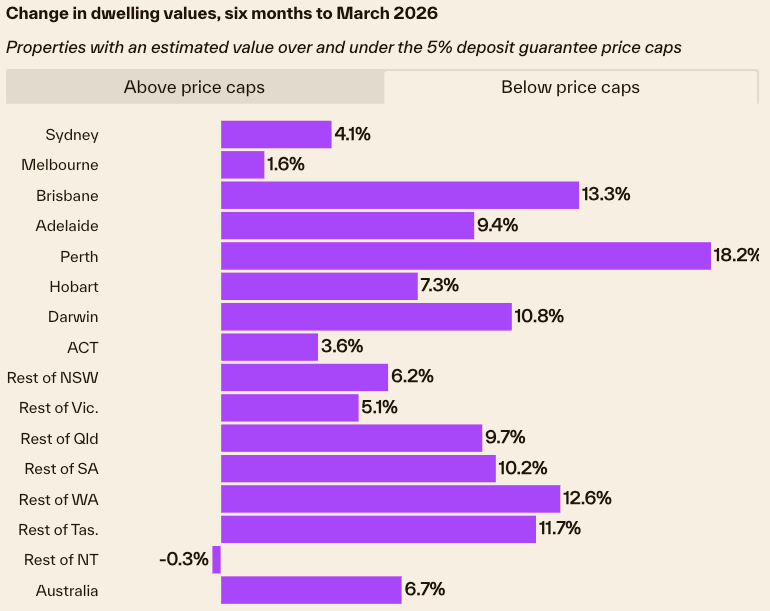
Australian properties with an estimated value below the 5% deposit guarantee scheme price caps have recorded stronger growth than higher-priced homes.
According to Cotality data, homes with values below the price caps increased 6.7%, compared with a 3.6% rise in value for properties with estimated values above the price caps.
Momentum was building in the sub-price-caps market before the scheme's expansion on October 1st, with the divergence opening around the announcement in late August.
Cotaility has suggested several factors to explain the greater growth at lower price points, including the scheme bringing forward demand, serviceability constraints, and increased investor presence in the lower price segment.
Investors made up 40% of mortgage demand in Q4, which is well above the decade average, where investors typically comprised around one-third of mortgage demand.
Stronger growth at values below the price cap could be seen in every capital city and regional market except for Regional Western Australia and the Northern Territory.
Sydney had the largest growth differential, with homes under the price cap up 4.1% and those above the cap falling 1.1%.
Across Australia, 81 of the 88 (92%) SA4-sub markets have shown a stronger growth rate for properties with a value under the price caps.

However, as values rise, the number of suburbs with a median value below the price caps is becoming smaller.
At the end of September last year, just before the expanded deposit guarantee went live on October 1st, 48.6% of suburbs nationally had a median house value below the price caps, and 92.7% of suburbs had a median unit value below the caps.
By the end of March, this portion had dropped to 39.5% and 89.1%.
Darwin was the only capital where the cap wasn’t adjusted in October, and has the smallest portion of suburbs with a median below the price caps.
Only 10.3% of suburbs in the city have a median house value below the A$600,000 price cap, down from 32.4% in September.
Perth isn’t far behind, with only 11.6% of suburbs recording a median house value below the price caps in March, down from a third in September last year.
Despite being the most unaffordable city, Sydney has the highest proportion of suburbs where the median falls below the price cap, with 46.8% of suburbs recording a median below the cap of $1.5 million, down marginally from 47.8% of suburbs in September last year.
The average first home buyer loan amount increased by 7.7% in the December quarter (according to ABS lending indicators) to $606,400. Since then, we have seen interest rates rise by half a percent, reducing borrowing capacity for a household with an income of $100k by about $34,300.