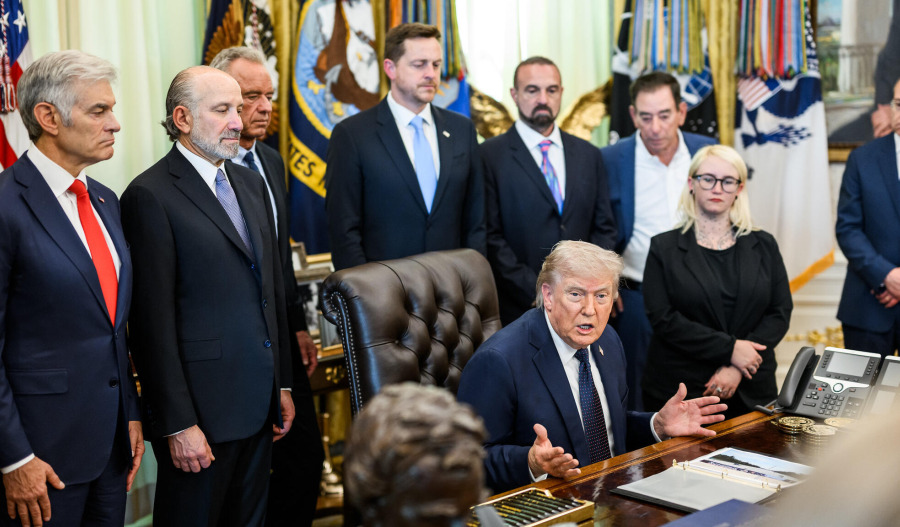
United States President Donald Trump met with senior national security officials on Monday to discuss a new proposal from Iran aimed at resolving the ongoing conflict, as the war remains locked in a stalemate and regional energy supplies stay constrained.
The proposal would postpone negotiations on Tehran’s nuclear ambitions for a later date, Axios reported earlier Monday.
According to reports, White House press secretary Karoline Leavitt confirmed the discussions were underway during a press briefing.
“I will confirm the president has met with his national security team this morning,” Leavitt said at a press briefing Monday afternoon when asked about the reports.
“The meeting may be ongoing,” Leavitt said, “but the proposal was being discussed.”
“I don’t want to get ahead of the president or his national security team. What I will reiterate is that the president’s red lines with respect to Iran have been made very, very clear, not just to the American public, but also to them as well.”
U.S. Secretary of State Marco Rubio expressed scepticism about Tehran’s intentions, suggesting the proposal may be an attempt to delay substantive concessions.
"We can't let them get away with it," Rubio said in an interview with Fox News.
"They’re very good negotiators. They're very experienced negotiators. We have to ensure that any deal that is made, any agreement that is made is one that definitely prevents them from sprinting toward a nuclear weapon at any point," Rubio said.
Rubio also rejected Iran’s framing of reopening the Strait of Hormuz under its terms.
“What they mean by opening the straits is, ‘Yes, the straits are open, as long as you coordinate with Iran, get our permission, or we’ll blow you up and you pay us,’” Rubio said, when asked about Trump’s claim Saturday that Iran had sent a “much better” offer.
“That’s not opening the straits. Those are international waterways. They cannot normalise, nor can we tolerate them trying to normalise, a system in which the Iranians decide who gets to use an international waterway and how much you have to pay them to use it,” Rubio said.

Despite the absence of direct talks, diplomatic efforts to bridge the gap between Washington and Tehran are continuing through intermediaries.
Pakistani officials indicated that negotiations remain active remotely, even after Trump cancelled a planned visit by his envoys, Steve Witkoff and Jared Kushner, to Islamabad over the weekend.
Hopes for a breakthrough have faded following the cancellation of the trip, which had been expected to facilitate face-to-face discussions.
Iranian Foreign Minister Abbas Araqchi had travelled frequently between regional capitals, including visits to Oman and Russia, where he met President Vladimir Putin.
Senior Iranian officials, speaking on condition of anonymity, told Reuters that the proposal envisions a phased negotiation process.
The initial stage would require an end to the U.S.-Israeli war on Iran, alongside guarantees that hostilities would not resume.
Subsequent talks would address the U.S. blockade and the status of the Strait of Hormuz, which Tehran seeks to reopen under its oversight.
Only after these steps would negotiations expand to broader issues, including Iran’s nuclear programme. Tehran continues to seek recognition of its right to enrich uranium for what it maintains are peaceful purposes.
In Pakistan, authorities have lifted a week-long lockdown in Islamabad that had been imposed in anticipation of high-level talks that ultimately did not occur.
Officials said in-person negotiations are unlikely until both sides are closer to reaching a formal agreement.
Meanwhile, tensions have escalated elsewhere in the region. Fighting in Lebanon intensified, with Israeli strikes in the south killing 14 people and wounding 37 on Sunday, according to the health ministry.
The violence marks the deadliest day since a U.S.-brokered ceasefire was announced in mid-April. Iran has signalled it will not engage in broader negotiations unless the ceasefire in Lebanon holds.