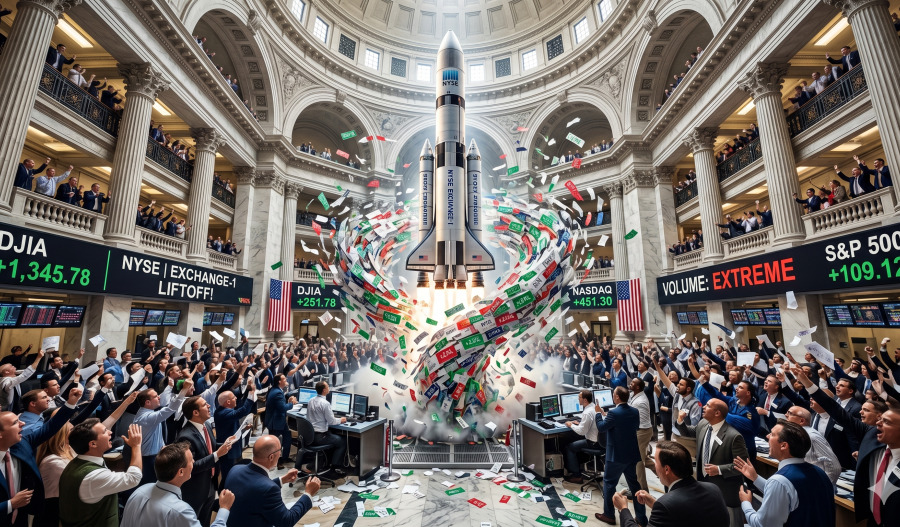

Wall Street spent the week lurching between air strikes and earnings calls, with the Iran-Israel ceasefire fraying just as the SpaceX initial public offering finally landed at a record US$1.77 trillion valuation.
Inflation data out of Washington gave incoming Federal Reserve chair Kevin Warsh a headache before he has even sat through his first meeting, with consumer and producer prices both posting their hottest annual readings in more than three years.
Throw in a $10.6 billion pharma deal, the public release of Anthropic's most capable model yet, and a reminder that the AI boom runs on helium as much as it does on chips, and the gap between the market narrative and the underlying mechanics has rarely looked wider.
The ceasefire held up about as well as you'd expect when one side was lobbing missiles at the other's airport.
Wall Street ignored all of it, setting fresh records as money poured into anything GPU-adjacent, with every major tech company racing to announce it was building more compute than the last.
All the top moves, shakes, and infrastructure stakes from Azzet's editorial team unpacked right here in your weekly business wrap every Friday (12 June, 2026).
Monday
The U.S. economy added 172,000 jobs in May, easily beating Wall Street forecasts near 80,000, even though more than two-thirds of that gain came from leisure, hospitality and local government rather than anything resembling the AI economy everyone keeps talking about.
The week opened with a fresh missile strike rattling the fragile April ceasefire, as Yemen's Houthi rebels threatened to bar any Israel-linked vessel from the Red Sea after Israel renewed its own strikes on Iranian targets.
Despite the supply crisis gripping the Gulf, OPEC+ kept raising its targets, lifting July output by 188,000 barrels per day (bpd) in what is now its fourth consecutive monthly increase, even as the Strait of Hormuz remains effectively closed to most of the producers meant to be pumping it.
S&P Dow Jones Indices confirmed this week that it would keep its profitability requirement intact, so SpaceX's float carries an asterisk, with the rocket-and-AI conglomerate unlikely to join the S&P 500 before 2028, even at a valuation north of $1.77 trillion.
Oil markets weren't far behind, with crude adding $3 a barrel on fresh reports of Israeli and Iranian strikes, extending a run that has seen benchmarks gain more than $20 a barrel on several occasions since the conflict reignited in February.

Tuesday
By Tuesday, Israel had halted its attacks on Iran, according to Prime Minister Benjamin Netanyahu, who stopped short of calling it a ceasefire, even as Iran suspended its own retaliatory strikes and warned it would resume them if Israeli action in Lebanon continued.
Donald Trump's social media habit is becoming its own market indicator, with traders reacting to his posts on the Iran conflict almost as fast as he can hit publish, a pattern that fits the U.S. president's tendency to promise a deal is just "two weeks" away.
Households are growing more anxious about their own finances, and the New York Fed's survey made grim reading this week, with 43.7% of respondents saying their finances were worse than a year earlier - the highest share since January 2023 - even as one-year inflation expectations eased slightly to 3.5%.
Amazon signed Corning up for a multiyear optical fibre supply deal to wire up its U.S. AI data centres, and the stock jumped 5.6% in response, the latest in a run of megadeals that has helped the shares climb roughly sixfold since the end of 2023.
OpenAI confidentially filed for its own stock market listing on Sunday, becoming the third group to file for a trillion-dollar float after Anthropic and SpaceX, a queue that now totals close to $4 trillion just as Alphabet launches an $85 billion share sale to fund its own AI build-out.
The OPEC+ output decision landed within hours of renewed Iran-Israel strikes to push crude higher heading into the new week, and our commodities wrap caught it as the weekend's double supply shock worked through the market.
Wednesday
President Trump accused Tehran of shooting down a U.S. Army Apache helicopter over the Strait of Hormuz, and within hours, Washington launched fresh strikes on Iran, with both crew rescued by an unmanned underwater drone before Iran retaliated against American bases in Bahrain, Kuwait and Jordan.
May brought a five-month high for the housing market, with existing home sales rising 3.2% to an annualised 4.17 million units, a figure that sits alongside a median price of $429,300 and mortgage rates that have crept roughly 50 basis points higher since the war began.
Record exports of petroleum products and capital goods - the latter swollen by AI-related imports - did more heavy lifting than any tariff policy has managed so far, and the trade deficit narrowed accordingly, down to $55.9 billion in April.
Anthropic's new Mythos tier reached the public this week, with the release of Fable 5 arriving complete with guardrails that hand off any cybersecurity or biology queries to its existing Opus 4.8 model, a safety net built ahead of Anthropic's own run at the IPO market alongside OpenAI and SpaceX.
Nuvalent is a Boston biotech with two late-stage lung cancer drugs awaiting FDA decisions later this year, and GSK agreed to acquire it for $10.6 billion, sending Nuvalent shares up close to 40% and marking GSK's biggest deal since its 2014 vaccines swap with Novartis.
Australia's superannuation industry has pushed its combined asset base past $4.5 trillion, and this week's Super Nation column dug into the widening gap in how funds cover member compensation, a question that's becoming harder for trustees to dodge.
The AI coding wars got another entrant this week, with Microsoft using its Build conference to stake a bigger claim and roll out tools aimed squarely at the territory Anthropic's Claude Code and OpenAI's Codex have come to dominate over the past year.
Thursday
Defense Secretary Pete Hegseth warned further "key facilities" could be hit as the Pentagon confirmed new strikes on multiple targets inside Iran, while Iran's president dismissed threats to civilian infrastructure as a sign of weakness rather than strength.
The server maker unveiled a $7 billion equity raise to fund its $39 billion AI order backlog, and Super Micro shares slumped 13% in response, dragging the stock down alongside Broadcom, Nvidia, AMD and Micron as last week's cautious Broadcom guidance continued to weigh on chip valuations.
A 3.9% jump in energy costs - up 23.5% over twelve months - accounted for more than 60% of the headline increase as consumer prices rose 0.5% in May on the month and 4.2% on the year, the hottest annual reading since April 2023.
Revenue of $19.2 billion and a backlog of $638 billion, up 363% on a year earlier, meant Oracle beat Wall Street's targets comfortably, yet the stock still fell around 10% after management flagged another $40 billion in debt and equity to fund its 2027 capital spending plan.
A tech-led rally in global equities left most funds on track for high single-digit returns for the financial year, as Australian super funds returned 2.1% in May, enough to fully claw back March's 3.2% loss.
Friday
Trump said talks with Tehran had reached its top leadership and been approved, and on that basis he cancelled a third night of planned strikes, adding that a signing date would be announced shortly even though Tehran stopped short of confirming any agreement.
Roughly 30% of the world's high-purity helium is tied to a Qatari hub still recovering from the conflict, and this week's Mission Critical column traces the AI boom's quiet dependence on party balloons, with chipmakers holding barely two to three months of the gas needed for wafer cooling and leak detection.
A day after the CPI shock, producer prices climbed 1.1% in May and 6.5% over the year, the fastest annual pace since November 2022, adding to the case that the Iran-driven energy spike is starting to work its way through supply chains.
A record $6.62 billion quarter saw Adobe lift its full-year guidance to between $24.35 and $24.45 a share on revenue of up to $26.6 billion, only for news that chief financial officer Dan Durn is leaving for Marvell Technologies to send the stock down about 5% after hours.
Late on Wednesday, SpaceX priced its IPO at $135 a share, selling about 4.2% of the company to raise as much as $75 billion and implying a $1.77 trillion valuation that would make it the seventh-largest company in the U.S. ahead of Tesla, with trading under the ticker SPCX due to begin on Nasdaq.
The week ahead:
- The Fed's first Warsh meeting (16-17 June): a hot CPI and an even hotter PPI print make this a tense start for the new chair, with rate-cut hopes now colliding with an inflation profile the White House would rather not discuss.
- SPCX's first days of trading: watch for volume, volatility and any early signal on whether Nasdaq-100 fast-tracks the stock into its ranks within the promised 15 trading days.
- Iran-Israel "signing ceremony" watch: Trump says a deal is close and the naval blockade stays in place until it is finalised, but this ceasefire has been declared "close" before, more than once.
- OPEC+ core group meets again on 5 July: the question is no longer whether the cartel raises quotas, but whether any of the extra barrels can physically get past the Strait of Hormuz.
- Adobe's CFO handover (15 June): interim CFO Steve Day takes the reins as the market decides whether the after-hours sell-off was about Durn's exit or about genAI disruption fears that have already taken 40% off the stock over the past year.
- AI capex financing: after Oracle and Super Micro both went back to debt and equity markets in the same week, expect scrutiny of which other hyperscalers and server makers follow suit.