It was a week shaped by two forces that fed directly into each other: A Middle East conflict cycling through another round of brinkmanship, and a fixed-income market delivering its most pointed message yet to the incoming head of the Federal Reserve.
Wall Street slid to open the week as Treasury yields surged on fresh inflation concerns and the overnight news from the Gulf landed poorly.
Donald Trump cancelled a strike on Iran, then threatened fresh ones, then declared talks were in their "final stages" - all within 72 hours. Treasury yields climbed to levels not seen since 2023. NVIDIA posted quarterly numbers that look invented.
SpaceX filed to go public at a valuation that would place it among the five largest listed companies on earth. And Australia shed jobs for the first time in five months, with a result the market had not seen coming.
All the top moves, shakes, and market-moving moments from Azzet's editorial team, right here in your weekly business wrap every Friday (22 May, 2026).
Monday
Gulf-based drone intercepts and a fresh round of warnings from Trump - posted on Truth Social before most traders had finished their coffee - set the week's tone early.
G7 foreign ministers convened to coordinate a response to the Iran conflict, a gathering that reflected how thoroughly a bilateral dispute has become a multilateral headache.
U.S. industrial production rose 0.7% to a 14-month high, a clean number that, on a different week, would have led the bulletin.
New York's rail workers entered their third consecutive day of strike action, with no resolution framework in sight.
Publicis Groupe announced it had reached an agreement to acquire data collaboration platform LiveRamp for a total enterprise value of US$2.167 billion, at $38.50 per share in cash - a 29.8% premium to the previous Friday close.
Publicis chief Arthur Sadoun framed the purchase around LiveRamp's 25,000-publisher network and more than 500 technology partners across 14 markets, positioning the combined entity as the infrastructure for what the group is calling "agentic marketing".
BlackRock was reported to be weighing a US$10 billion stake in SpaceX ahead of the anticipated Nasdaq float - a detail that would become considerably more relevant by Wednesday.

Tuesday
The most consequential decision of the week arrived Tuesday morning: Trump had called off a planned strike on Iran, citing what he described as "serious negotiations" and the counsel of Gulf allies.
"There seems to be a very good chance that they can work something out," Trump told reporters, calling the pause a "very positive development".
A Pakistani source quoted by Reuters offered a less charitable read, noting that both sides "keep changing their goalposts".
The Treasuries selloff continued regardless, with yields pressing higher as rates desks and equity strategists digested the compounding effect of conflict-driven energy costs on U.S. consumer prices.
The 30-year yield was sitting above 5% - a level last touched in October 2023 - while the 10-year was hovering near 4.60%, both a direct consequence of inflation running at 3.8% year-on-year in April.
OpenAI moved closer to an IPO after Elon Musk lost a related legal challenge, removing an obstacle that had introduced uncertainty into the timing of one of the most anticipated market debuts in years.
Gold retreated as climbing real rates and a firm dollar removed much of the metal's short-term appeal - a textbook move that nonetheless stung funds positioned for haven demand.
Reports of a possible settlement framework in the New York rail dispute began circulating by afternoon, offering commuters the first credible prospect of a resolution.
Chant West data showed Australian super funds had returned 6.4% for FY26 year-to-date, a result that looks reasonable given the conditions, though the fixed-income volatility accumulating through the week will take time to filter through portfolio valuations.
The U.S. Senate's confirmation of Kevin Warsh as the next Federal Reserve chairman - ratified on 13 May - meant his swearing-in was set for Friday, with markets watching every rate-sensitive release through that prism.
Wednesday
Equities fell again as yields extended to fresh multi-year highs, with the session producing little by way of cover for fund managers already navigating elevated borrowing costs.
The SEC unveiled a package of IPO reforms framed around making the U.S. listing environment more competitive, describing the measures internally as an effort to reinvigorate a public-market pipeline that has been running well below historical norms.
Trump issued fresh warnings to Tehran, telling reporters that military action remained on the table unless a deal materialised - language that kept oil desks attentive despite Monday's call-off.
The auto sector issued increasingly specific warnings about imminent shortages, with the combination of tariff-driven supply-chain fragility and Middle East-related shipping disruptions narrowing the industry's buffer.
Toyota, which had already flagged tariff costs of roughly $8 billion in fiscal 2026, described the current environment as "highly disruptive" and stated plainly that it "cannot be sustained".
Google's annual I/O developer conference overhauled the company's AI product range, with Gemini Spark - a general-purpose agent capable of reasoning across connected applications and acting on user instruction - the centrepiece announcement.
Gemini 3.5 Flash was named the new default model for the Gemini app and AI Mode in Search, with CEO Sundar Pichai describing it as available at roughly one-third the cost of comparable frontier models.
Samsung workers walked off the job following a pay dispute, extending a pattern of industrial action across manufacturing and transport that has tracked the inflationary cycle through 2026.
James Murdoch's investment vehicle, Lupa Systems, struck a deal to acquire three major divisions of Vox Media, including New York Magazine and the company's podcast network, giving Murdoch control of one of the most recognisable magazine brands in the English-speaking world.
Thursday
Trump told reporters that Iran talks were in their "final stages", adding that a letter of intent was being drafted to formally end hostilities and open 30 days of structured negotiation covering the Strait of Hormuz and Tehran's nuclear programme.
The phrase "final stages" has appeared in relation to these negotiations more than once, which is either encouraging or a reliable indicator of how the next 72 hours will go.
NVIDIA reported record quarterly revenue of US$81.6 billion for Q1 FY2027, up 20% from the previous quarter and 85% from a year earlier.
Net income came in at $58.3 billion against analyst estimates of $42.9 billion, while the company guided Q2 revenue to $91 billion - well above the $86.84 billion consensus compiled by LSEG.
CFO Colette Kress confirmed the next-generation Vera-Rubin architecture will ship in fiscal Q3 and ramp in Q4, positioning the company for another step-change in revenue as hyperscaler capital expenditure continues to expand.
NVIDIA is now on track for annual revenues approaching $370 billion, a figure that represents more than 20 times its entire fiscal 2021 turnover of $17 billion.
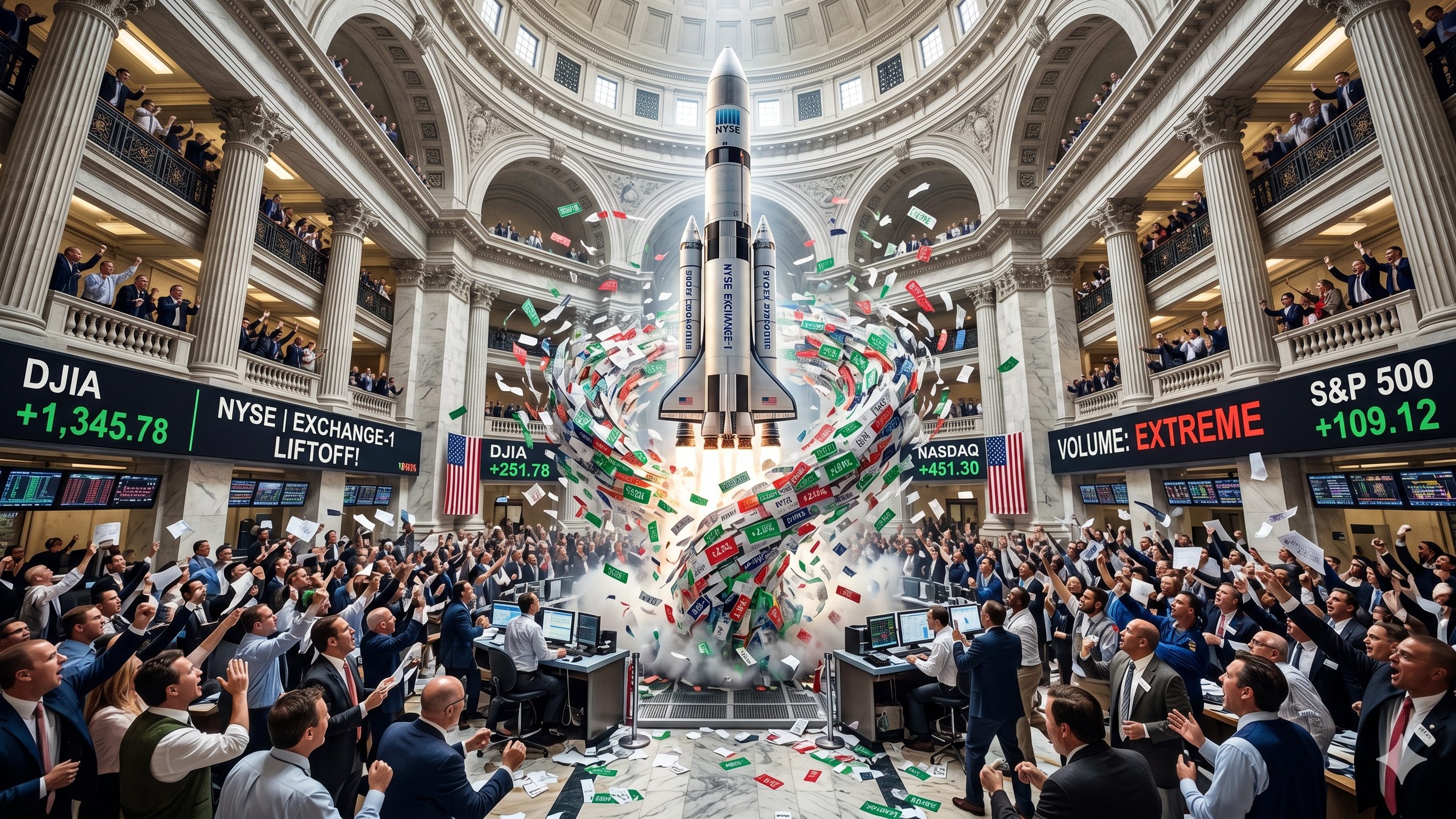
SpaceX's S-1 prospectus, confidentially filed on 1 April and publicly circulated on Wednesday, disclosed 2025 revenue of $18.67 billion following February's all-stock acquisition of xAI, alongside a net loss of $4.94 billion and adjusted EBITDA of $6.58 billion.
Goldman Sachs is leading a syndicate including Morgan Stanley, Bank of America, Citigroup, and JPMorgan for a June 12 Nasdaq debut under the ticker SPCX, with Bloomberg and Reuters reporting a target valuation of $1.75 trillion to above $2 trillion and a raise of up to $75 billion.
At the midpoint of that range, SpaceX would rank as the sixth-largest listed company globally, behind Nvidia, Alphabet, Apple, Microsoft, and Amazon.
The Federal Reserve's April meeting minutes were the week's sharpest policy signal: A majority of officials raised the possibility of rate hikes, the April 29 hold registered eight votes to four - the most dissents since 1992 - and the CME FedWatch Tool placed a nearly 30% probability on an actual hike in the final quarter of 2026.
Markets moved from pricing roughly 8 basis points of cuts through year-end to pricing essentially none.
This week's Mission Critical column examined the reagent wars - the accelerating global contest for the chemical processing inputs that sit at the centre of battery production and critical minerals refining, and which are attracting the same strategic attention as the raw materials themselves.
Target lifted its full-year guidance as its turnaround plan showed tangible results, and Home Depot beat expectations despite a housing market weighed down by elevated mortgage costs.
Intuit announced it would cut 17% of its workforce after revenue came in short of estimates, while E.l.f. Beauty released Q4 results alongside a plan to lower prices - a margin decision that signals cost pressure reaching the premium end of the consumer segment.
Australia's unemployment rate climbed to 4.5% in April, above both the prior month's 4.3% reading and the 4.3% economist consensus, with the economy shedding 18,600 positions - the first decline in employment in five months, and well short of the 15,000-job gain the market had anticipated.
The number of unemployed Australians rose by 33,000 to 692,500, youth unemployment climbed 0.9 percentage points to 11.1%, and Commonwealth Bank revised its full-year growth forecast from 1.9% to 1.6%.
Friday
Wall Street reversed course and the Dow registered a fresh record close, with diplomacy-related optimism sweeping through risk assets after reports of tangible progress in U.S.-Iran negotiations.
Walmart issued conservative guidance, citing elevated fuel costs as a structural drag on logistics and household spending - a note from the world's largest retailer that is worth filing alongside the auto sector's shortage warnings as evidence the energy transmission mechanism from the Gulf remains active.
Ralph Lauren surged following strong Q4 results, extending a run of outperformance from premium brands with sufficient pricing power to hold margins in an inflationary environment.
IBM jumped 12.67% after the U.S. Department of Commerce announced $2 billion in quantum computing investments, with the company set to receive $1 billion towards establishing a dedicated quantum chip foundry - to be spun out as a new entity called Anderon, based in Albany, New York - and committing a matching $1 billion of its own.
GlobalFoundries will receive $375 million under the same programme to build domestic production capacity, while smaller firms, including D-Wave Quantum and Rigetti, are each set to receive up to $100 million.
IBM estimates the quantum computing sector will generate up to $850 billion in global economic value by 2040; McKinsey puts the potential value to automotive, chemicals, financial services, and life sciences alone at $1.3 trillion by 2035.
AMD announced it would invest more than US$10 billion across Taiwan's semiconductor ecosystem to scale advanced packaging for next-generation AI chips, including production of Venice CPUs on TSMC's 2-nanometer process and the deployment of its Helios rack-scale platform - housing Instinct MI450X GPUs - in the second half of 2026.
Anthropic was reported to be in early discussions with Microsoft to rent servers running on the Maia 200 chip, Microsoft's second-generation custom AI silicon built on TSMC's 3-nanometer process and released in January 2026.
No deal has been reached and the talks may not produce one, but the reported discussions are notable: a Maia contract would give Microsoft a credible win in the race to supply inference capacity to frontier AI developers, a market where Amazon and Google have moved faster.
Anthropic CEO Dario Amodei has acknowledged compute constraints openly as a limiting factor on Claude's growth, and the company already runs on cloud from Amazon and Google alongside its existing Microsoft arrangement.
Formal gaps between Washington and Tehran persisted, with the White House confirming that both the Strait of Hormuz framework and the nuclear question remained unresolved - Thursday's "final stages" characterisation not yet matched by anything resembling final terms.
Kevin Warsh is set to be sworn in as Federal Reserve chairman, inheriting a central bank in which a majority of his colleagues favour keeping rates elevated, the 30-year yield is north of 5%, and the primary source of inflationary pressure originates from a conflict his policy settings cannot directly influence.
Ed Yardeni of Yardeni Research laid out the chairman's counter-intuitive option: Acting more hawkishly than markets expect could deliver the outcome the White House actually wants - lower real borrowing costs - by convincing fixed-income investors that the Fed will not allow inflation to entrench.
How Warsh plays his first FOMC meeting in June will shape rate expectations in Australia, fixed-income positioning globally, and the valuation of every duration-sensitive asset caught between the two.
The week ahead
- Warsh's first public remarks as Fed chair: June's FOMC is a live event for the first time in some months - markets will want a read on whether the easing bias survives contact with the new chair.
- Strait of Hormuz transit counts: Lloyd's List vessel data remains the most direct measure of whether diplomatic progress is converting into restored shipping volumes.
- SpaceX IPO bookbuild: institutional orders will indicate whether the $1.75 trillion target clears or needs revision - either outcome has broader implications for technology valuations heading into mid-year.
- Australian retail sales and CPI: the April jobs miss makes the next inflation print the most consequential domestic data release in months, with CBA now forecasting unemployment peaks at 4.6%.
- NVIDIA Vera-Rubin shipment updates: any guidance on Q3 order volumes relative to the current Blackwell generation will recalibrate near-term data centre spending estimates across the hyperscaler field.