
The world's largest asset manager, BlackRock, is reportedly in discussions to commit as much as US$10 billion (A$13.99 billion) to what would become the largest stock market listing on record.
BlackRock has discussed investing between $5-10 billion in SpaceX's initial public offering (IPO), according to a report published Saturday by The Information, citing people familiar with the matter.
The potential commitment would be drawn from BlackRock's $536 billion pool of actively managed funds, sitting apart from the asset manager's far larger passive business, which runs under index-tracking mandates.
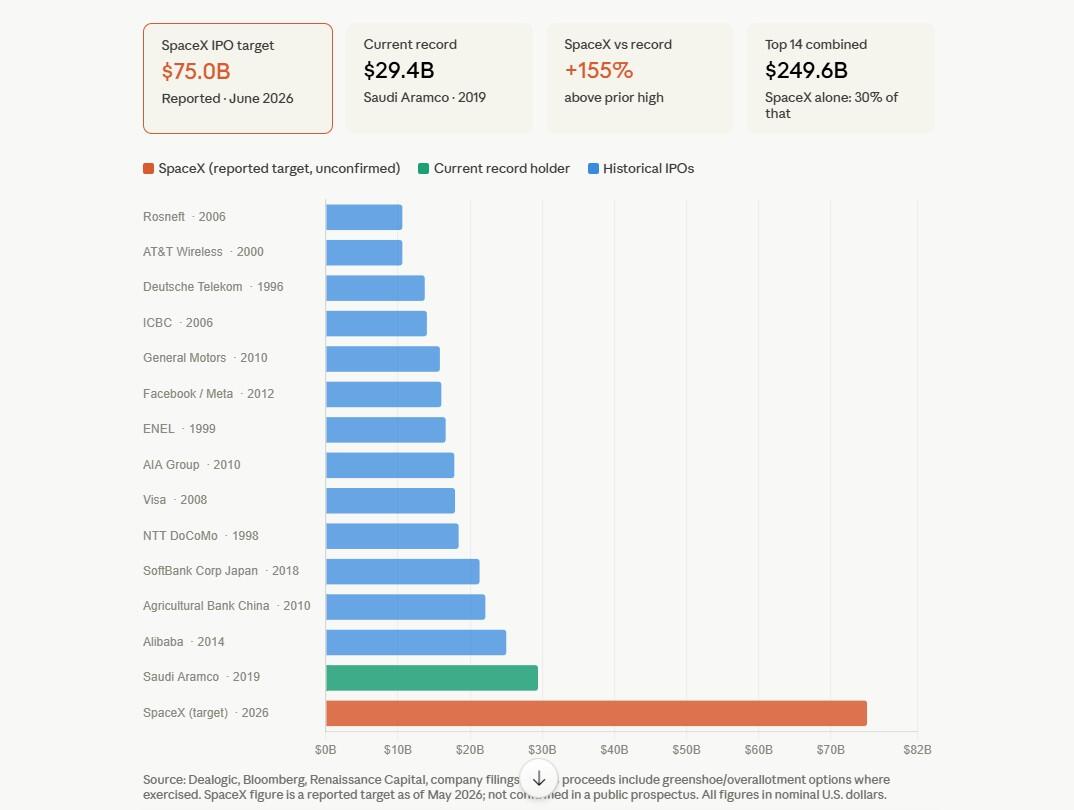
Elon Musk's rocket and satellite company is targeting a raise of roughly $75 billion at a valuation of approximately $1.75 trillion, a deal that would make it the largest stock market debut on record - surpassing Saudi Aramco's $29 billion float in 2019 by a factor of roughly two and a half.
Pricing is targeted for as early as 11 June, with trading on Nasdaq expected to begin around 12 June under the reported ticker SPCX.
A five-bank syndicate - Morgan Stanley, Bank of America, Citigroup, JPMorgan and Goldman Sachs - is handling the bookbuild, with an investor roadshow scheduled to begin around 4 June.
SpaceX filed a confidential S-1 registration statement with the U.S. Securities and Exchange Commission in April, with the public prospectus expected as early as the week of 19 May, when investors will receive the first audited financial disclosures on a business that pulled in an estimated $15.8 billion in revenue across 2025, the bulk of it from Starlink's satellite internet service.
Musk has stated he will not sell any personal SpaceX shares through the offering, while ~30% of available stock is reportedly earmarked for retail investors - an unusual allocation at a deal of this magnitude.
Adding to demand
Beyond active institutional positioning, the listing carries a separate layer of structural demand tied to benchmark inclusion rules that were quietly rewritten earlier this year.
Nasdaq's fast-entry rule, which came into effect on 1 May 2026, permits any newly listed company ranking inside the top 40 by total market capitalisation to enter the Nasdaq-100 after just 15 trading days, replacing a previous three-month seasoning requirement the exchange shelved to win SpaceX's listing from the New York Stock Exchange.
At an estimated 0.44% weight across the Nasdaq-100 ecosystem, analysts calculate the inclusion event alone could produce a market-on-close order of roughly $6.2 billion on a single day, drawn from index-tracking products including the Invesco QQQ suite, which held $385 billion in net assets as of 1 May 2026.
MSCI flagged the broader dimension in a February scenario analysis, warning that mega-cap IPOs anticipated in 2026 could generate billions in forced passive buying whilst simultaneously requiring index-tracking funds to liquidate proportionate stakes across hundreds of existing holdings to fund mandatory purchases.
FTSE Russell has concluded a parallel consultation and signalled adjustments to its own inclusion framework, adding a further estimated demand pool of $10 billion to $15 billion at rebalancing.
The S&P 500 remains the most conservative of the major benchmarks, retaining its minimum seasoning period, public float threshold and sustained GAAP profitability requirements, with no fast-track mechanism presently in place.
The S&P index committee is due to publish feedback on a proposed rule change by 28 May, with possible implementation pencilled in before markets open on 8 June.

What to watch:
- Public S-1 filing expected the week of 19 May - the first audited revenue, margin and governance data available for scrutiny
- Investor roadshow commencing approximately 4 June will test whether the $1.75 trillion valuation holds through the bookbuild
- Nasdaq-100 Day-15 inclusion event, estimated around 1 July, at which point index-tracking fund buying is projected to produce a single-session order of $6 billion or more
- S&P 500 index committee feedback on fast-entry rule changes due 28 May, with possible implementation before 8 June
- Lockup and insider-unlock schedules, which remain undisclosed, will determine how much of the remaining roughly 95% of SpaceX equity eventually reaches the open market