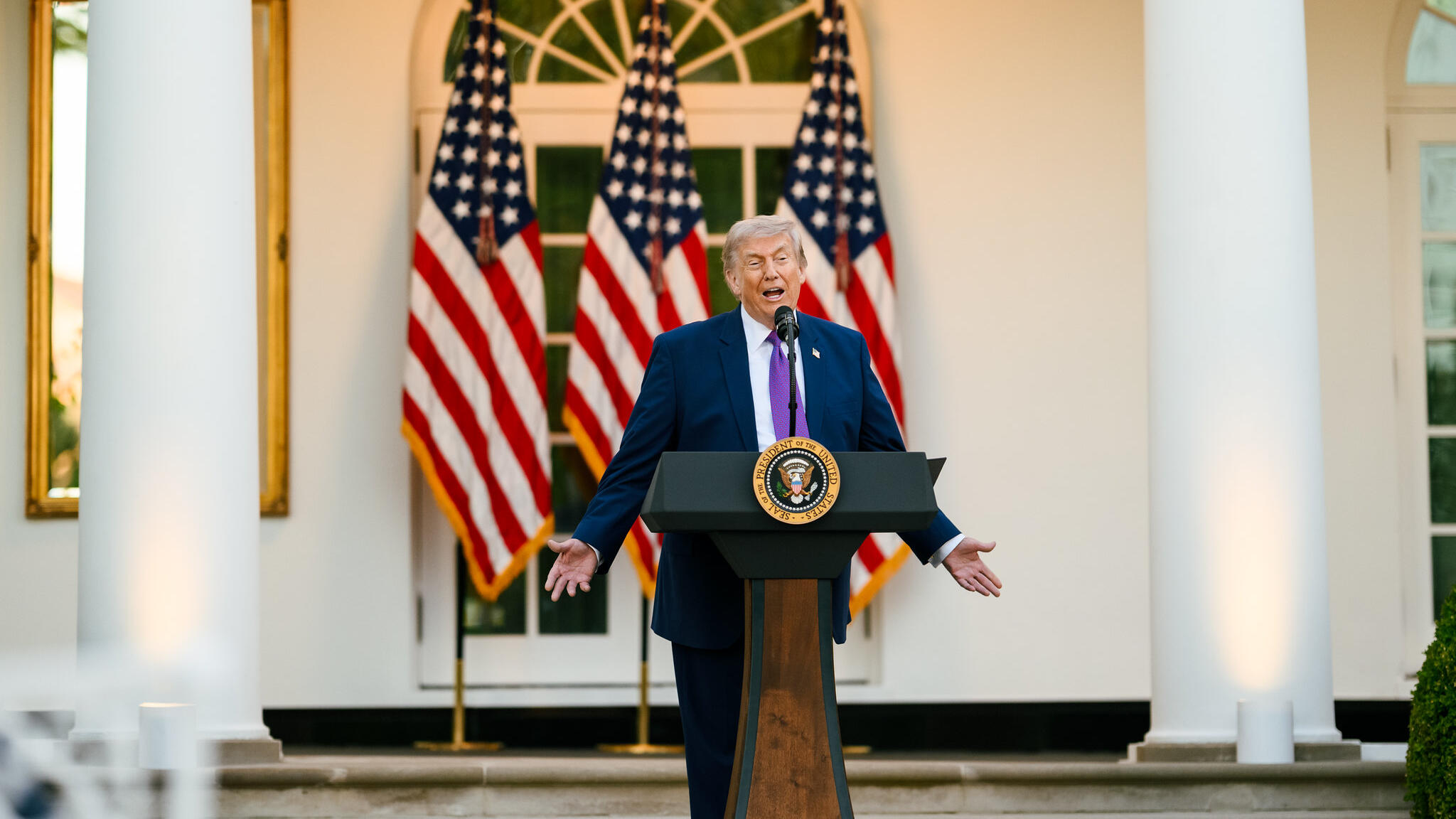
United States President Donald Trump said Monday (Tuesday AEST) he has postponed a planned military strike on Iran after requests from key Middle Eastern allies seeking more time for negotiations aimed at ending the conflict.
In a post on Truth Social, Trump said he had instructed U.S. military leaders that “we will NOT be doing the scheduled attack of Iran tomorrow” following appeals from Qatari Emir Tamim bin Hamad Al Thani, Saudi Crown Prince Mohammed bin Salman and United Arab Emirates President Mohammed bin Zayed Al Nahyan.
There had been no official indication prior to Trump’s statement that the United States was preparing to launch military action against Iran on Tuesday.
Earlier in the day, Trump told the New York Post that Iran knew “what’s going to be happening soon”, but declined to provide additional details.
According to Axios, Trump had been considering renewed military operations after Iran’s latest response during negotiations over a potential agreement to end the conflict was viewed as inadequate.
In his post, Trump said the Gulf leaders requested the attack be delayed “in that serious negotiations are now taking place, and that, in their opinion, as Great Leaders and Allies, a Deal will be made, which will be very acceptable to the United States of America, as well as all Countries in the Middle East, and beyond”.
“This Deal will include, importantly, NO NUCLEAR WEAPONS FOR IRAN!” Trump wrote.
Trump added that he instructed Defence Secretary Pete Hegseth and Joint Chiefs Chairman General Dan Caine to remain ready to proceed with military action if negotiations fail.
The president said military leaders should “be prepared to go forward with a full, large scale assault of Iran, on a moment’s notice, in the event that an acceptable Deal is not reached”.
Reuters reported that Pakistan has continued acting as an intermediary between Washington and Tehran following peace talks held last month.
A Pakistani source confirmed Islamabad had delivered Iran’s latest proposal to the United States, though negotiations remained difficult.

The sides "keep changing their goalposts," the Pakistani source said, adding: "We don't have much time."
The conflict has increasingly centred on the Strait of Hormuz, a critical global oil shipping route where competing blockades have disrupted tanker movements and intensified economic pressure on both sides.
The deteriorating situation has further weakened an already fragile ceasefire that began almost six weeks ago.
Although technically still in place, the truce has repeatedly been undermined by renewed fighting, with Trump last week describing it as being on “life support”.
Meanwhile, U.S. Treasury Secretary Scott Bessent announced a further 30-day extension of a sanctions waiver allowing certain countries to continue purchasing Russian seaborne oil amid supply disruptions linked to the Iran conflict.
Bessent said the Treasury Department issued the temporary licence after the previous waiver expired on Saturday, allowing access to Russian oil cargoes stranded on tankers without breaching U.S. sanctions.
A source familiar with the decision told Reuters the extension was requested by poorer countries unable to secure Gulf oil supplies because of the ongoing conflict and the closure of the Strait of Hormuz.
"This extension will provide additional flexibility, and we will work with these nations to provide specific licenses as needed," Bessent said in a post on X. "This general license will help stabilise the physical crude market and ensure oil reaches the most energy-vulnerable countries."
Bessent, who previously indicated no further extension was expected, said the measure would help redirect existing oil supplies to countries most affected by the disruption while easing competition with China for sanctioned cargoes.
Separately, Israel carried out airstrikes in southern Lebanon on Monday, according to Lebanese security sources and state media, while Hezbollah announced further attacks on Israeli forces despite the continuation of a U.S.-backed truce.
More than 3,000 people have been killed in Lebanon since the conflict began on 2 March, according to the country’s health ministry.
Fighting between Hezbollah and Israel has continued since Trump first announced a ceasefire on 16 April, with hostilities largely concentrated in southern Lebanon but periodically escalating amid the broader regional conflict involving Iran.