Three times this year, the president has called time on a Middle East war from his phone, and three times, traders have piled into the same trade before bothering to check whether the guns actually stopped.
Here is a trade that has worked three times running, which on Wall Street is about two more times than anyone has a right to expect.
Each time Iran and Israel have started swinging, crude has rocketed, and equities have lurched risk-off, and each time Donald Trump has tapped out a Truth Social post promising peace, sending the whole move into reverse.
It happened again on Monday in New York.
Oil was grinding higher, and stock futures were sagging, with the two old foes trading missiles for the first time since April, when the president floated an immediate ceasefire for both sides.
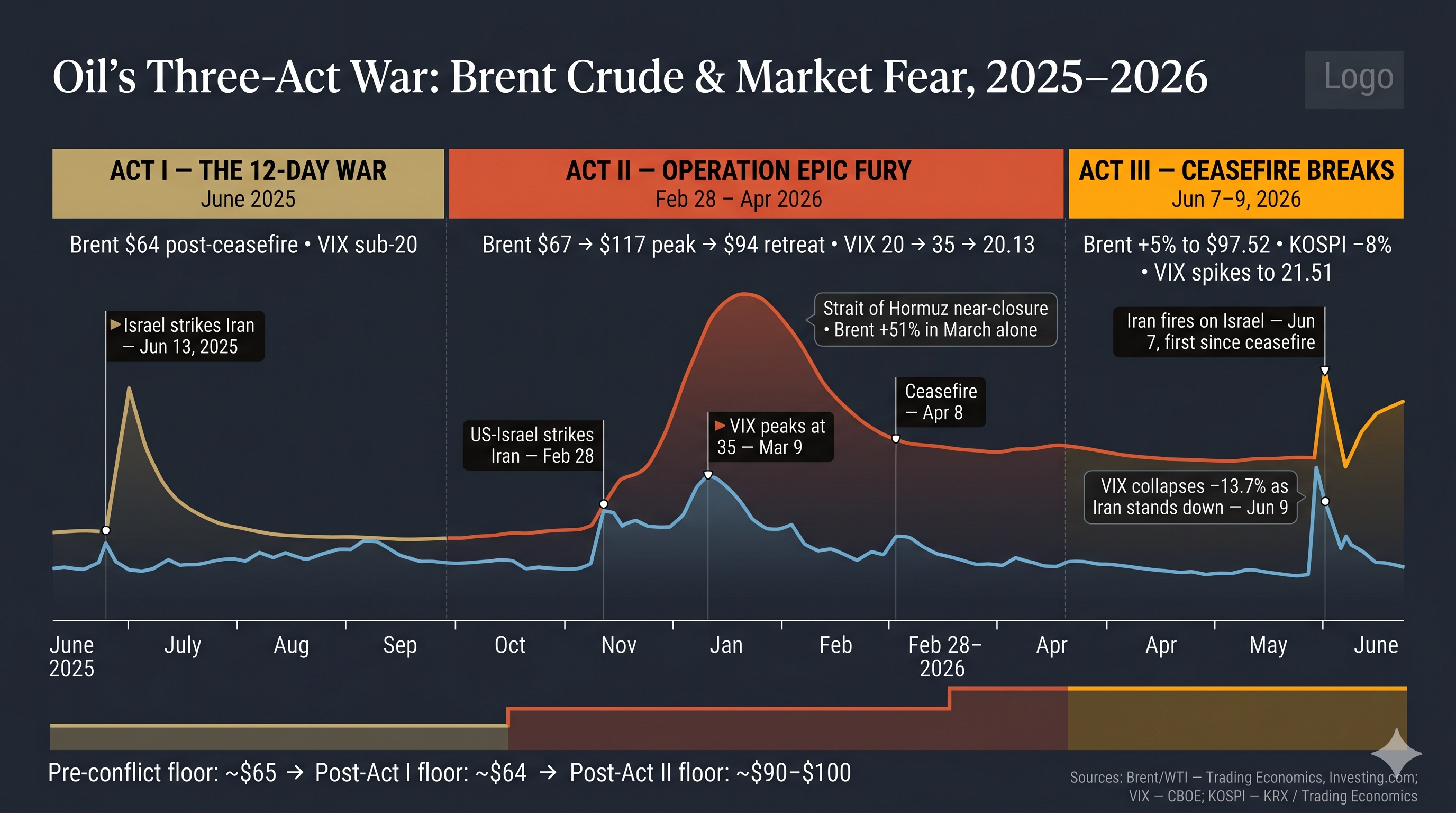
Brent had already punched close to 5% higher to US$97.52 a barrel, with Seoul's Kospi shedding 8%, before the post took the sting out of it.
If that sequence rings a bell, it is because the desks have now run this playbook three times in twelve months.
Three wars, one script
The template got written in June last year, when Trump declared a complete and total ceasefire to wrap up what he branded the 12 Day War.
Asian bourses screamed higher overnight, U.S. crude slid back to around $64 a barrel, and the Cboe Volatility Index (the VIX), Wall Street's fear gauge, quietly sank below 20.
The sequel was a nastier piece of work, a U.S.-Iran shooting war that ran from late February to April and hauled crude from roughly $67 all the way to $117, with the VIX spiking north of 35.
That one ended on the evening of 7 April, barely two hours shy of a strike deadline, when the president posted he had agreed to a double-sided ceasefire so long as the Strait of Hormuz reopened.
In every episode the barrel moves first, because the whole risk premium is really a Hormuz premium, and it evaporates the second that chokepoint looks navigable.
April served up the textbook version, with West Texas Intermediate settling 16% lower at $94.41 and Brent off 13%, their heaviest one-day drops since the pandemic rout of 2020.
The fear gauge tagged along rather than leading the charge, sliding 5.8 points to 20.13 in its sharpest single-day fall since Trump hit pause on his tariffs the year before.
Stocks then repriced the cheaper-petrol, softer-inflation maths, with futures markets lifting the odds of a Fed rate cut to 43% from 14% inside a day, and the Dow piling on 1,325 points for its best session since April 2025.

Who wins, who cops it
Underneath the index numbers sits a sector reshuffle that runs the same way every time, handing back the spoils to whatever the war had hammered.
Airlines and travel names lead the bounce, with United and American jumping 7% and 6.2% in April as cheaper jet fuel flowed straight to the bottom line, a rerun of last June when IAG, easyJet and Carnival took off.
Chipmakers and the wider artificial-intelligence trade tend to rip hardest, and Nvidia, AMD and Micron tacked on between 4% and 10% on the April truce.
Defence is the photo negative of the lot, selling the mere whiff of peace even with order books bulging, as Lockheed Martin, RTX and Northrop Grumman shed 3% to 6% the day the shooting paused.
Buy first, read the fine print later
The knack to the trade is that the desks act on the headline and audit it afterwards, which is perfectly sensible right up until it is not.
That reflex was on show again on Monday, with the iShares Semiconductor ETF up 7% and Micron rising 10% intraday after Friday's hiding, even while Iran and Israel were still lobbing missiles at one another.
The sting in the tail is that not one of the three ceasefires has actually stuck, with the April truce unravelling inside 48 hours and now in open tatters, which leaves Monday's rally perched on a deal that is, once again, more press release than peace.
For a market trained to front-run the president's optimism, the only question left is how many more times the same handful of words can shift the same prices before the punters start wanting the deal as well as the post.
What to watch:
- Brent and WTI, still the most honest read on whether anyone really believes the Strait stays open
- The VIX, parked up near 20, and whether it deflates on cue or digs its heels in this time
- The defence-versus-airlines split, the cleanest gauge of how much faith the tape is putting in any given post
- Asian indices, with the Kospi the twitchiest barometer going whenever Hormuz cops a fright
- Whether the words hold, because the first two ceasefires came undone and number three is already creaking