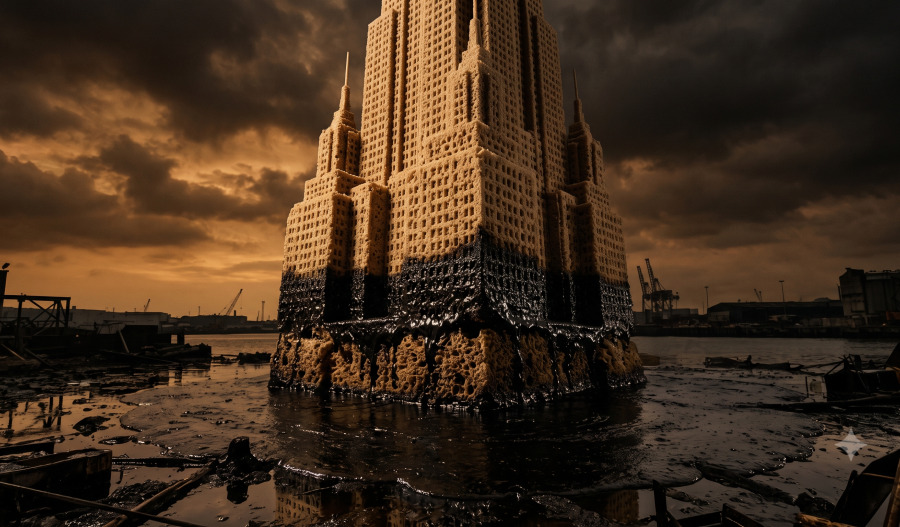

Iran declared the Strait of Hormuz closed and Washington answered with six straight nights of strikes, Apple took OpenAI to court, the big U.S. banks printed records into a cooling inflation number, and Kevin Warsh promised a Fed regime change - all while crude clawed back above US$86 and tech dropped the most it has in recent memory.
Welcome back Unpacked.
All the top moves, shakes and shipping-lane closures from Azzet's editorial team are right here in your weekly business wrap every Friday (17 July 2026).
Monday
The week opened with Tehran widening its Gulf campaign and declaring the Strait of Hormuz closed, a phrase the tanker market reads less as maritime law than as a pricing instruction.
President Donald Trump called for all trade with Spain to be cut off, leaving traders to work out what Madrid had done to deserve it.
Away from the shipping lanes, Tim Cook's Apple sued OpenAI over trade secrets, moving the AI arms race from the poaching of engineers to the discovery of documents.
Apple's next chip push chooses memory over speed, an admission that the bottleneck in on-device AI is feeding the silicon, not running it.
That thesis found an immediate audience in Seoul, where SK Hynix surged on its debut as investors queued for anything with high-bandwidth memory attached.
Ed Bastian's Delta beat earnings and backed its outlook to close the day, a confident call in a week that began with the world's most important oil chokepoint declared shut.

Tuesday
Washington escalated, with Trump reinstating the shipping blockade and ordering fresh strikes, turning a rhetorical closure of Hormuz into a contested one.
The AI chip queue lengthened as TSMC posted a 68% revenue leap, confirming the constraint in this cycle sits in fabrication capacity, not customer appetite.
Across the Pacific, a coalition of U.S. states sued to stop Paramount-Warner, arguing that folding two studios into one is a problem whatever streaming economics happen to be doing.
Oliver Blume's Volkswagen warned of more cuts as costs climb, evidence that Europe's industrial base is still absorbing an energy shock it never fully shook off.
Wednesday
Arc shareholders approved the Shell acquisition, handing Wael Sawan a fresh block of assets at the point in the cycle where oil majors tend to look prescient.
Washington reimposed the port blockade and pressed on with strikes, keeping the war premium bolted onto every barrel leaving the Gulf.
David Solomon's Goldman Sachs delivered a 46% earnings beat that still left one ratio sliding, proving a blowout quarter and a deteriorating balance sheet metric can share a press release.
Jamie Dimon's JPMorgan Chase went further with a record quarterly banking profit, a curious result to book in a week when energy prices were doing the heavy lifting on inflation.
On that front, U.S. inflation cooled to 3.5% as energy prices eased, a figure already looking historical given where crude spent the rest of the week.
Kevin Warsh capped the day by vowing a Fed regime change to tackle inflation, pledged just as the oil market began rebuilding the problem he intends to solve.
Thursday
Our Commodities Wrap watched reality bite as crude reclaimed US$86, unwinding the peace-trade optimism quietly priced in before Hormuz went dark.
U.S. strikes on Iran continued as tensions around the Strait escalated, with the shipping lane now the single most important variable in the global inflation outlook.
Larry Fink's BlackRock saw its stock jump as markets inflated assets under management, the purest example available of a business paid to have things go up.
U.S. wholesale prices fell as fuel costs eased, a data point measuring a period that ended before the tankers stopped moving.
Friday
Mission Critical put the US$6.5tn price tag on China's rare earths grip, quantifying the industrial base sitting downstream of Beijing's export controls.
Ted Sarandos and Greg Peters at Netflix watched shares slide 8% after hours despite a profit beat, the streaming sector's traditional penalty for meeting expectations rather than shattering them.
American strikes on Iran ran into a sixth consecutive night, neither side showing much appetite for the off-ramp.
U.S. retail sales rose as spending held, complicating life for anyone at the Fed hoping demand would do the tightening for them.
James Quincey's Coca-Cola stopped US production after a cyber attack, proof that supply chains break at the server room as readily as at the port.
Andrew Witty's UnitedHealth lifted its guidance amid an earnings rebound, capping a fortnight in which the insurer's problems apparently became somebody else's.
Week ahead:
- Geopolitics - the Hormuz closure and the U.S. strike campaign remain the dominant variable for crude, freight rates and every inflation forecast built before this week.
- Macro data - the next U.S. CPI print will be the first to capture crude above $86, and the first honest test of the 3.5% cooling narrative.
- Central bank - Warsh's regime change rhetoric needs a policy instrument attached; watch the next FOMC communication and any dissent around it.
- Earnings - the balance of Q2 reporting, with the read-through from TSMC's 68% leap into the rest of the AI supply chain still to land.
- Legal - Apple v OpenAI, plus the state suits against Paramount-Warner, with early procedural rulings likely to shape both.
- Sector data - memory contract pricing after SK Hynix's debut, the cleanest test of whether the bandwidth thesis holds or is simply the latest thing to be bid.
- Trade - Trump's call to cut off trade with Spain, and whether it becomes policy or joins the long list of things that did not.
- Corporate - completion mechanics on Shell's Arc acquisition, and further detail on Volkswagen's cuts.