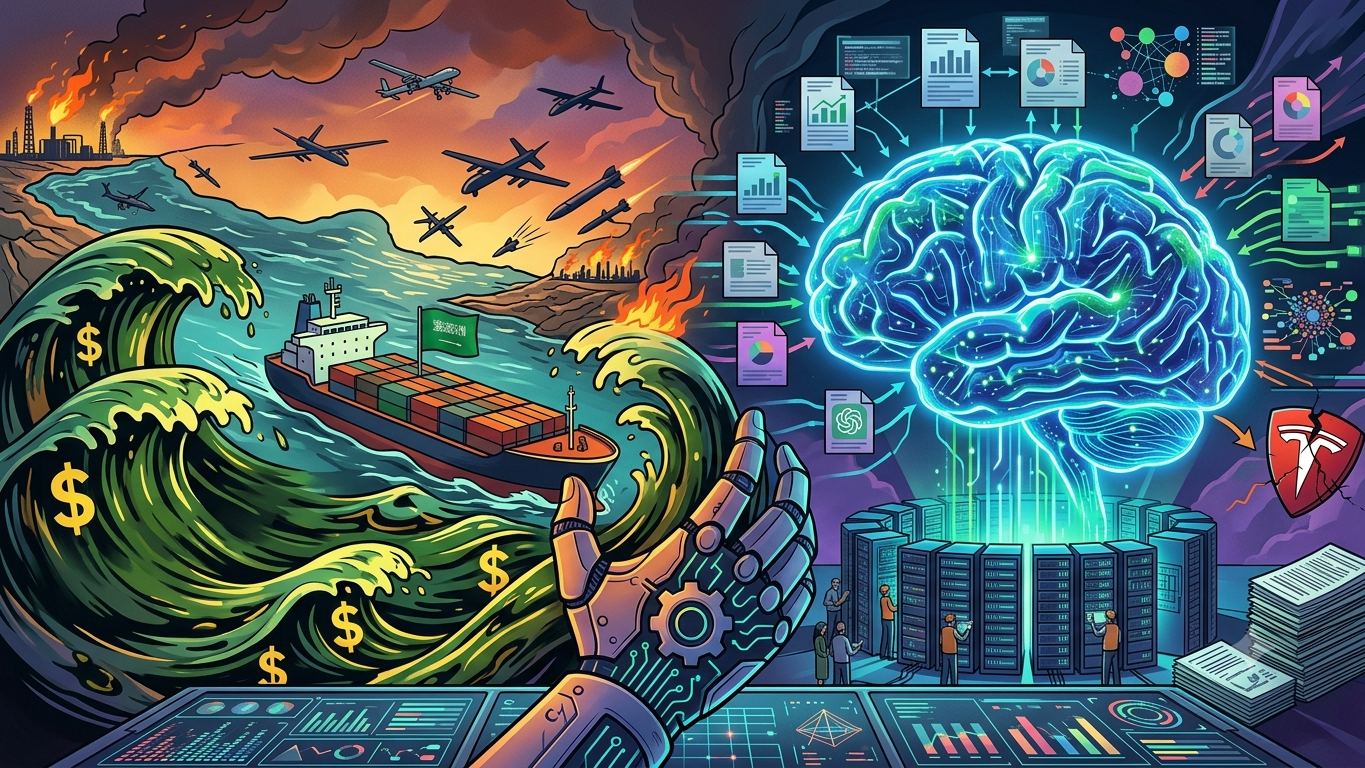
Iran expanded the battlefield, oil found a new route higher, and artificial intelligence kept rewriting the corporate playbook as markets navigated a week where geopolitics and technology collided.
Washington threatened Iranian infrastructure, Houthi attacks pushed energy risks beyond the Strait of Hormuz, Tesla discovered AI spending comes with a bill, while Alphabet and Super Micro showed investors are still willing to fund the next generation of computing.
Welcome back to Unpacked.
All the top moves, shakes and market-defining events from Azzet's editorial team are right here in your weekly business wrap every Friday (24 July 2026).
Monday
The week opened with Washington widening its campaign against Tehran after confirming two American military personnel were killed in an Iranian attack in Jordan, with U.S. Central Command launching another wave of strikes aimed at degrading Iran’s ability to threaten shipping through the Strait of Hormuz.
Away from the battlefield, American consumers offered a temporary vote of confidence. The University of Michigan’s Consumer Sentiment Index climbed to 54.4 in July, its highest reading since February and comfortably above expectations, suggesting households had not yet fully absorbed the latest energy shock.
But confidence arrived with an expiry date attached. A stronger reading built before crude began climbing again is a snapshot of yesterday’s economy, not tomorrow’s.
China’s artificial intelligence (AI) ambitions then moved back into focus as Beijing-based Moonshot AI unveiled Kimi K3, a 2.8 trillion-parameter open-weight model designed to compete with leading U.S. systems at a fraction of the cost.
Backed by Alibaba and Tencent, Moonshot’s launch was another reminder that the AI race is no longer simply Silicon Valley versus the world. China is building its own stack, its own models and increasingly its own alternatives.

Tuesday
The commodity market delivered its diagnosis: copper is not short of demand, it is short of supply.
Copper continued its structural rally as investors priced in a widening deficit driven by electrification, AI infrastructure and expanding data centre demand.
The metal, often treated as a global economic pulse check, is increasingly becoming a measure of the energy transition’s physical limits.
That supply pressure was joined by another shipping threat as Yemen’s Iran-aligned Houthis announced a naval blockade against Saudi Arabia, opening a new front in the conflict and placing another major trade route under pressure.
The Strait of Hormuz controls Gulf energy flows. The Bab el-Mandeb controls the gateway between the Red Sea and global shipping lanes. Markets suddenly had both in the same conversation.
Away from geopolitics, Domino’s delivered a reminder that some businesses can still navigate cautious consumers. The pizza chain narrowly exceeded revenue forecasts as its supply chain operations helped offset weaker restaurant demand.
Britain also experienced another political reset as Andy Burnham became the country’s seventh prime minister in a decade after Sir Keir Starmer’s resignation.
The revolving door at Westminster continued, extending a period of political instability that has defined British leadership since 2016.
Wednesday
The shipping market began rewriting routes as Saudi oil tankers reversed course in the Red Sea following Houthi threats, adding fresh pressure to global energy flows.
Two Saudi crude carriers changed direction as attacks and warnings spread across the region, while a separate tanker incident in the Strait of Hormuz intensified fears that the conflict could disrupt both major energy chokepoints simultaneously.
In technology, OpenAI strengthened its financial leadership ahead of its next corporate chapter, appointing Nubank chief executive David Vélez and BNY chief executive Robin Vince to its boards.
The appointments reflected a company moving beyond research lab status and toward a structure increasingly resembling a major global technology enterprise.
General Motors provided a different kind of corporate surprise, lifting its 2026 forecasts after stronger-than-expected earnings.
GM credited stable vehicle pricing, lower warranty costs and improving electric vehicle losses, suggesting the automaker’s expensive EV retreat may be starting to stabilise.
Then Super Micro Computer reminded investors where the AI money is flowing.
The company surged after revealing more than US$60 billion in new orders during its fourth quarter and lifting gross margin guidance significantly.
Chief executive Charles Liang linked the demand surge to work with SpaceXAI, reinforcing the message that AI infrastructure remains one of the market’s most crowded investment themes.
Thursday
Washington raised the stakes further as Donald Trump threatened to strike Iranian infrastructure if Tehran attacked commercial vessels passing through the Strait of Hormuz.
The warning transformed the shipping crisis from a battle over vessels into a potential battle over national infrastructure.
Iran responded by warning it would retaliate against U.S.-linked energy assets across the region, leaving markets to price the possibility of a conflict expanding beyond ships and into supply chains.
Meanwhile, Tesla missed earnings expectations as AI and manufacturing investments weighed on profitability.
Revenue rose 26% to $28.24 billion, but adjusted earnings per share came in at $0.33, below forecasts of $0.53.
Google parent Alphabet beat earnings expectations, powered by cloud growth, but shares fell after the company increased its 2026 capital expenditure forecast to accelerate AI infrastructure spending.
Away from earnings, concerns around conversational AI moved into sharper focus as researchers documented increasing reports of psychological harm linked to chatbot interactions.
A review published in JMIR Mental Health examined dozens of reported cases involving psychiatric crises connected with chatbot use, bringing a growing debate around AI safety into the mainstream.
Australia added another complication for central banks as employment surged.
Australian employment increased by 76,300 in June, far above expectations, while unemployment remained at 4.4%.
Friday
The oil market finally crossed the line investors had feared all week.
Brent crude surged above US$100 a barrel after Houthi attacks on two Saudi oil tankers in the Red Sea prompted Donald Trump to promise “major military punishment” against Iran and its allies.
The conflict had expanded from one shipping lane to two, turning global energy security into the dominant market variable.
The Strait of Hormuz was already under pressure. The Bab el-Mandeb had now joined the risk map.
For central banks watching inflation, the timing could hardly be worse.
Yet the U.S. economy continued to resist pressure.
Initial jobless claims fell by 22,000 to 187,000 in the week ended 18 July, the lowest level since 1969 and far below expectations.
The labour market remains stubbornly strong, creating a difficult equation for the Federal Reserve: inflation risks are rising again, but economic momentum has not disappeared.
Week ahead:
- Central banks - The Federal Reserve interest rate decision arrives with markets watching whether policymakers acknowledge renewed energy inflation risks or remain focused on previous cooling trends.
- Australian inflation - The latest consumer price index (CPI) release will test whether the Reserve Bank of Australia’s recent rate concerns are justified after employment growth exceeded expectations.
- U.S. growth - Gross domestic product (GDP) growth data will show whether the world’s largest economy maintained momentum despite elevated rates and geopolitical uncertainty.
- Consumer confidence - The Conference Board consumer confidence reading will reveal whether households remain resilient after oil prices surged and Middle East tensions escalated.
- Energy markets - Crude prices remain hostage to shipping security, with both Hormuz and Bab el-Mandeb now central variables for inflation forecasts.
- AI spending - Alphabet, Super Micro and OpenAI’s developments leave investors watching whether AI investment continues producing returns, as more major tech earnings come into focus.
- Geopolitics - Washington’s threats against Iranian infrastructure and Tehran’s response remain the biggest risk to global markets heading into the new week.