The ceasefire premium burned off as quickly as it arrived - Brent is back below US$103 per barrel, copper broke COMEX records on a Gulf acid crunch, and Westpac revised its oil call higher while gold slips on the inflation it helped create.
The week's commodity moves split cleanly into two camps: those running hot because of the Middle East, and those running hot in spite of it.
Oil and LNG remain hostage to the Strait; copper's supply problem runs through Chilean smelters that have lost their sulphur feed; aluminium is watching Gulf facilities that won't fire back up for at least a year; and gold has pulled back - not because the conflict risk has abated, but because the inflation it triggered is now the Fed's problem.
Gold
The yellow metal had a hard week on the rates side of the ledger, with April's hotter-than-expected CPI reinforcing the case for a prolonged Fed hold and driving a further leg down from January's all-time high.
Rising U.S. real yields and a resurgent dollar did the work that geopolitical noise couldn't, flushing speculative long positions off London and New York desks that had built through Q1.
Westpac economists Justin Smirk and Luka Belobrajdic flag the clearing of those positions as broadly constructive, noting it creates a cleaner entry for longer-dated buyers to rebuild without fighting an overstretched book.
Their peak call of around $5,000 per ounce (oz) in Q1 2027 holds, contingent on conflict resolution unwinding both the real yield premium and the dollar bid that is currently capping bullion.
Central bank accumulation - the secular bid that has held the floor through every correction since 2022 - shows no institutional sign of reversal, keeping the downside contained even as the macro turns awkward.
Price: US$4,697/oz

Silver
Silver tagged a two-month high mid-week before losing the thread, caught between a genuine long-run electrification thesis and a near-term tape that is trading more like a currency hedge.
Photovoltaic manufacturers trimming silver loadings per cell in response to high input costs continue to chip away at the forward demand picture, while the leveraged accounts that drove the metal through key resistance levels earlier in the year have largely stepped away.
The dollar's hold near multi-month highs is the gating factor: until that reverses convincingly, the silver bid will keep arriving in small, impatient parcels rather than the sustained institutional flow the chart needs for a clean break.
Price: ~US$76.50/oz
Crude oil
The ceasefire trade unwound quickly this week, with Brent slipping below $103/bbl as markets squared up to a harder read: the Strait of Hormuz is functionally closed, a kinetic pause is not a resolution, and the IEA is tracking global oil stockpile draws of around 8.5 million barrels per day through Q2.
Westpac revised its Brent call higher in its May Commodities Update, now targeting a Q2 2026 average of $110/bbl - around 5% above its April estimate - before a gradual descent to $87/bbl in Q4 as demand destruction from three-digit crude begins to register.
The bank's baseline assumes Hormuz traffic recovers to just 10-15% of pre-conflict levels through June, with full resumption not expected until mid-2027 as security costs and marine insurance premiums outlast the conflict itself.
ExxonMobil and Chevron are running non-Gulf basins hard, but infrastructure damage across the Arabian Peninsula continues to cap any credible near-term supply response from within the region.
Price: Brent US$102/bbl; WTI US$101.50/bbl
Natural gas
Henry Hub is finding quiet traction as the domestic market reprices a shift in baseload demand that has little connection to heating cycles or seasonal storage norms.
Hyperscale data centre buildouts and the agentic AI expansion are emerging as persistent load drivers, with the U.S. forward curve repricing higher through May to account for sustained power consumption from tech hubs running around the clock.
LNG export utilisation near record levels is pulling on the domestic buffer that had previously kept Henry Hub insulated from the Hormuz shock, tightening the pipeline from a separate direction entirely.
The domestic gas market is running its own supply-demand squeeze at a different pace and for different reasons than Europe or Asia - worth keeping in mind before conflating a Henry Hub move with the global LNG crisis.
Price: US$2.67/MMBtu
LNG
Cheniere Energy and the North American export complex are effectively the load-bearing wall of a global LNG market that lost roughly one-fifth of its supply when Qatar's Ras Laffan facility went dark in early March and has not restarted.
An estimated 300 million cubic metres per day of curtailed output from Qatar and the UAE is keeping the Asian JKM benchmark well above pre-conflict levels, with 80-90% of Hormuz-routed LNG cargoes historically bound for Asian utilities that have no alternative source of comparable scale.
Westpac's call puts the Japanese LNG price peak at around $22.50 per million British thermal units (mmbtu) in Q3 2026, averaging above $20/mmbtu through year-end, with no return to pre-conflict pricing expected until 2028 given the scale of infrastructure damage at Ras Laffan.
The Australian domestic market has remained insulated by ample supply under the government's A$12 per gigajoule cap, with a proposed 20% reservation on uncontracted export gas providing a further buffer that neither Europe nor North Asia can replicate.
Price: JKM US$16.02/MMBtu; TTF US$14.80/MMBtu
Copper
COMEX copper broke to a fresh all-time high of $6.58 per pound (lb) on Tuesday as a Gulf sulphur crunch tightened its grip on Chilean smelter throughput, pushing the metal through levels that had previously marked the ceiling of demand-driven price optimism.
Around one-third of global sulphur production originates in the Gulf, and with that feed line severed since March, the sulphuric acid used by Chilean heap-leach and anode refiners has turned critically short - forcing output cuts and tightening a concentrates market that was already running thin heading into the year, as Argus Media's supply analysis makes clear.
China's subsequent suspension of sulphuric acid exports layered a trade-policy complication onto what was already a geopolitical supply shock.
Major technology companies continued signing large-scale infrastructure agreements through the week, while China's manufacturing PMI climbed to a five-year high, adding demand-side fuel to a price already running on supply-side fear.
Westpac's LME peak call sits at around $13,350 per tonne (t) in Q1 2027, with longer-run electrification demand expected to drive a further leg once the current supply-shock premium clears.
Price: COMEX US$6.58/lb (record); LME >US$13,000/t
Aluminium
Rio Tinto estimates close to 2.5 million tonnes of annual production has been pulled from Gulf smelters, with Emirates Global Aluminium's flagship plant and Bahrain's ALBA complex facing multi-year restart timelines that no amount of price incentive can compress.
The Gulf accounts for roughly 9% of global primary smelting capacity, and the geographic concentration of that footprint inside the Arabian Gulf has amplified the hit well beyond what a 9% market share would ordinarily imply.
The LME three-month price has repeatedly tested its four-year high near $3,650/t this month without holding it - a signal the market has absorbed the known supply shock but won't move materially higher without fresh curtailments or an unexpected demand acceleration.
Alcoa has restarted idle capacity at its Portland smelter in Victoria to capitalise on prices that Westpac expects to spike to a Q1 2027 average of around $4,000/t before easing as capacity elsewhere gradually fills the gap left by the Gulf outage.
Price: US$3,562/t
Iron ore
The 62% Fe index is holding above $100/t in the wake of China's Labour Day break, with steel mills restocking inventories after the holiday and temporarily widened margins encouraging a production uptick that has kept the near-term bid solid.
Freight costs are doing quiet work on the landed price, with higher energy input costs adding an estimated 15-30% to delivery economics - a dynamic Westpac has factored into its revised Q2 2026 forecast of $106/t, easing to $97/t in Q4 and $83/t in Q4 2027 as surplus conditions build.
The medium-term headwinds are real and accruing: new low-cost tonnes from Guinea's Simandou project, record port inventory levels at Chinese berths, declining Chinese steel output, and rising scrap substitution all point toward an increasingly well-supplied seaborne market through 2027.
BHP, Rio Tinto, and Fortescue are pushing shipment windows hard in the near term, but the tonnage expansion thesis is being quietly re-examined against a demand profile that no longer has the Chinese property sector as its anchor.
Price: US$105.14/t
Thermal coal
Asian utilities are doing what they pledged they would never do again - piling back into coal - with LNG curtailments returning thermal generation to baseload duty across South and South-East Asia as grid managers weigh the political cost of brownouts against the reputational cost of burning coal.
Westpac's read is direct: the risk of outages is currently trumping near-term environmental commitments, and coal's return to the dispatch stack in the region reflects that calculus rather than any policy reversal.
Indonesia's push to lift export volumes is the primary price cap, with Jakarta moving supply hard to prevent a surge that would invite government intervention before the Q2 peak arrives.
Prices are expected to ease toward $120/t by end-2027 as the secular demand decline reasserts once LNG supply stabilises sufficiently to give Asian utilities genuine fuel-switching flexibility again.
Price: ~US$130/t
Lithium
The 2024-25 supply glut is clearing, with spodumene settling in the $2,000-2,500/t range as processors run lean and the overhang from peak oversupply gradually works off.
Higher petrol prices from the Hormuz shock are doing what government subsidy programs could not: materially improving the total-cost-of-ownership case for EVs across Asia and Europe in a way that is now measurably shifting purchasing decisions at scale.
Westpac notes the EV market has reached a maturity where fuel-cost dynamics drive near-term adoption cycles - a change from prior years when the economics were primarily a function of incentive schedules rather than pump-price pain.
Albemarle is banking on the 2026 demand rebound, while battery energy storage growth, expanding renewables deployment, and data centre build-outs provide demand legs well beyond the EV cycle alone.
Price (spodumene 6% FOB Australia): US$2,200/t
Nickel
Nickel remains pinned by a supply overhang that refuses to clear, with the Indonesian production pipeline delivering volumes into an LME market carrying high warehouse stocks and limited downstream conviction on either the battery-grade or Class 1 side.
Jakarta has floated output curbs to support pricing, but the signal lacks credibility against the country's ongoing HPAL capacity expansion, which has repositioned Indonesia as the dominant global supplier across both end markets.
The Hormuz conflict is adding hidden logistics costs to refined metal delivery that BHP and Glencore are absorbing, though those costs are unlikely to shift the fundamental price picture until LME nickel inventory levels begin drawing more convincingly.
Price: US$17,200/t
Uranium
Yellowcake has eased from recent highs as the fragile ceasefire allowed some of the near-term fear premium to unwind, though the medium-term demand case is accumulating weight that sits well above geopolitical noise.
Paladin Energy has lifted its FY2026 guidance at Langer Heinrich, reading the long-term demand signal even as spot prices soften, while analysts at Bank of America maintain a $135/lb target for late 2026 on the back of an unprecedented utility pivot toward firm baseload power.
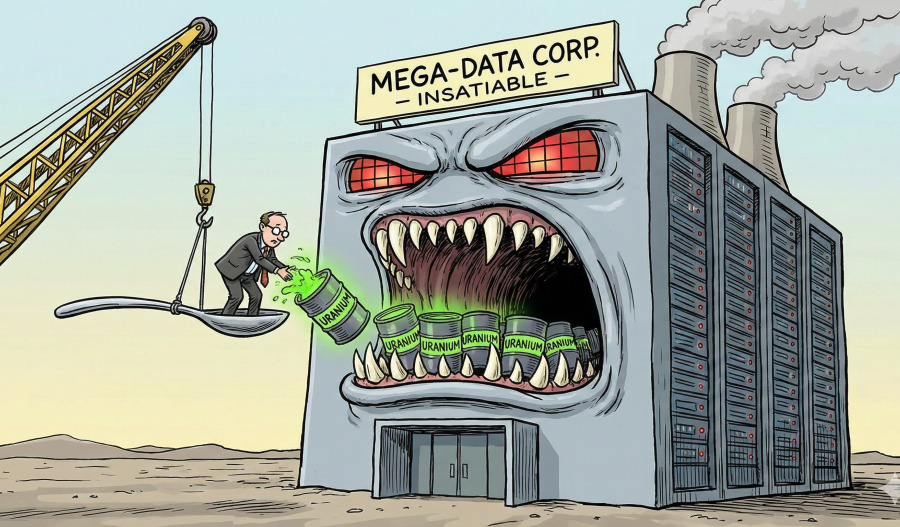
The more durable catalyst is not conflict risk but the growing recognition that a data centre economy running flat-out, year-round cannot be reliably powered by intermittent renewables alone - an argument that sharpens with every hyperscaler that commits to a long-term power purchase agreement.
Price: US$84.30/lb