Australia's economy expanded faster than expected in the second quarter, adding to the case for the Reserve Bank of Australia to maintain its tightening bias as inflation remains elevated.
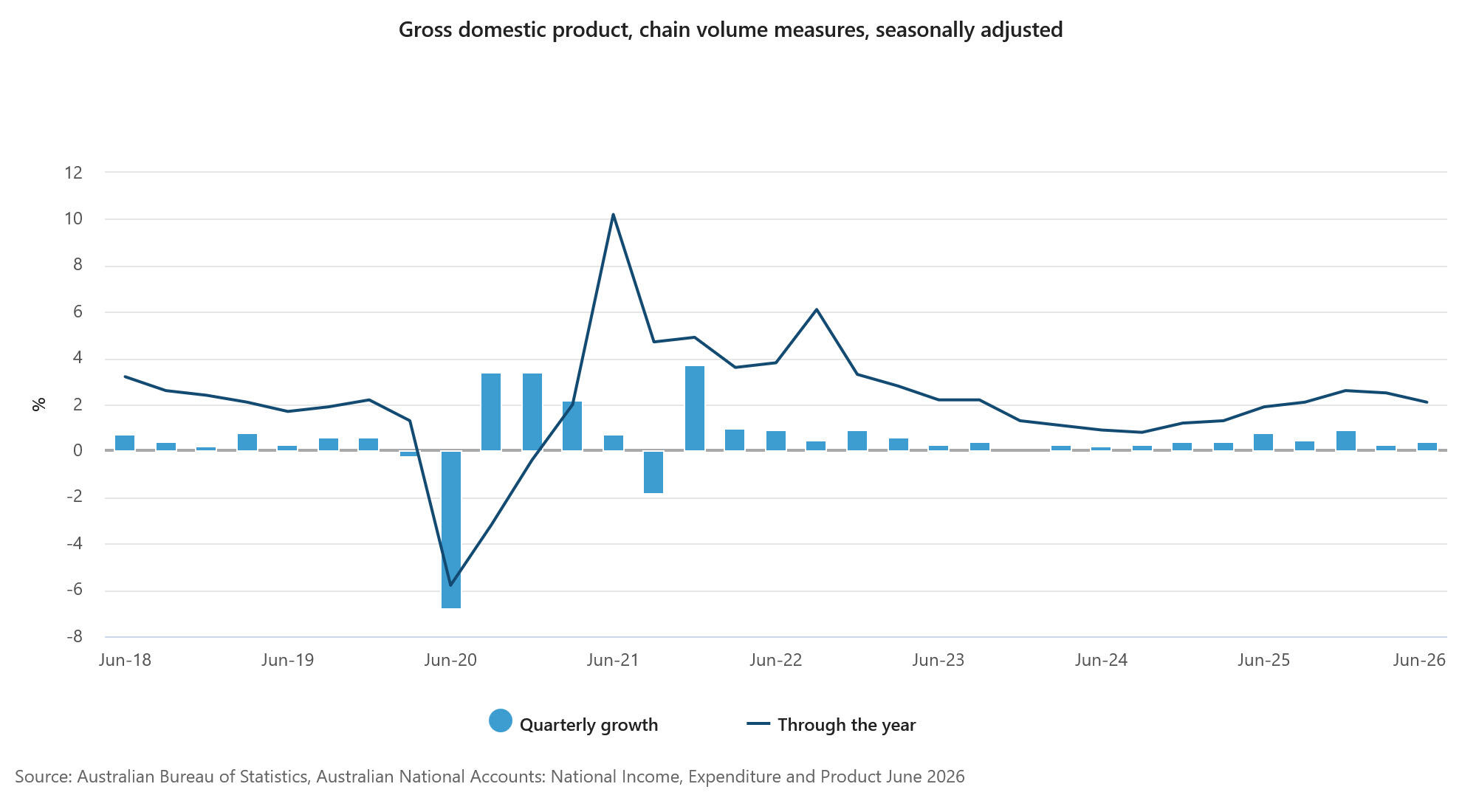
Gross domestic product (GDP) rose 2.1% year on year in the June quarter, according to data released by the Australian Bureau of Statistics (ABS) on Wednesday.
Markets were expecting growth of 1.8%, while the economy had grown 2.5% in the previous quarter.
On a quarterly basis, GDP increased 0.4%, marginally exceeding expectations of 0.3%.
Grace Kim, ABS head of National Accounts, said: "Economic growth remained subdued in the June quarter as households continued to behave cautiously.
"While increased spending and business investment occurred in pockets of the economy, imports supported much of the growth, moderating its contribution to overall GDP growth".
Household consumption increased 0.4% in the quarter, with spending subdued across most categories.
The Middle East conflict influenced consumer behaviour, contributing to lower fuel consumption amid elevated prices and reduced domestic and international travel.
Vehicle purchases rose 10.3% as households continued to transition towards electric vehicles.
"The rise in electric vehicle purchases may have reflected households taking a longer-term approach to cost of living pressures, with some choosing EVs to help reduce ongoing expenses," Kim said.
Goods imports increased 2.4%, driven by cars and aircraft, while services imports fell 4.9% as the Middle East conflict disrupted international travel plans.
"The number of Australians travelling overseas for the northern hemisphere summer fell for the first time since the COVID-19 pandemic, significantly reducing international travel expenditure," Kim said.

Exports increased 0.8%, supported by coal as production recovered from weather-related disruptions in the March quarter.
The rise in exports outpaced the 0.5% increase in imports, with net trade contributing 0.1 percentage points to GDP growth.
The data also provided the first estimate of economic growth for the 2025-26 financial year. Annual GDP growth reached 2.4%, while GDP per capita increased 0.8%.
"Annual growth outpaced the previous two years with stronger growth from service industries which account for over 70% of economic activity in the Australian economy," Kim said.
ANZ analysts said the GDP result was broadly consistent with the RBA's estimate of potential growth, although much of the strength reflected the second half of 2025.
"At 2.1% y/y GDP growth is around the RBA’s estimate of potential, although that reflects a robust second half of 2025, not strength in 2026.
"We expect that the RBA will need to see a further easing in y/y growth and ongoing weak quarterly growth outcomes to bring demand more into balance with supply.
"As far as our November rate hike call is concerned, these data take a back seat to inflation and hence will have little impact on the near-term path of policy.
"By the same token, today’s release does not give the RBA Board a strong reason for a September rate hike."
Westpac analysts said the figures suggested the economy was performing slightly more strongly than anticipated by the RBA.
"Today's result suggests the economy is running a touch firmer than expected by the RBA (1.9%yr). This firmer outcome and a tick higher in unit labour costs will likely add to the Board's unease leading into its September meeting."
At its latest meeting, some RBA board members considered the case for further monetary tightening, citing inflation that remained too high.
Australia's July inflation rate exceeded expectations, rising 3.5% year on year compared with forecasts of 3.3%.