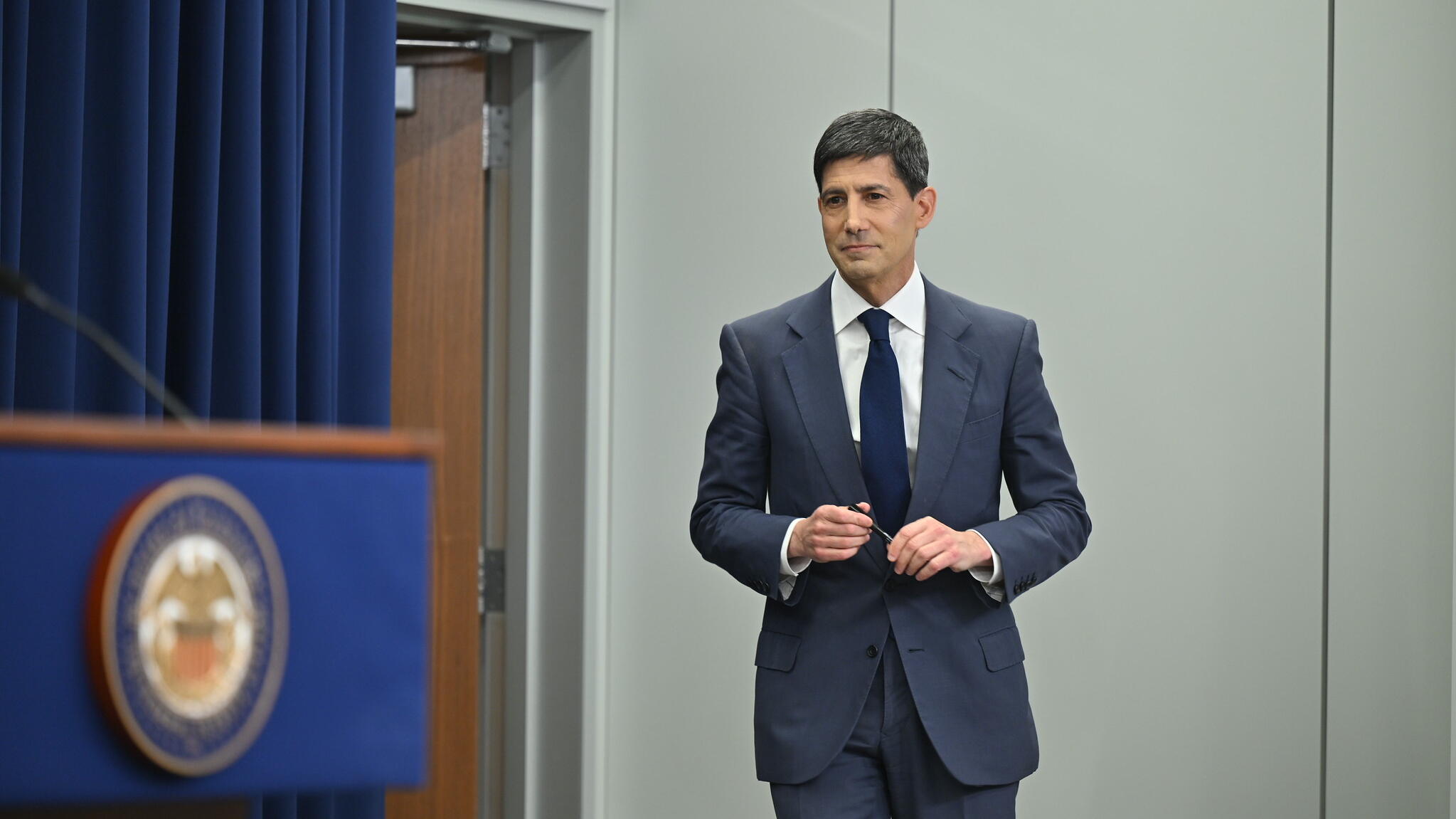
Federal Reserve Chairman Kevin Warsh delivered a more hawkish assessment of inflation at Jackson Hole on Friday, prompting traders to increase bets on an interest rate hike at the Federal Reserve's September meeting.
Warsh said elevated prices should remain the central bank's primary focus and described financial conditions as not broadly restrictive, a shift from his July news conference, when he characterised conditions as uneven.
“We can be held accountable for delivering on our remit - the only true test of our credibility,” Warsh said.
The Fed will not meet to decide interest rates until mid-September, and Warsh stopped short of explicitly signalling what policymakers would do at the meeting.
Warsh also reaffirmed the Fed's commitment to its 2% PCE inflation target.
"there should be no misunderstanding: The Fed's price-stability objective of 2 percent, as measured by the personal consumption expenditures (PCE) price index, is a firm, fixed target. Let's be equally clear about another aspect of the objective: Price stability is not self-executing, nor is inflation necessarily mean-reverting. It is the Fed's job to deliver stable prices."
United States personal consumption expenditures (PCE) inflation stood at 3.7% in July, according to government data released last week.
Warsh also outlined his preference for limiting the use of forward guidance by Fed policymakers, arguing that excessive communication about future policy decisions could restrict the central bank's flexibility.
"I have set out to change the form and function of the Fed Chairman's so-called forward guidance. You might know about my long-time discomfort with early pronouncements of future policy decisions. I much prefer another path … and will make the case for it."

He said transparency should serve the Fed's responsibility to implement effective monetary policy rather than be an objective in itself.
"Transparency in communications about future policy decisions is not a virtue unto itself. Communications must be in service to the Fed's paramount responsibility: getting monetary policy right."
Warsh argued that forward guidance, which became more prominent during the global financial crisis, had outlived its usefulness under normal economic conditions.
"In normal times, the role of forward guidance should be limited and circumscribed. Otherwise it risks creating ambiguity in the name of clarity."
He also said the Fed needs clear signals from financial markets, including movements in asset prices, Treasury securities, the U.S. dollar, credit conditions and commodities, to assess economic activity, inflation and broader financial conditions.
Warsh also addressed criticism that he would not respond quickly to inflation through interest rates. President Donald Trump, who selected Warsh as Fed chairman, has repeatedly called for lower borrowing costs.
At Jackson Hole, Warsh was clear about the role of interest rates, saying: “short-term interest rates are the predominant tool to achieve the dual mandate.”
Trump has continued to push for lower rates, while some investors have speculated that Warsh could delay any rate increase until after the November midterm elections.
Warsh did not directly address Trump in his Jackson Hole speech. However, his assessment that inflation remains a concern puts him at odds with the president's preference for lower rates.
Markets are now pricing in a 60.4% probability of an interest rate hike in September, according to the CME Group's FedWatch Tool.