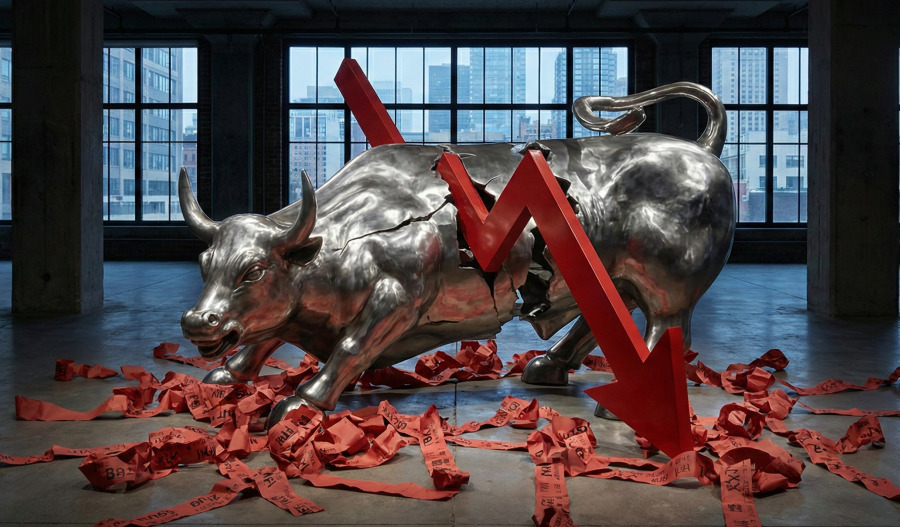
Major United States equity benchmarks closed lower on Friday, led by renewed weakness in technology stocks, as investors weighed President Donald Trump’s nomination of Kevin Warsh to lead the Federal Reserve and a sharp reversal in precious metals.
The Dow Jones Industrial Average fell 179 points, or 0.36%, to settle at 48,892.5. The S&P 500 declined 30 points, or 0.4%, to finish at 6,939.0. The technology-heavy Nasdaq Composite lost 223.3 points or 0.9% to close at 23,461.8.
Market reaction to Warsh’s nomination was broadly constructive. Trump endorsed the former Fed governor in a Truth Social post, saying, “I have known Kevin for a long period of time, and have no doubt that he will go down as one of the GREAT Fed Chairmen, maybe the best.”
Warsh’s selection is widely seen as easing concerns about the Federal Reserve’s independence, given his prior experience on the Board of Governors and a history of firm positions on inflation.
While he is viewed as open to lower rates in the near term, in line with Trump’s preferences, investors believe he would retain institutional credibility and not simply follow political direction.
Currency and bond markets reflected that view. The U.S. dollar ticked up from multi-year lows, while U.S. Treasury yields held broadly steady, suggesting investors were comfortable with the leadership outlook at the central bank.
ANZ analysts said Warsh’s policy leanings may differ from his earlier tenure. "While in his time as a governor, Warsh was considered an inflation hawk, he has recently expressed support for lower interest rates. He favours a smaller Fed balance sheet and less forward guidance.
"Therefore, the bar to implement new quantitative easing in times of stress will likely be higher. He is likely to focus on Fed reform and this could include less responsibilities, such as aspects of bank regulation and a narrower focus on the dual mandate.
"While Warsh is viewed as a credible candidate, his nomination may face opposition.

"Republican Senator Tillis, a member of the Senate Banking Committee, said following the announcement that while Warsh is a qualified nominee, he will not endorse his nomination until the Department of Justice’s criminal investigation into Powell is resolved. Senator Tillis’ support is seen as crucial to confirming the nomination, given the 13:11 Republican-Democrat split on the Senate Banking Committee."
Commodities saw some of the most dramatic moves. Spot gold and silver fell about 9% and 28%, respectively, as a speculative run-up in silver unwound sharply.
Despite the pullback, gold and silver futures remain up roughly 67% and 142%, respectively, over the past year.
Corporate earnings also drove stock-specific volatility. Apple swung between gains and losses after beating fiscal first-quarter expectations and reporting a sharp rise in iPhone sales.
The mixed reaction followed Microsoft’s 10% post-earnings drop on Thursday, its worst session since 2020, which erased more than US$350 billion in market value.
Outside the technology sector, Verizon was a notable outperformer. Shares surged nearly 12%, marking their strongest daily performance since 2008, after the telecommunications group exceeded analyst expectations and issued a solid full-year earnings outlook.
Despite Friday’s declines, the major indices posted gains for the month. The S&P 500 and Dow advanced 1.4% and 1.7%, respectively, in January, while the Nasdaq rose 1%.
The small-cap Russell 2000 outperformed, climbing more than 5% over the month.
On the bond markets, the yield on the 10-year U.S. Treasury note edged 0.1% higher to 4.239%, while the 2-year yield fell 1% to 3.524%.