
United States consumer sentiment improved modestly in June as easing tensions between the United States and Iran and lower fuel prices helped lift confidence, although households continued to cite the high cost of living as their biggest financial concern.
The latest University of Michigan Surveys of Consumers showed the Consumer Sentiment Index rose to a final reading of 49.5 in June, up from 44.8 in May and slightly above the preliminary reading of 48.9 released earlier in the month.
The result marked the first improvement after sentiment declined following the outbreak of conflict involving the United States, Israel and Iran in February. However, the reading fell just short of market expectations for a final figure of 50.0.
The improvement was broad-based, with gains recorded across income groups, wealth levels and political affiliations.
"The cost of living remains at the forefront of consumers' minds," said Joanne Hsu, the director of the Surveys of Consumers. "For the third straight month, over half of consumers spontaneously mentioned that high prices are weighing down their personal finances."
Hsu noted that the strong performance of equity markets has benefited household finances, although the gains have been concentrated among wealthier investors.
Around 28% of consumers in the highest tercile of stock ownership cited rising asset values as having a positive effect on their personal finances, the highest proportion recorded since January 2025.
By comparison, only 8% of respondents in the middle tercile of stock ownership and 4% in the lowest tercile identified higher asset prices as benefiting their financial situation.

Consumers also became more optimistic about the longer-term economic outlook, with expectations for business conditions over the next five years rising 16% as concerns over the prolonged impact of the Iran conflict eased.
Despite the improvement, overall sentiment remained subdued, standing 13% below its February 2026 level before the conflict began and nearly 20% lower than a year earlier.
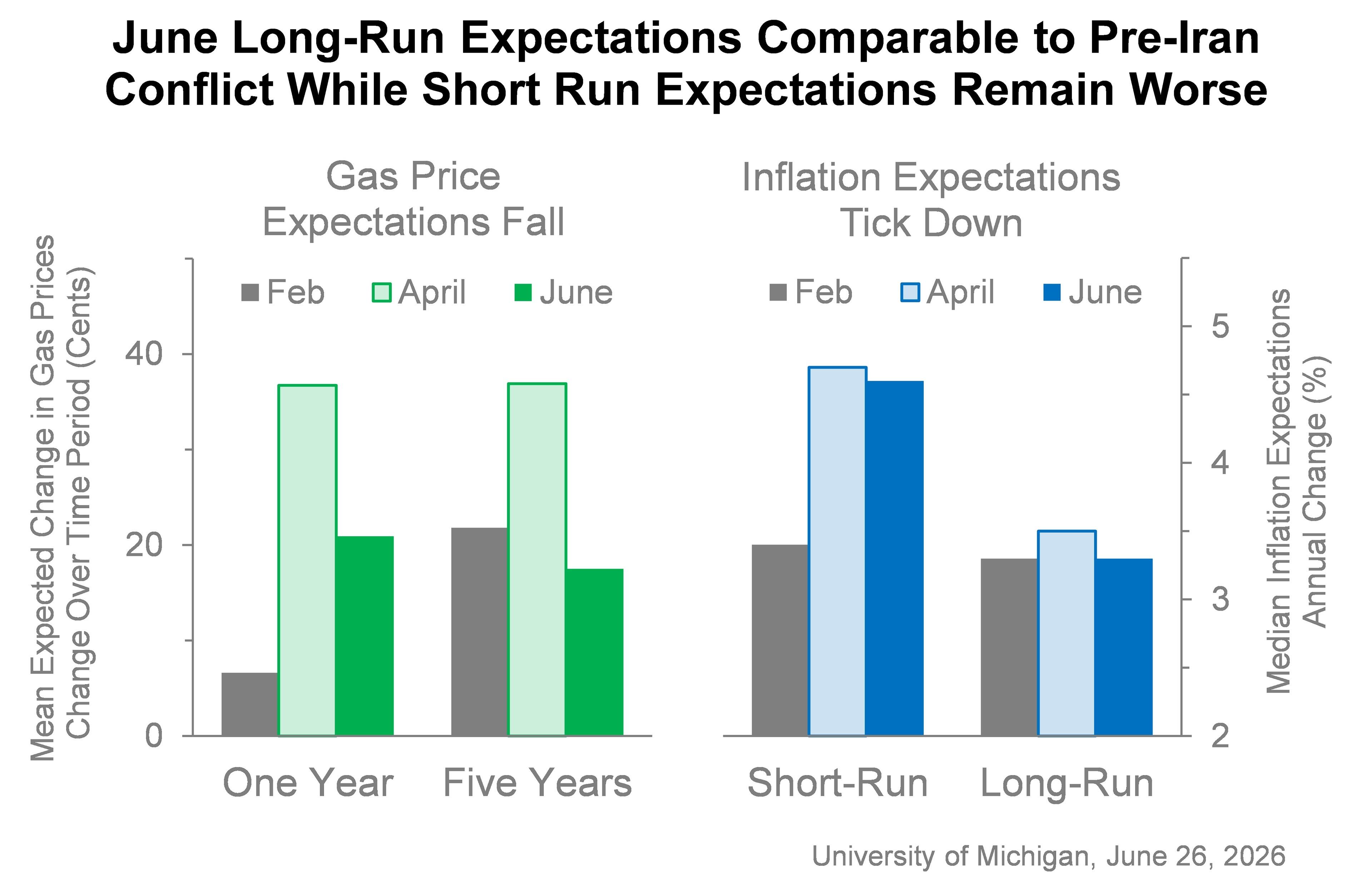
Inflation expectations also moderated during the month. Consumers now expect inflation to average 4.6% over the next year, down from 4.8% in May and unchanged from the preliminary June estimate.
Longer-term inflation expectations also eased, with the five-year outlook falling to 3.3% from 3.9% in May. The preliminary June reading had been 3.4%.
Even so, economists cautioned that many households continue to face significant financial pressures despite signs of improving confidence.
"Even though the war appears to be winding down, people are paying a lot more for everything because of the war," Mark Zandi, chief economist at Moody's Analytics, was quoted as saying in a New York Times article.
"Gas prices have come down but they’re still very, very high."