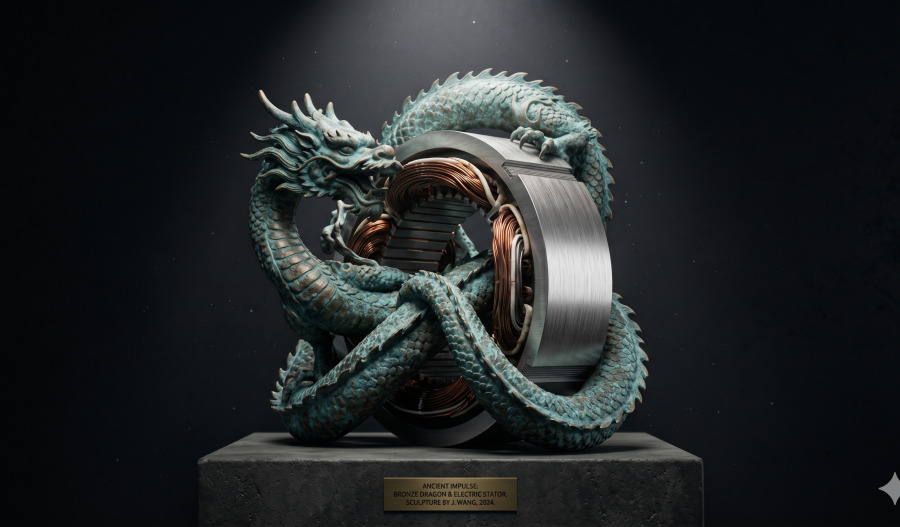

Washington has put US$17.5 billion behind nuclear reactors to close its AI power deficit, but the metals that build both the grid and the machines still run through Chinese refineries as Beijing gallops ahead in power generation across all sectors.
Azzet’s Mission Critical is a weekly column that lays out the ebbs and flows around critical minerals supply chains - from pricing, production, refinement and mergers & acquisitions, to energy, manufacturing and consumer products.
The shorthand doing the rounds among energy strategists is the "electron gap", and the figures behind it are difficult to argue with.
Since 2021, China has added more power generation capacity across every technology than the United States has built in its entire history, including 543 gigawatts in a single year, leaving it with a reserve margin American grid operators can only theorise about.
That advantage explains the urgency behind last week's Department of Energy commitment of US$17.5 billion in conditional loans for ten Westinghouse reactors, with AI data centres named as the explicit demand driver. That framing, though, mistakes the symptom for the disease.
Electrons (power) sit downstream of metal, and the wind turbines, transmission lines, battery banks and the reactors themselves are assembled from materials whose processing China quietly cornered over the past two or three decades.
That logic extends to the hardware the power is meant to feed, because every hyperscale data centre is a copper-hungry box wired into a grid that is itself a tangle of copper and magnets.
On that measure, the U.S.-China power deficit looks wider, older and far harder to close than any loan facility can manage.
Copper is the chokepoint
Let's begin with the metal that touches everything, because copper has quietly repriced from a cyclical industrial input into a strategic infrastructure asset.
Prices briefly touched US$14,527 per tonne (t) in January 2026 before settling above $13,000/t, well clear of historical averages, on a demand picture that no longer behaves like the old cycle.
A single large AI data centre can swallow up to 50,000t of copper, and J.P. Morgan puts total data centre demand at 475,000t a year by 2026, a category that barely registered five years ago.
Layer that onto grid expansion and electric vehicles, where each battery EV carries roughly 83 kilograms of copper, close to three times a combustion car's load, and the demand curve steepens sharply.
S&P Global sees consumption climbing from about 28 million tonnes (Mt) in 2025 to more than 42Mt by 2040, opening a shortfall near 10Mt by then, roughly a quarter below projected need, even after recycled scrap more than doubles.
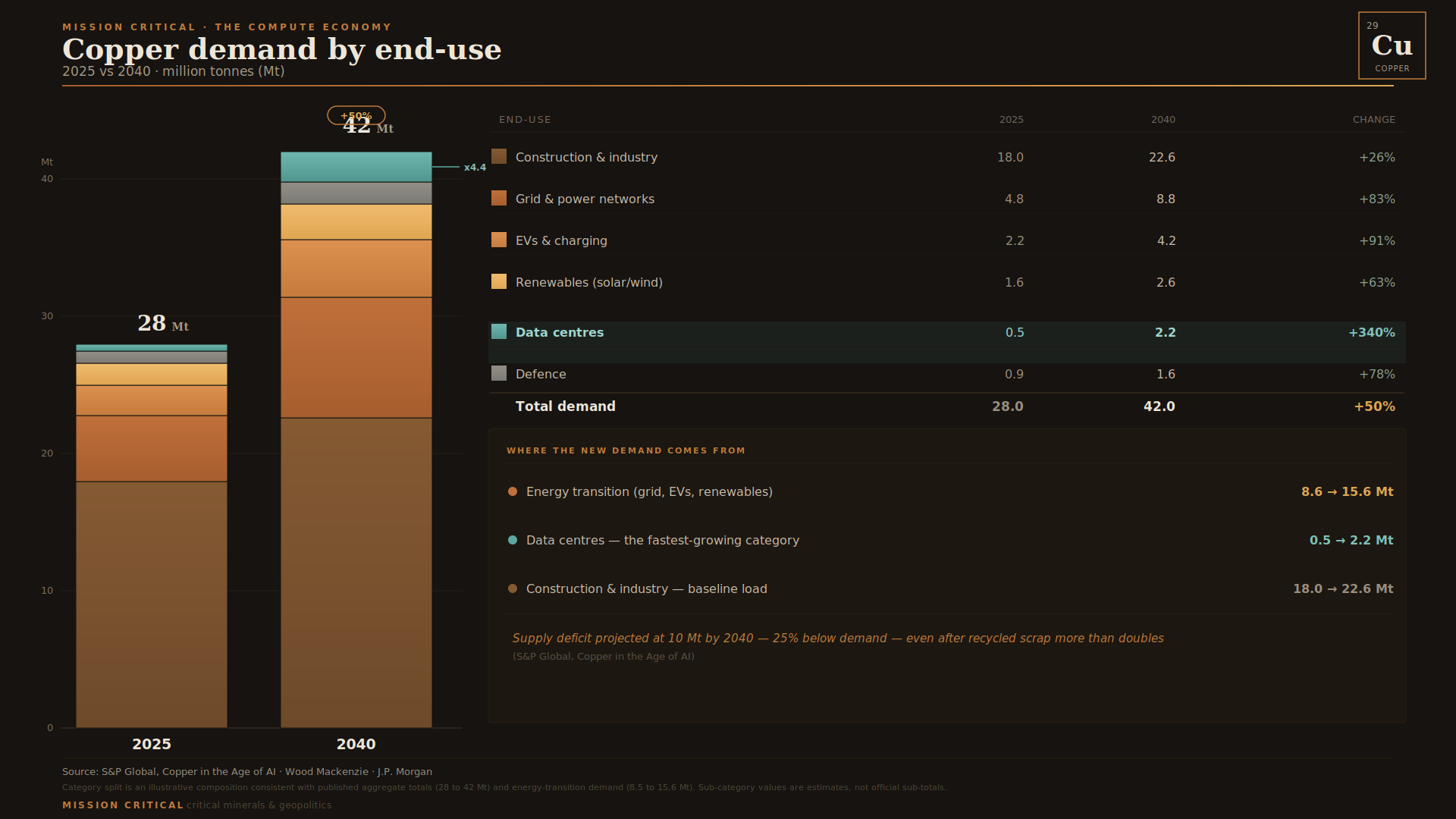
Data centre operators rank among the buyers least able to flinch, since the physics of their systems leaves no room to design copper out when prices climb, so their demand passes straight through to the screen.
China, for its part, has been the single largest contributor to global copper demand growth for two years running on the back of its grid build, while also dominating the refining stage where the West stays structurally short.

Refineries
The deeper exposure is not copper, which is at least mined across diversified jurisdictions, but the materials where China owns the midstream outright.
In magnet rare earths - the neodymium and praseodymium spinning inside every wind turbine and EV motor - Beijing accounts for around 60% of mining yet about 91% of global separation and refining, with Malaysia's Lynas plant the only alternative of any scale.
Battery materials repeat the pattern with harder edges, China holding shares of 80% or more across most key segments and a near monopoly above 95% in precursor cathode and lithium iron phosphate cathode materials.
Graphite, the anode material with almost no commercial substitute, sits near 96% refined production inside China, and the numbers for gallium, magnesium and tungsten run similarly lopsided.
By the IEA's reckoning, the average market share of the top three refining nations across copper, lithium, nickel, cobalt, graphite and rare earths climbed to 86% in 2024 from 82% in 2020, with nearly all the growth accruing to one supplier.
Mining can be diversified given enough money and patience, but refining remains the hard part to rebuild, demanding years of construction, heavy outlay and a tolerance for the environmental permitting that pushed the industry offshore to begin with.
Therein lies the asymmetry the electron gap obscures. China does not simply generate more power; it controls the inputs that allow anyone else to generate it at all.
Beijing makes its move
None of this would matter much if the dominance sat idle, yet Beijing has spent two years converting market share into a working policy instrument.
China imposed sweeping rare earth export controls in April 2025, then widened the net in October to cover lithium-ion battery materials, cathode precursors, anode materials and the production equipment itself, effective from November.
The precedent for how hard such measures bite already exists, given that Chinese antimony shipments fell roughly 97% after the August 2024 restrictions while global prices tripled.
A January 2026 catalogue expansion folded samarium, gadolinium, lutetium and silver into the control list, and the architecture is deliberately supple, letting Beijing intensify, suspend or redirect restrictions without touching the underlying legal authority.
Timing is the catch for anyone hoping the worst has passed, since extraterritorial enforcement of the October measures was delayed only until November 2026, a suspension that reads less as retreat than as a deliberate pause.
Washington's scramble
The American answer has been to drop the pretence that markets alone will fix this, and to put the state balance sheet directly into the supply chain.
The Department of Defense and Department of Commerce have shifted from passive buyers to active investors, taking equity-like stakes and financial warrants alongside offtake agreements, price floors and guarantees across MP Materials, Lithium Americas, USA Rare Earth and others.
That same template now underpins the Westinghouse loan structure, where Washington takes a 20% cut of cash flows above the threshold plus equity warrants, industrial policy dressed as project finance.
Genuine Western footholds do exist, since Australia leads global lithium output at nearly 37% and Indonesia is on course for roughly 71% of refined nickel by 2030, the one battery metal China does not control.
The Council on Foreign Relations argues the only workable path is to leapfrog rather than match, scaling recycling and novel extraction such as lithium from fracking wastewater and metals from tailings, because America cannot out-mine and out-process China on the current timeline.
Beneath the announcements sits a quiet admission that every loan, price floor and equity stake is an effort to buy back ground conceded over twenty years, and metal does not arrive on a political schedule.
For this journo, bets are on that the U.S. stays structurally reliant on Chinese refining well into the 2030s, leaving the supply chain a permanent pressure point rather than a solved problem.
What to watch:
- November 2026 is the date that matters, when China's delayed extraterritorial enforcement of its battery and rare earth controls is currently set to bite, and any flare-up in trade tensions before then could pull it forward.
- Copper's structural deficit reads as a 2027-and-beyond story, with several houses modelling a brief 2026 surplus on tariff-driven demand softness before the AI-and-grid pull reasserts itself, and this year's price action will test which view holds.
- Watch the DoD and Commerce equity stakes, since the cadence of fresh positions in rare earth, lithium and magnet names signals how aggressively Washington intends to subsidise a parallel supply chain.
- Indonesian nickel policy is the swing factor in the one chain China does not own, and any move on export rules or Chinese investment there reshapes the battery calculus.
- ASX-listed processors and developers with genuine non-China separation or refining capacity, Lynas (ASX:LYC) the obvious bellwether, become strategic assets the moment controls tighten, regardless of near-term spot prices.