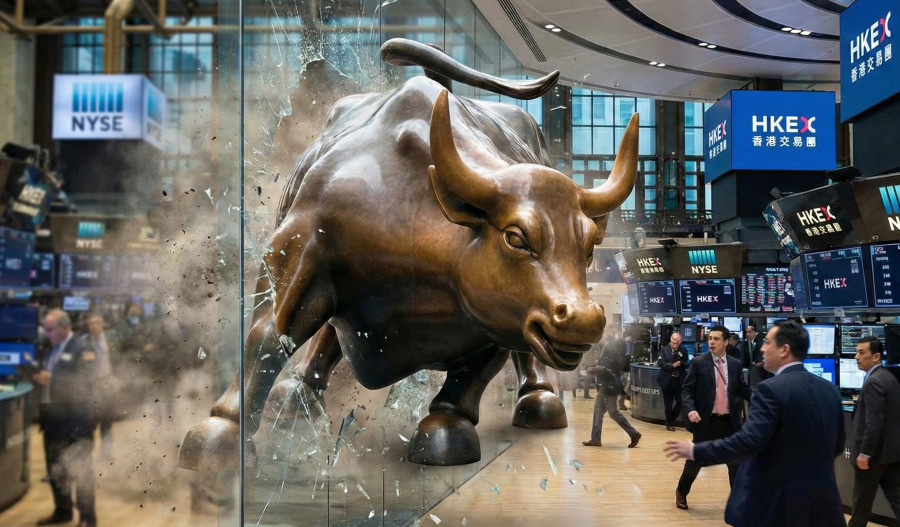

Due to attractive private credit markets – discouraging private companies from going public to raise money – and a surge in high-value mega-mergers and takeovers that are removing blue-chip companies from the exchange faster than new listings can replace them, the value of the ASX is expected to shrink in 2026 for the first time in two decades.
It’s a phenomenon analysts refer to as de-equitisation, which occurs when the total value of shares delisted through these transactions exceeds the capital raised from new initial public offerings (IPOs) and secondary offerings.
Admittedly, there’s no shortage of stocks queuing up to list on the ASX this year.
Trouble is, while many of the new companies entering ASX will be micro-caps, they’re replacing large caps that are progressively being taken out by global suitors.
Big pharma, healthcare and resources
While stock-specific takeover hotspots this year include big pharma and healthcare, along with critical minerals and resources, the following eight potential takeover targets alone would wipe over A$30 billion worth of value off the ASX:
Ramsay Healthcare (ASX: RHC)
Orora (ASX: ORA)
Domino Pizza (ASX: DMP)
IDP Education (ASX: IEL )
IPH (ASX: IPH)
Inghams (ASX: ING)
Reliance Worldwide (ASX: RWC)
Sonic Healthcare (ASX: SHL)
While the value of these above-mentioned stocks ranges from $1 billion to $11.3 billion, in 2025, the average quoted market cap of new listings on the ASX in 2025 was a paltry $255 million per listing.

IPOs stalled in 2025
While 2025 was one of the slowest years on record for IPO activity, the biggest ASX listings in 2025 included over-50s resort living provider Gemlife Communities (ASX: GLF), airline Virgin Australia (ASX: VGN), and the Forrest family-backed gold producer Greatland Resources (ASX: GGP) - all of which are trading well ahead of their issue price.
In 2025, 35 new companies were listed on the ASX, below the 20-year average of 83 listings, but above the 29 listings in 2024 and 32 in 2023.
Last June, ASIC announced that entities listing on the ASX via the fast-track process now have access to a shorter IPO timetable designed to reduce deal execution risk as part of a two-year trial.
It’s understood that ASIC now plans to informally review eligible offer documents two weeks prior to public lodgement, which could reduce the IPO timetable by up to a week.
IPO recovery in 2026
Meanwhile, after a rocky end to share market trading in 2025, Australia’s IPO market appears to be displaying early signs of recovery.
The average value of new stocks coming to market may be relatively small in 2026, but according to HLB Mann Judd’s IPO Watch Report, encouraging signs of recovery as the year progresses point to a potential uplift this year.
According to Simon James, partner at HLB Mann Judd Sydney, there are early indications that 2026 could be stronger than the past three years, when ongoing economic and geopolitical uncertainty resulted in historically low numbers of listings.
“The pipeline remains soft, with just four ASX listings announced so far, but several high-profile names have signalled an intention to float later in the year.”
While major tech names like Canva and Rokt remain the most anticipated IPOs this year, others in the industrial, AI, and consumer sectors are also preparing for potential floats.
Meanwhile, investment bankers and market reports have identified the following major entities preparing for a potential float in the second half of the year:
- Firmus Technologies: An AI infrastructure operator currently valued at approximately $6 billion.
- I-MED Radiology Network: One of Australia's largest medical imaging providers.
- Greencross Vets: A pet wellness and veterinary giant currently held by TPG Capital.
- Home Furniture Group: The owner of major retail brands Amart and Freedom.
- Estia Health: Bain Capital is reportedly weighing the return of this $2 billion aged care provider to the ASX.
Small caps dominate
In a repeat of 2025, small-cap listings are expected to again dominate the market this year.
While the number of small-cap IPOs was up 11% in 2025 compared with 2024, materials was the standout sector, accounting for 63% of all IPOs, up from 45% in 2024, with capital raised of $999 million, followed by real estate ($750 million) and transportation ($685 million).
New listings delivered an average first-day gain of 15% and an average year-end gain of 23%, outperforming the ASX All Ordinaries Index, which rose 7%.
Of the 35 new listings in 2025, 26 recorded a first-day gain; however, only 12 remained above issue price at year-end.
“Despite prolonged softness, we remain positive about the outlook in 2026,” James said.
“IPO activity will not stay subdued indefinitely, and leading businesses will not remain private forever.”