Beijing-based commercial aerospace firm LandSpace is accelerating its capital market strategy, aiming for a listing on the Shanghai STAR Market.
Regulatory filings from the East indicate LandSpace completed its pre-listing "tutoring" process on December 23, marking a significant step toward an IPO that could value the entity at ~US$2.7 billion.
The move comes as the company attempts to operationalise its Zhuque-3 (ZQ-3) reusable rocket, a vehicle explicitly engineered to compete with SpaceX’s Falcon 9 dominance.
LandSpace is targeting high-frequency launch contracts for China’s "Guowang" satellite constellation, a 13,000-satellite network designed to provide global internet coverage.
If the tech company can achieve routine reusability by 2026 as projected, it would become the first non-U.S. entity to operate a commercially viable reusable orbital launch vehicle.

Zhuque-3 and company growth
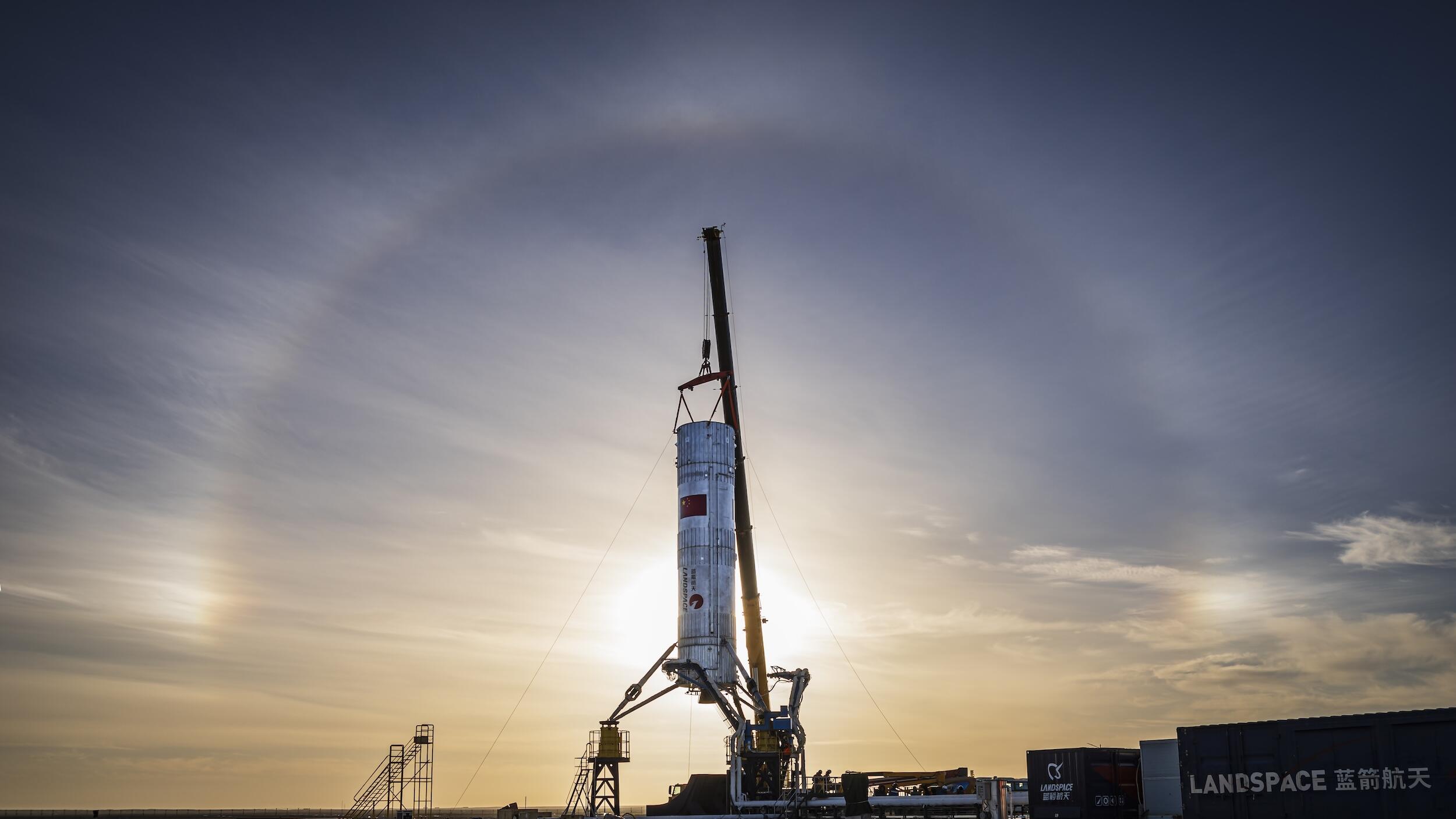
In January 2024, the company successfully completed a vertical takeoff and landing test (VTVL-1) at the Jiuquan Satellite Launch Center.
During that test, the prototype hovered for approximately 60 seconds and reached an altitude of 320 metres before executing a precision touchdown, validating the guidance algorithms used in the recent orbital attempt.
While the mission successfully delivered its second stage and payload into orbit, the first-stage recovery attempt ended in a hard landing.
Despite the recovery failure, the mission generated critical telemetry data for the vehicle’s reusable architecture.
The ZQ-3 features a 4.5m diameter and uses stainless steel tanks and methane-liquid oxygen (methalox) propulsion - a material choice distinct from the Falcon 9’s aluminium-lithium alloy but similar to SpaceX’s Starship.
Even SpaceX CEO Elon Musk has publicly addressed the technical convergence between the two companies.
In October 2025, Musk noted that LandSpace’s approach of applying stainless steel and methalox to a proven vertical-landing architecture gears up to rival the performance metrics of the Falcon 9.
Musk stated on social media that this hybrid design "would enable it to beat Falcon 9" in efficiency, though he maintained that SpaceX’s larger Starship system remained in “another league.”