Australia's annual inflation rate eased in June, although underlying price pressures remained unchanged as housing costs and electricity prices continued to drive inflation.
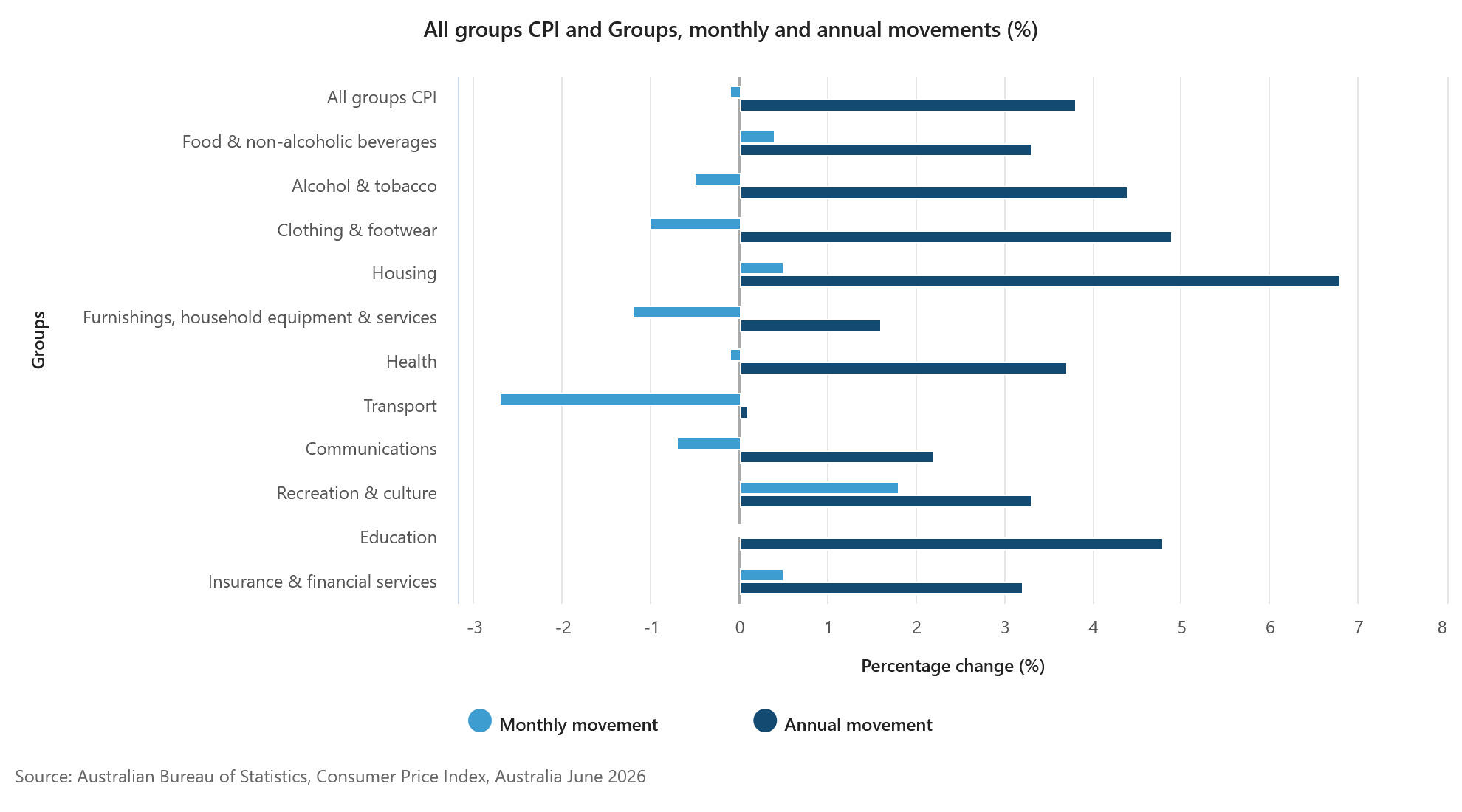
The Consumer Price Index (CPI) rose 3.8% in the 12 months to June 2026, down from 4.0% in May, according to the latest data from the Australian Bureau of Statistics (ABS).
Markets had expected headline inflation to remain steady at 4%.
The trimmed mean inflation rate, the Reserve Bank of Australia's preferred measure of underlying price pressures, remained unchanged at 3.6% in the year to June.
On a monthly basis, the CPI declined 0.1% in both original and seasonally adjusted terms.
Housing was the largest contributor to annual inflation, rising 6.8% over the year, followed by food and non-alcoholic beverages and recreation and culture, both increasing 3.3%.
ABS Head of Price Statistics Rachael McCririck said underlying inflation remained stable after removing the impact of large temporary price movements.
“When we look through some of the bigger price movements, underlying inflation is steady at 3.6 per cent in the 12 months to June 2026. This is the same as in the 12 months to May 2026.”
Housing inflation reflected higher electricity prices and increased costs for new dwellings, with electricity prices rising 22.4% over the year, following the expiry of government rebates that had reduced household energy bills.
New dwelling prices also continued to climb, with annual inflation reaching its highest level in almost three years at 5.8%, driven by builders passing on higher material and labour costs.
“Annual inflation for New dwellings has reached its highest level in almost three years, at 5.8 per cent. This was driven by builders passing on higher material and labour costs,” Ms McCririck added.

Recreation and culture inflation accelerated to 3.3% in the year to June, up from 2.4% in May.
Holiday travel and accommodation prices increased 4.6% during June as demand increased with the start of the northern hemisphere's peak travel season and higher jet fuel prices.
“Prices for Holiday travel and accommodation rose 4.6 per cent in June driven by more travel to the northern hemisphere with the start of their peak tourist season and higher jet fuel prices.”
Transport inflation moderated sharply, rising just 0.1% annually in June, down from 3.3% in May.
The slowdown was driven by falling automotive fuel prices, which declined for three consecutive months between April and June.
“Lower world oil prices as a result of some stabilisation in the Middle East in June contributed to fuel prices falling 10.9 per cent in the month,” Ms McCririck said.
“The federal government’s fuel excise relief measures which contributed to lower Automotive fuel prices in April and May, also remained in place.”
The ABS also released quarterly inflation figures for the June quarter of 2026.
The quarterly CPI increased 0.6%, while the trimmed mean measure rose 0.8% on the pre-October 2025 basis.
The data will be closely watched by the Reserve Bank of Australia as policymakers assess whether inflation is continuing to move towards its target range.