
The United States trade deficit widened sharply in May as record capital goods imports and resilient consumer demand pushed imports to their highest level in more than a year, signalling that trade is likely to remain a drag on second-quarter economic growth.
The Commerce Department's Bureau of Economic Analysis and Census Bureau reported on Tuesday that the trade gap jumped 42.2% to $77.6 billion, the widest deficit since March 2025.
Markets had expected a deficit of $78.5 billion.
Imports rose 3.3% to $395.3 billion, the highest level since March 2025, supported in part by a stronger U.S. dollar, which also contributed to higher import prices.
Goods imports climbed 4.0% to $317.0 billion, the strongest reading since April 2025, when businesses accelerated purchases ahead of President Donald Trump's tariff increases.
Exports fell 3.2% to $317.7 billion as the stronger dollar reduced the competitiveness of U.S.-made goods overseas. Goods exports declined 5.1% to $210.6 billion, led by a $3.5 billion drop in capital goods shipments, including computers and computer accessories.
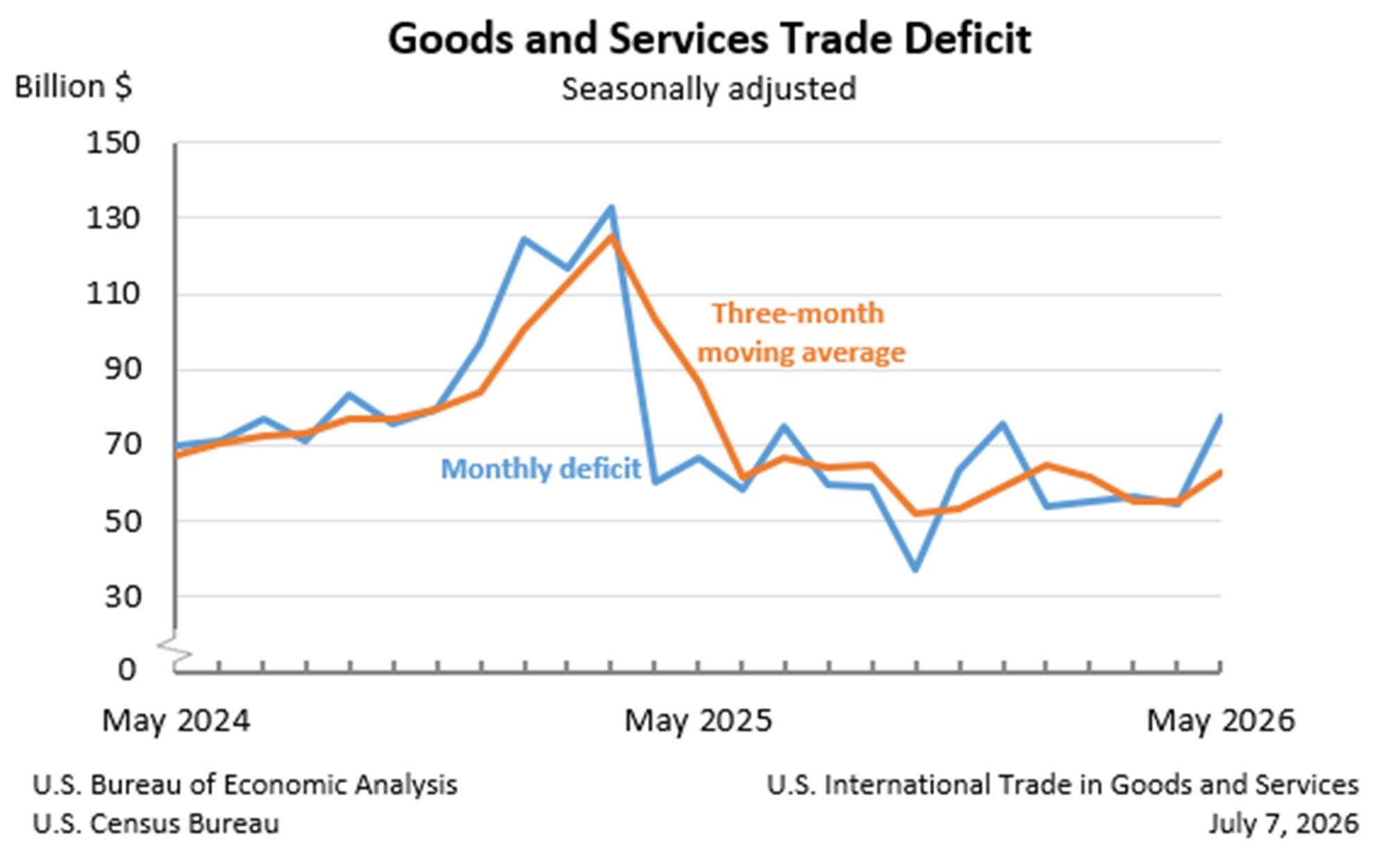
The widening deficit also reflected businesses increasing purchases to avoid potential supply disruptions linked to the Middle East conflict and the prospect of additional tariffs. Overall imports reached a 14-month high.
The U.S.-Israeli conflict with Iran also boosted energy exports, with petroleum shipments rising to a record high.
Although stronger imports are expected to weigh on gross domestic product (GDP) growth, they also highlight resilient domestic demand and continued investment in artificial intelligence infrastructure.
ANZ analysts said in a note to clients:
"Weakness in exports was concentrated in non-monetary gold and other precious metals. While capital goods imports tied to the AI-investment boom remained a significant contributor, strength in imports broadened in May.
"Consumer goods rose USD3.5bn, industrial supplies and materials rose USD3.1bn, mostly tied to crude imports, while autos rose USD2.2bn. The recent strength in imports, which have picked up sharply in the first five months of the year, is likely a reflection of the normalisation in orders following last year’s pre-tariff frontloading, and there may be a renewed element of that with current tariffs implemented through Section 122 of the Trade Act set to expire on 24 July.
"Trump Administration officials have signalled these measures will be replaced to return to the prior tariff regime. Stepping back from the volatility, the strength of the AI investment boom is clearly evident in the trade data.
"As of May, the trade deficit in computers, peripherals and semiconductors stood at USD44.1bn, accounting for around 57% of the overall trade deficit, and growing."

Although the U.S. Supreme Court struck down the tariffs earlier this year, the White House subsequently introduced a global duty, with new Section 301 tariffs also under consideration.
Trump has defended tariffs as a necessary measure to reduce the trade deficit and revive domestic manufacturing.
Capital goods imports increased by $1.1 billion to a record $128.0 billion, driven by strong demand for computer accessories and semiconductors despite a $3.4 billion decline in computer imports.
Businesses continue to invest heavily in AI infrastructure, much of which relies on imported components.
Imports of civilian aircraft and parts, generators, industrial engines and related equipment also increased.
Industrial supplies and materials imports rose $3.1 billion, including a $1.5 billion increase in crude oil imports.
Consumer goods imports climbed $3.5 billion, led by pharmaceutical products, mobile phones and household goods, pointing to a likely rebound in consumer spending after a subdued first quarter.
Imports of motor vehicles, parts and engines rose $2.2 billion, largely reflecting passenger cars, while imports of other goods increased $1.4 billion to a record $15.3 billion.
On the export side, consumer goods shipments fell $2.1 billion as pharmaceutical exports declined.
Exports of industrial supplies and materials dropped $5.5 billion, mainly reflecting lower shipments of non-monetary gold and other precious metals, which are excluded from GDP calculations.
Natural gas exports fell $1.1 billion, though crude oil exports increased $2.0 billion, lifting petroleum exports to a record $38.4 billion.
The United States remains a net exporter of oil.
Trade has now subtracted from U.S. economic growth for two consecutive quarters. The Atlanta Federal Reserve's GDPNow model is currently forecasting annualised GDP growth of 1.4% for the second quarter, following growth of 2.1% in the January-March period.
The United States continued to record goods trade deficits with countries including Vietnam, Mexico, Taiwan, China, Canada, Germany, South Korea, India and Ireland despite Trump's tariff measures.
The United States recorded goods trade surpluses with several countries, including the Netherlands, Hong Kong, Australia, the United Kingdom and Brazil.