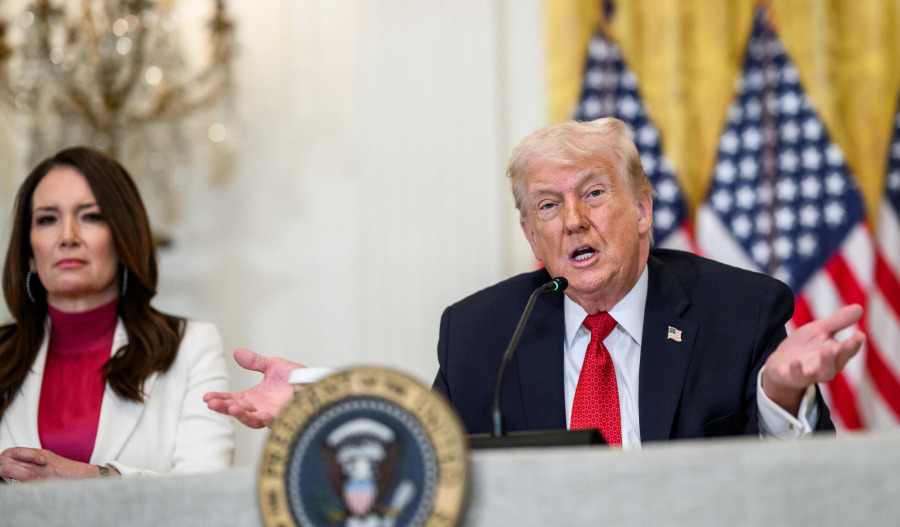

United States sharemarkets closed sharply lower on Tuesday (Wednesday AEDT) as escalating rhetoric from President Donald Trump over Greenland rattled investor confidence and fuelled concerns over a widening trade dispute with key allies.
The Dow Jones Industrial Average fell 870.7 points or 1.8% to 48,488.6, while the S&P 500 declined 143.1 points or 2.1% to 6,796.9. The Nasdaq Composite led losses, sliding 561.1 points or 2.4% to 22,954.3.
Market volatility surged during the session, with the Cboe Volatility Index (VIX), often referred to as Wall Street’s “fear gauge”, climbing to an intraday high of 20.69 - its highest level since 25 November.
The sell-off followed a series of tariff threats from Trump, who over the weekend warned that eight NATO members would face escalating tariffs on their U.S. exports unless they supported the “Complete and Total purchase of Greenland” by the United States.
In a post on Truth Social, Trump said tariffs would begin at 10% on 1 February and rise to 25% by 1 June if no agreement was reached.
Trump later broadened his warnings, threatening to impose 200% tariffs on French wines and champagne amid reports that French President Emmanuel Macron was unwilling to join his proposed Board of Peace.
He also criticised the United Kingdom over plans to transfer sovereignty of the Chagos Islands to Mauritius, describing the move as an “act of great stupidity”.
According to Trump, the decision was “another in a very long line of National Security reasons why Greenland has to be acquired”.

European leaders have condemned the latest tariff threats as unacceptable and are reportedly weighing countermeasures.
France is said to be urging the European Union to consider deploying its most powerful trade defence mechanism, the so-called Anti-Coercion Instrument.
Trump, who is due to address the Davos forum on Wednesday, said he had agreed to meet European leaders at the conference to discuss his Greenland ambitions.
U.S. Treasury Secretary Scott Bessent defended the administration’s stance in an interview with CNBC, arguing that acquiring Greenland could reduce future geopolitical risks.
“That will stop any kind of a kinetic war, so why not preempt the problem before it starts?” Bessent said.
Bond markets reflected the growing unease, with U.S. Treasury yields rising and the U.S. dollar weakening as investors reduced exposure to American assets.
Danish pension fund AkademikerPension also said on Tuesday it was exiting US Treasurys, citing concerns over the sustainability of U.S. government debt.
The yield on the US 10-year Treasury rose 1.6% to 4.295%, while the 2-year yield edged up 0.1% to 3.599%.