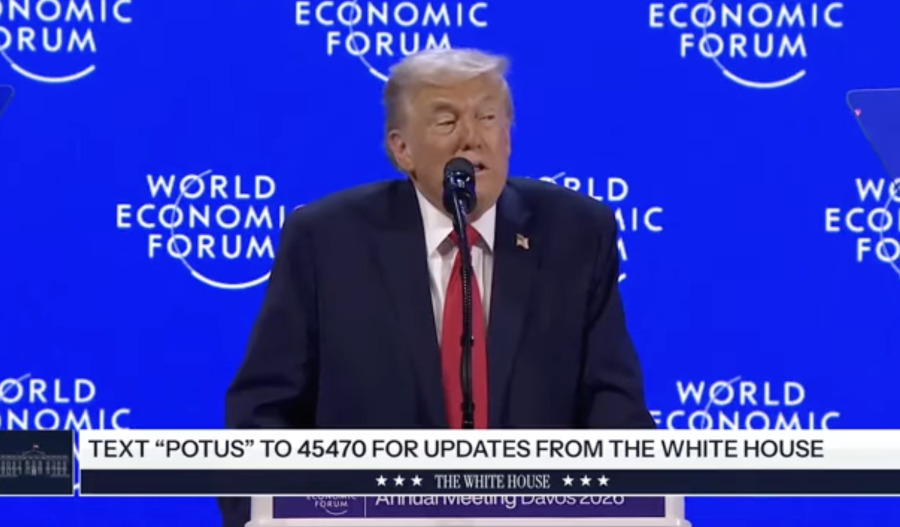
United States President Donald Trump went to Davos with a familiar sales pitch: brassy slogans, sweeping claims and a mountain of numbers designed to sound transformative. Standing before the world’s corporate elite, he boasted about his so-called “big beautiful bill” and declared an economic miracle powered by tax cuts, tariffs and American muscle.
But strip away the branding, and what’s left is not a revolution in prosperity—it’s a risky, expensive experiment built on half-truths and wishful thinking.
Trump is trying to sell the idea that America can cut trillions in taxes, bully global trade partners with tariffs, strong-arm central bankers, and somehow emerge richer, cheaper and more stable all at once.
It’s a fantasy that plays well on stage but collapses in broad daylight.
Start with the headline promise Trump loves to repeat: “no tax on tips, no tax on overtime, no tax on Social Security.”
However, these measures are temporary, limited and heavily caveated.
They don’t erase taxes outright; they offer deductions that phase out for higher earners and do nothing for workers who already owe little or no federal income tax.
In other words, millions of low-income Americans hear “no tax” and get nothing, and even for those who qualify, the benefits are narrow.
As a case in point, only certain tips count, and only the overtime premium (not regular wages) applies.
Everything must be formally reported, which excludes the very workers Trump claims to champion.
Meanwhile, these breaks expire after a few years, leaving behind a much larger hole in federal revenue.
According to independent estimates, the bill drains roughly US$5 trillion from government coffers over a decade.
To put a fine point on it, that money doesn’t vanish; it becomes debt.
Trump wants to slash corporate taxes to 15% while raising tariffs on companies that manufacture abroad.
He frames it as a clever “carrot and stick,” but tariffs are not paid by foreign countries; they’re paid by American importers and, ultimately, consumers.
Higher prices are not a side effect; they’re the mechanism, and the contradiction is hard to overlook.
Trump claims tariffs will defeat inflation, despite economists across the spectrum warning they are inflationary by design.
He promises lower interest rates, even though ballooning deficits push borrowing costs higher.
He boasts about reviving manufacturing, despite data showing factory spending falling and manufacturing jobs shrinking since his tariff announcements.
Then there’s energy.
Trump insists that more oil drilling will magically lower prices worldwide.
In reality, the U.S. is already producing oil at record levels, global demand is weak, and energy companies are not lining up to drill more.
Even his claim that cheaper oil would instantly end the war in Ukraine reads less like policy and more like bravado untethered from geopolitics.
At Davos, Trump also floated the idea of allowing homeowners to depreciate their primary residences for tax purposes.
It was presented as a populist fix to an unfair system; however, in practice, it would overwhelmingly benefit wealthier homeowners, complicate the tax code further, and trigger clawbacks when properties are sold.
In other words, it remains a talking point, not a plan.
Throughout the speech, Trump declared victory over inflation, claimed trillions in investment commitments, and dismissed critics as permanently wrong.
But confidence is not competence, and repetition is not evidence.
The uncomfortable truth is that Trump’s economic agenda relies on the hope that reality will bend to rhetoric—and that voters won’t notice the gaps.