
The Chinese tech giant has embedded an open-source AI agent inside the world's most-used messaging app - and it is not the only one racing to do so.
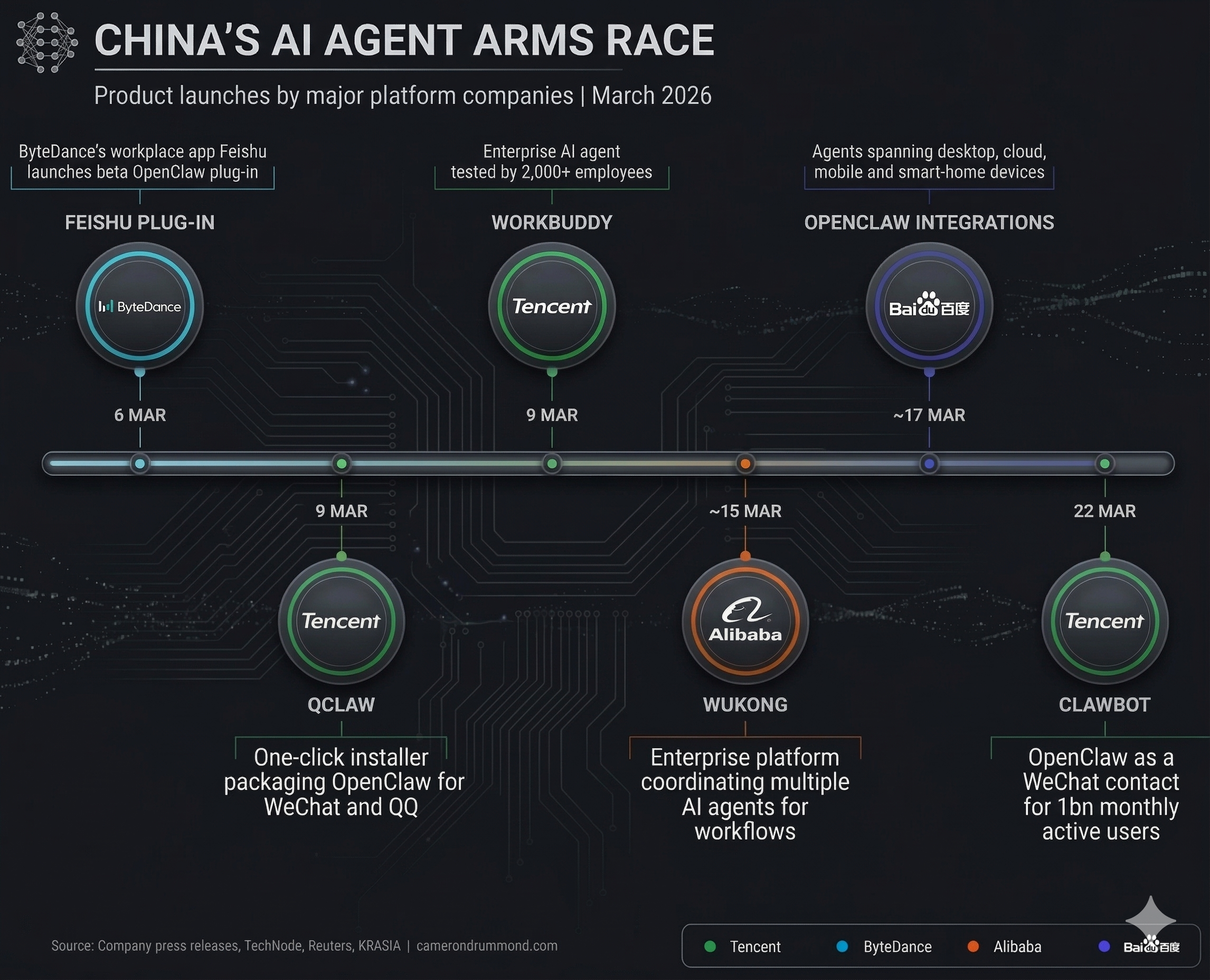
Tencent on Sunday launched ClawBot, a tool that surfaces the open-source AI agent OpenClaw as an ordinary contact inside WeChat, where more than one billion monthly active users can send natural language commands to trigger tasks like file transfers and email management.
The launch extends an intensifying contest among China's largest technology companies to control the distribution layer for AI agents, a category the industry now treats as commercially larger than chatbots.
From hobby project to arms race
OpenClaw began life in November 2025 as "Clawdbot", a project by Austrian developer Peter Steinberger derived from a personal AI assistant he had built and playfully named after Anthropic's Claude.
A trademark complaint from Anthropic triggered two rapid renamings - first to "Moltbot," then to OpenClaw in late January 2026 - each generating fresh press coverage.
Crypto scammers hijacking the abandoned social handles within seconds of each rebrand only added to the publicity, accelerating the project's viral growth.
By early March, the repository had amassed 247,000 GitHub stars, and Steinberger announced he was joining OpenAI with the codebase transitioning to an independent foundation.

Tencent's triple play
ClawBot extends a product offensive Tencent launched on 9 March, when the Shenzhen-based group began testing QClaw, a one-click installer packaging OpenClaw for WeChat and QQ, alongside WorkBuddy, an enterprise agent pre-tested by more than 2,000 non-technical staff.
A third product, Lighthouse, provides cloud infrastructure for developers deploying agent integrations at scale across Tencent's ecosystem.
Analysts view the suite as a deliberate test-and-learn phase before Tencent embeds a native agent directly into WeChat's core architecture, a step CEO Pony Ma has urged caution on.
Everybody wants a lobster
Alibaba launched Wukong last week, an enterprise platform coordinating multiple AI agents for complex workflows, while Baidu deployed OpenClaw-based agents spanning desktop software, cloud services and smart-home devices.
ByteDance's workplace app Feishu has been running daily OpenClaw tutorials since early March and released a beta plug-in alongside a significant boost to its free API call limit.
That commercial enthusiasm runs into mounting regulatory pushback - Chinese authorities restricted state-run enterprises and government agencies from installing OpenClaw on office devices over security concerns.
The cybersecurity coordination centre CNCERT, flagged the agent's vulnerability to prompt injection attacks and its requirement for high-level system permissions in a second public warning.
And Gartner separately described OpenClaw as an "unacceptable cybersecurity risk" for business users in a February assessment.
Yet while Beijing is simultaneously banning OpenClaw from government computers, it's subsidising its uptake at the municipal level - Shenzhen's Longgang district was reported to be offering subsidies of up to 2 million yuan (US$289,000) for OpenClaw-based application development earlier this month.