

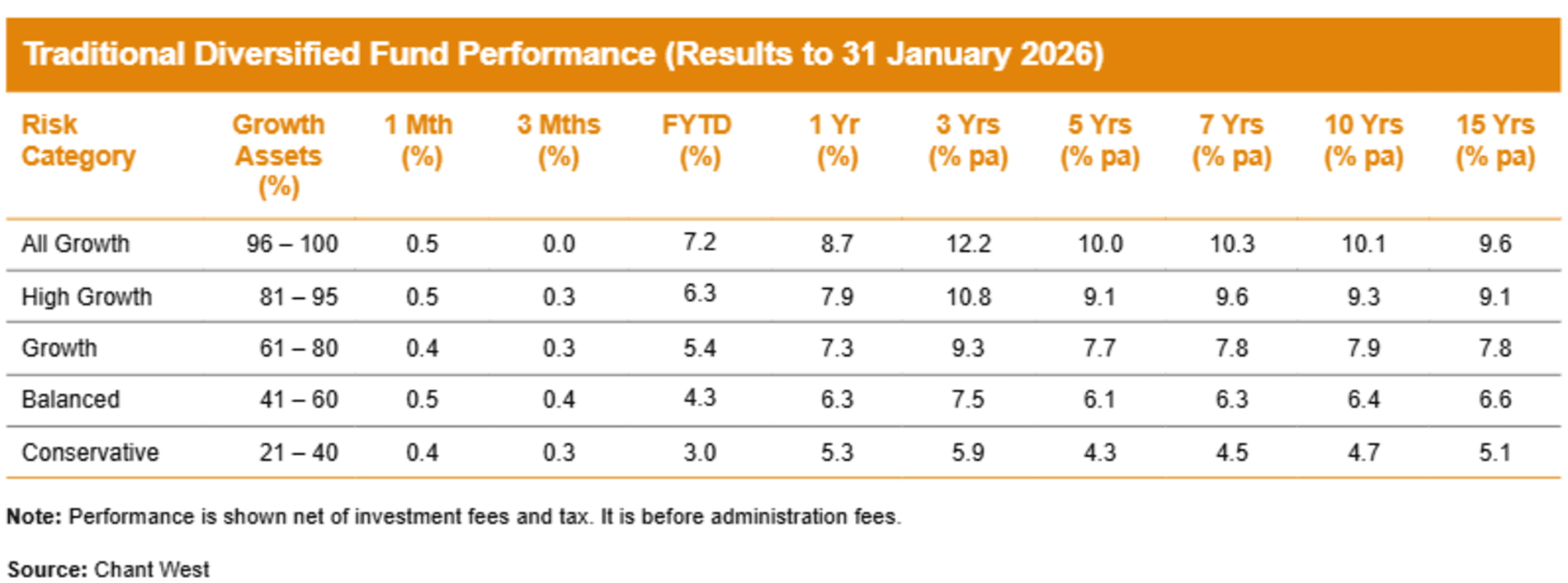
Superannuation investments defied market volatility to deliver a return of 0.4% from median growth funds in January, according to Chant West.
This lifted the return over the first seven months of the financial year to 5.4%, the research, data and analytics provider said in a media release.
“During the month, we saw heightened geopolitical risks including U.S. military action in Venezuela and renewed tariff threats against Europe in relation to Greenland, which were subsequently withdrawn,” Head of Superannuation Investment Research Mano Mohankumar said.
“However, markets focused on the global economic backdrop that still remains positive and expectations of continued earnings growth.”
The returns from all growth, high growth and balanced funds was 0.5% in the first month of the calendar year, raising the financial-year-to-date returns to 7.2%, 6.3% and 4.3%, while the one-month and seven-month returns from conservative funds were 0.4% and 3.0%.
International developed shares rose 1.7% in hedged terms in January, but the sharp appreciation of the Australian dollar against the U.S. dollar turned that into a loss of 2.7% in unhedged terms.

On average, super funds have about 70% of their international shares exposure unhedged.
Emerging markets returned 3.6% in unhedged terms, Australian shares rose 1.7%, while Australian and international bonds gained 0.2%.
Median growth funds (those with 61% to 80% in growth assets) delivered a return of 9.3% in the 2025 calendar year.
Mohankumar said since the introduction of compulsory super in July 1992 the median growth fund had returned 8% a year, more than the annual inflation rate and giving a real return of 5.3%, well above the typical 3.5% target.
“Even looking at the past 20 years, which includes three major share market downturns – the GFC (global financial crisis) in 2007-2009, COVID-19 in 2020, and the high inflation and rising interest rates in 2022 – super funds have returned 6.8% p.a., which is still well ahead of the typical objective,” he said.