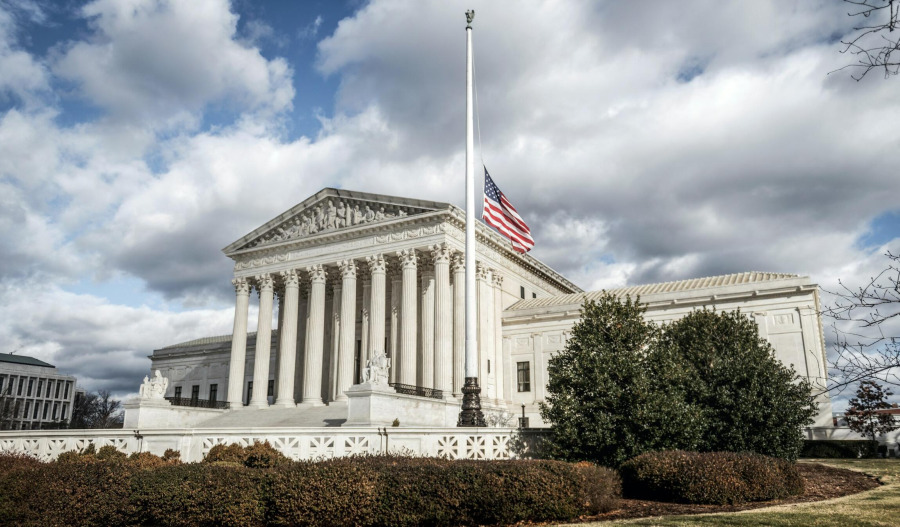

While markets were hoping the United States Supreme Court would draw a line under President Donald Trump’s tariff experiment, it has torn up the rule book and left bond traders, currency desks and policymakers guessing what comes next.
The court ruled that Trump overreached by using the International Emergency Economic Powers Act - a law designed for national emergencies - to impose sweeping tariffs.
In plain English, it said taxing imports is Congress’s job, not the President’s, yet it stopped short of clarifying whether the roughly US$170 billion already collected must be refunded.

That omission has created a lot of uncertainty.
If businesses successfully sue for refunds, Washington faces a funding gap at a time when deficits are already running red hot.
The U.S. government spends more than it collects annually, and it plugs the deficit by issuing bonds - aka Treasuries - to investors.
More bonds mean more supply, and greater supply typically means higher yields, which are simply the interest rates the government pays to borrow.
The White House responded within hours, pivoting to Section 122 of the 1974 Trade Act.
That provision allows a temporary tariff — up to 15% for 150 days — without congressional approval.
Trump promptly lifted his proposed across-the-board rate from 10 to 15%.
So what we witnessed was a legal defeat followed by a tactical reset, and markets are left to decide which matters most.
In the short term, the replacement tariff is lower than some feared.
That could trim near-term inflation pressures.
Bond traders initially focused on that. U.S. 10-year yields hovered around 4.1%, well below last year’s peaks above 4.5%.
The yield curve - the gap between short and long-term rates - has steepened as short rates fall on expectations that the Federal Reserve will cut.
A steepening curve often signals that investors expect stronger growth or higher inflation ahead.
But that’s only half the story.
If tariff revenues are clawed back, the Treasury may need to issue more debt.
Add to that ongoing quantitative tightening, and the marginal buyer of U.S. debt demands a better return.
This is where the complacency looks misplaced.
The Congressional Budget Office had pencilled in roughly $300 billion a year in tariff revenue over the next decade.
Strip some of that out, and the arithmetic deteriorates quickly.
Even if refunds are staggered through the courts, uncertainty alone can widen the extra return investors demand for holding U.S. assets.
The U.S. dollar has already shown strain, slipping against traditional havens such as the yen and Swiss franc.
Since the start of Trump’s second term, it has shed ground against the euro.
For Australia, the ripple effects are immediate.
The ASX 200 fell 0.6% on Monday, with banks and tech stocks under pressure.
Gold miners rallied as bullion prices climbed and the Australian dollar steadied around US70.7¢, caught between weaker U.S. sentiment and our own exposure to global trade.
There’s a temptation to view the court’s intervention as a triumph of checks and balances, but investors do not trade civics lessons; they trade cash flows and confidence.
The larger risk is not that tariffs disappear, it’s that they persist in a more fragmented, legally contested form.
Section 122 lasts 150 days, and after that, the administration can lean on other statutes, such as Section 301 or 232, to target specific sectors.
In other words, the trade war morphs rather than ends.
For U.S. consumers and businesses, that means the effective tariff rate - the actual average tax paid on imports - remains elevated.
Back home, policymakers would be wise to assume volatility rather than resolution.
Our export base - iron ore, LNG, agriculture - depends on stable global demand, and if the U.S. fiscal position worsens and bond yields climb, global financing costs follow.
The bond market is often described as the adult in the room, but right now, it's watching Washington with a raised eyebrow.
Relief? Well, not exactly.
The court has not removed uncertainty; it has redistributed it from trade policy to fiscal reckoning.