Nvidia's chief executive has confirmed China is part of the company's US$200 billion CPU market projection, even as export restrictions have prevented a single H200 chip from reaching a Chinese customer.
Jensen Huang arrived at Taipei's Songshan Airport on Saturday ahead of next month's Computex trade show and a scheduled meeting with TSMC chairman C.C. Wei.
The meeting is focused on securing production allocation commitments for the Vera Rubin platform, which combines Nvidia's Vera CPU and Rubin GPU architectures.
During Nvidia's 20 May earnings call, Huang described Vera as the "world's first CPU, purpose-built for agentic AI", adding that the company has already recorded US$20 billion (A$28.09 billion) in standalone Vera CPU sales this year.
Huang told analysts the Vera CPU gives Nvidia access to a $200 billion market it had not previously contested - and when reporters in Taipei asked whether that projection included China, he said: "I would think so."
Roughly 10 Chinese firms have been cleared to purchase the H200, but not a single chip has been delivered, and President Trump's talks with Chinese President Xi Jinping in Beijing earlier this month produced no breakthrough on Nvidia chip sales.
The H200 was conditionally licensed for approved Chinese buyers in late 2025, while the Blackwell-generation B200 remains fully prohibited.
The week also brought fresh enforcement action on chip smuggling.

Taiwan's Keelung District Prosecutors' Office executed its first formal criminal action against illegal AI chip exports on 21 May, citing document forgery and fraudulent customs declarations.
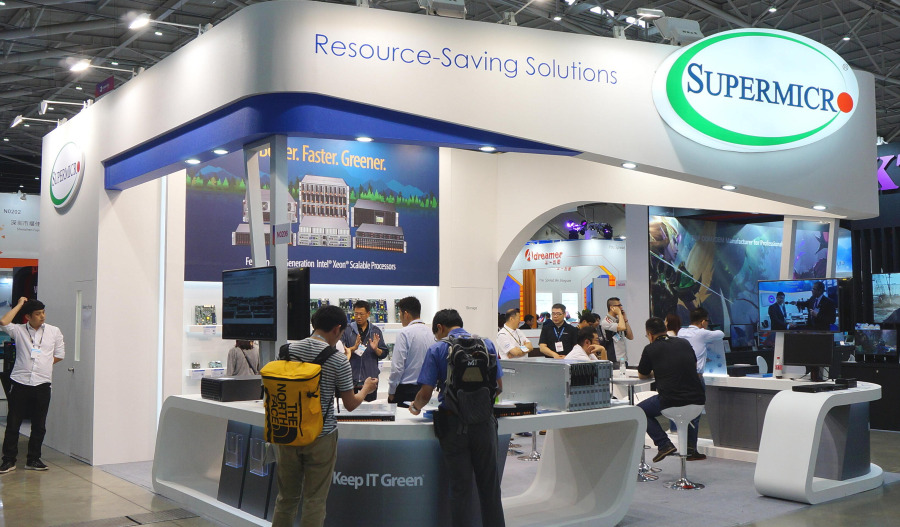
In March, the U.S. Justice Department charged three people affiliated with Super Micro - including co-founder Wally Liaw - with conspiring to sell $2.5 billion in servers through a Southeast Asian pass-through company, which repackaged and shipped more than $510 million worth of Nvidia-chip-containing servers to China in violation of export controls.
Huang addressed the case directly in Taipei, saying Nvidia was "very rigorous" in explaining laws and regulations to partners and required compliance with all applicable rules.
"Ultimately, Super Micro has to run their own company," Nvidia CEO Jensen Huang said.
"I hope that they will enhance and improve their regulation compliance and avoid that from happening in the future."
Chinese AI chip production currently sits at roughly 1-2% of U.S.-equivalent scale, according to Centre for Strategic and International Studies estimates, with domestic alternatives constrained by U.S. restrictions on lithography equipment from ASML and other suppliers.
On the manufacturing side, TSMC's CoWoS advanced packaging capacity remains oversubscribed, and Nvidia has reportedly pre-committed more than half of available capacity through 2027.
Huang is scheduled to deliver a Computex keynote on 1 June.