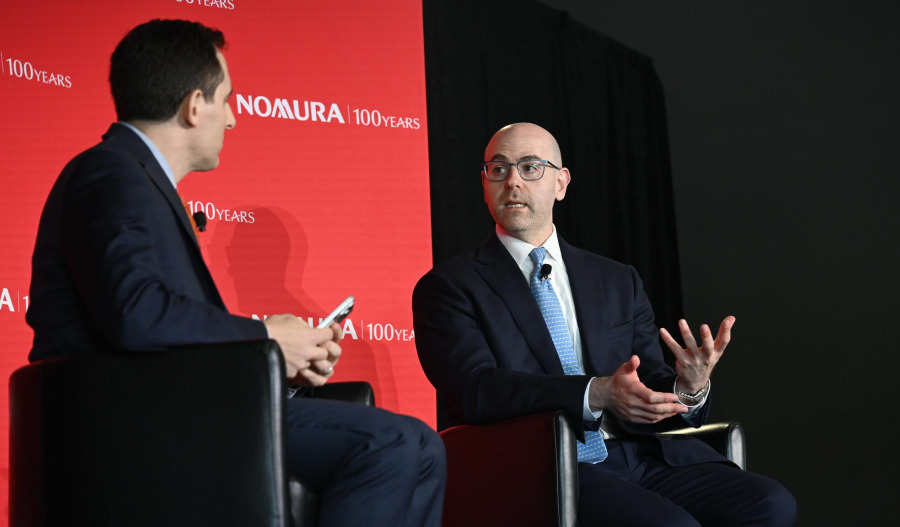
New York Federal Reserve President John Williams said the United States central bank’s recent interest rate cut has left monetary policy in a strong position heading into 2026, maintaining confidence that inflation pressures will continue to moderate while the labour market cools gradually.
Speaking on Monday after the Federal Reserve lowered its benchmark overnight rate by 25 basis points to a 3.50%–3.75% range on 10 December, Williams said the decision struck the right balance between inflation risks and growing softness in employment conditions.
“Monetary policy is well positioned as we head into 2026,” Williams said at an event hosted by the New Jersey Bankers Association in Jersey City.
With the recent easing, the rate-setting Federal Open Market Committee “has moved the modestly restrictive stance of monetary policy toward neutral”.
Williams stressed that returning inflation to the Fed’s 2% target remains critical, but not at the expense of the labour market.
Balancing inflation risks and a cooling labour market
“It is imperative that we restore inflation to our 2% longer-run goal on a sustained basis," he said, adding: “My assessment is that in recent months, the downside risks to employment have increased as the labour market has cooled, while the upside risks to inflation have lessened somewhat.”
Looking ahead to the 27–28 January meeting, Williams said policymakers would remain data-dependent.
The comments were Williams’ first since the December rate cut, which was aimed at balancing rising risks to the labour market against inflation that remains above the Fed’s target.
He also noted that tariffs have had a smaller impact on prices than he had anticipated, saying they appeared to have led to one-off increases rather than persistent inflation.
The full effect of tariffs on prices “will be fully realised in 2026”, Williams said, adding that inflation is expected to moderate to 2.5% next year and to 2% in 2027.
On the labour market, Williams said he expects the unemployment rate to rise to 4.5% this year before easing in the coming years, supported by growth of around 2.25% next year.
“The labour market is clearly cooling, I should emphasise that this has been an ongoing, gradual process, without signs of a sharp rise in layoffs or other indications of rapid deterioration,” he said.
Williams also flagged elevated asset prices, telling reporters that market “valuations are elevated, in a way, if you look at standard measures,” while adding that “stock market wealth is one factor that will boost growth next year”.
He also addressed the Fed’s announcement of reserve management asset buying, which involves purchasing Treasury bills to rebuild liquidity in the financial system.
While the Fed has described the move as technical, some observers have likened it to stimulus.
“This is the natural next step in the implementation of our ample reserves framework to ensure effective interest rate control,” Williams said, adding that he expects banks to make active use of the Fed’s Standing Repo Facility when liquidity is needed.

Miran challenges inflation narrative, dissents on size of cut
Meanwhile, separate remarks on Monday from Federal Reserve Governor Stephen Miran underscored divisions over inflation and the appropriate pace of rate cuts.
Miran said current above-target inflation does not reflect underlying supply and demand conditions, arguing that price pressures are already much closer to the Fed’s 2% goal.
“Prices are now once again stable,” Miran said, even as the Fed’s preferred inflation gauge recently showed annual inflation running at 2.8%.
He said shelter inflation is backward-looking and fails to capture the ongoing slowdown in rent increases, while other components, such as portfolio management fees linked to elevated asset prices, distort the true inflation picture.
“Excess measured inflation is unreflective of current supply–demand dynamics. Shelter inflation is indicative of a supply–demand imbalance that occurred as much as two to four years ago, not today,” Miran said.
“Given monetary policy lags, we need to make policy for 2027, not 2022.”
Stripping out those factors, Miran said “underlying inflation is running below 2.3%, within noise of our target”, warning that keeping policy too tight risks unnecessary job losses.
Miran dissented at last week’s decision, favouring a larger 50 basis point cut, marking his third dissent since joining the Fed in September while on leave as a senior adviser to President Donald Trump.
Two other Fed officials dissented in the opposite direction, arguing against any rate cut because inflation has yet to make sufficient progress towards the target, a concern some policymakers have linked to goods price increases associated with U.S. import tariffs.
Miran said he does not yet have a full explanation for why goods inflation remains elevated and acknowledged uncertainty around the current drivers of price pressures.
“I accept I don’t know what’s driving higher goods inflation currently,” he said, while allowing the unsavoury possibility that inflation could be settling in at a higher level than before the pandemic.
Despite that risk, Miran said policy should reflect the reality that inflation has stabilised. “American families are still rightly distraught” and “unhappy with affordability”, he said. But, “prices are now once again stable, albeit at higher levels. Policy should reflect that.”