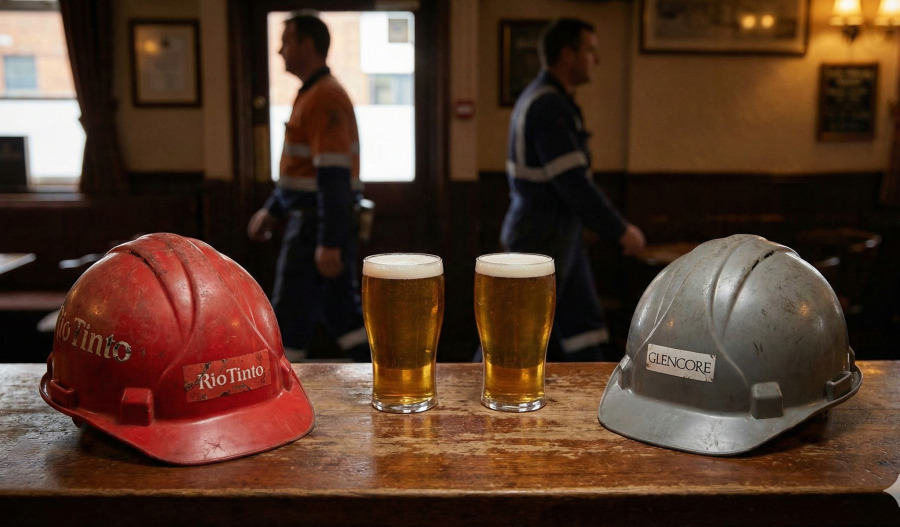
Staring at the embers of a failed marriage with long-term suitor, Glencore (GLNCY), has given recently appointed CEO of Rio Tinto (ASX: RIO) Siom Trott time to reflect on what’s in store for Australia’s second largest miner.
While potential nuptials between Glencore and Rio were always framed as a merger, the market never saw it as anything but a takeover, with Rio’s market cap being more than double that of its Switzerland-based counterpart.
Having seemingly moved on from its unrequited romance with Glencore – which Trott worked so hard to get over the line - Rio has pivoted towards a stronger, sharper, simpler solo strategy, and for this - most of the market appears truly grateful.
While Glencore CEO Gary Nagle appears to want to keep the door open for a future Rio Tinto merger, that doesn’t appear to be something investors – sceptical about the value of a Glencore merger from the start - or Rio management are now willing to entertain right now.
Since both companies confirmed on 5 February that weeks of negotiations had collapsed – with plans for a potential US$260 billion mining giant shattered – Rio’s share price rose to a record high of $170.19 on 13 February.
While Rio remains open to acquisitions, it has shifted its focus toward disciplined, value-driven growth, and is prioritising assets essential for the energy transition, particularly copper, lithium, and low-carbon aluminium.
More specifically, Rio is doubling down on its copper portfolio, with a target to produce 1 million tonnes by 2030.
Key projects include the ramp-up of Oyu Tolgoi in Mongolia and advancing the Winu project in WA.
To fund additional selective, mid-tier acquisitions in the copper sector - rather than another mega-merger - Rio has flagged plans to offload between US$5–$10 billion in non-core assets, with titanium dioxide, borates, and legacy iron ore high on its disposal list.
Copper aside, Rio is also accelerating lithium projects like Rincon in Argentina and Salares Altoandinos in Chile to capitalise on growing electric vehicle (EV) demand.
However, while a lot has been written about the future of iron ore and the fate of the Pilbara, Rio has made it clear it’s not looking to exit iron ore.
Despite the failed merger with Glencore, Rio remains the world's largest iron ore producer and continues to progress the Simandou project in Guinea, with expected sales of 5–10 million tonnes in 2026.
Underpinning Rio’s plans for a cleaner balance sheet is its commitment to return 40–60% of free cash flow to shareholders while keeping annual capex capped at US$10 billion or under.
Revelations that the Glencore merger was dead in the water were followed by Rio’s shock FY25 update.
Rio’s underlying earnings were in line with analyst estimates at US$10.9 billion, while underlying EBITDA, rose 9% to $25.4 billion.
But the miner reported that net profit had fallen 14% to $9.97 billion, with the weakest result since 2020 being attributed to weaker iron ore prices and rising operational costs in Australia.
To put rising costs in context, in 2018, each tonne of iron ore produced by Rio in WA cost $13.30, but those costs have since soared to $23.50 a tonne in 2025.
After witnessing Rio take a scalpel to the senior management line-up, investors now want to see a renewed focus on cost-cutting and improving productivity, especially within the Australian iron ore division, where the cost of mining iron ore could rise by a further 6% in the year ahead.
While prices for Rio’s most important export, iron ore, were 6% lower in the year, they were offset by a 17% increase in prices for aluminium and an 8% rise in copper.
Meantime, while iron ore provided 56% of Rio’s underlying earnings, copper provided around a quarter.
What may have irked many investors is that rival BHP (ASX: BHP) recently celebrated a milestone of more than half its EBITDA coming from copper alone.
Also embedded within yesterday’s result were revelations that the Mongolian government has accused its Oyu Tolgoi of underpaying taxes.
Given that it will be a top-five global copper producer after future planned expansion, the Oyu Tolgoi copper mine – of which Rio owns 66% - is one of Rio’s most important growth assets.
While Rio offered to settle that dispute last year for $295 million, it’s understood that Mongolia had asked for an additional $440 million of primary tax, interest and penalties relating to 2021 and 2022.