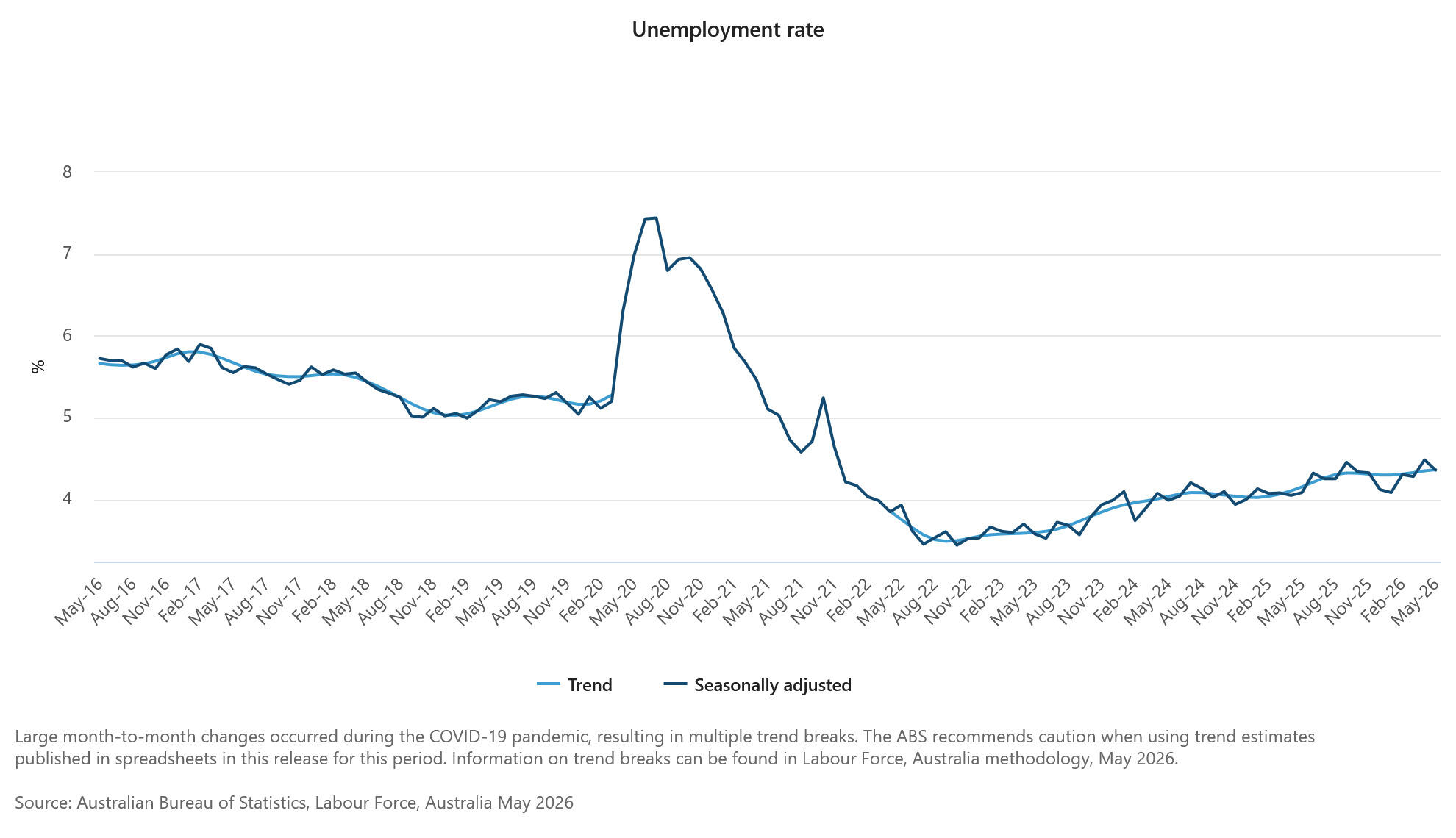
The seasonally adjusted unemployment rate in Australia fell to 4.4% in May, according to the latest data from the Australian Bureau of Statistics (ABS), easing slightly from 4.5% recorded in the previous month.
ABS head of labour statistics Sean Crick said the increase in employment reflected a backlog of jobseekers entering the workforce.
“Over the past few months, we have recorded higher proportions of unemployed people waiting to start jobs who then remained unemployed in the following month.
“The backlog of people waiting to start a job has eased in May, contributing to the 40,000 rise in employment and 18,000 fall in unemployed persons.”
Employment rose by 40,300 people to 14,738,800 in seasonally adjusted terms.
Full-time employment increased by 5,200 to 10,140,800, while part-time employment rose by 35,200 to 4,598,000.
The number of unemployed people fell by 18,300 to 671,300, with the unemployment rate declining by 0.1 percentage point to 4.4%.

The rate remained steady at 4.6% for males, while it fell by 0.2 percentage points to 4.1% for females. The youth unemployment rate decreased by 0.6 percentage points to 10.4%.
Underemployment edged higher, rising 0.1 percentage points to 5.9% in May.
Hours worked declined by 1.1% in May, following a 0.9% increase in the previous month.
“In April, less people took leave during the Easter holiday period and instead worked their usual hours, contributing to non-seasonal strength in hours worked,” Mr Crick said.
“The fall this month brings hours worked back in line with employment growth since the end of the pandemic in June 2022.”
Trend employment and hours worked both rose 0.1% in May, with trend unemployment steady at 4.4%.
“Trend employment has grown at a monthly rate of 0.1% since January 2025,” Mr Crick said.
Underemployment in trend terms fell slightly to 5.8%, while the underutilisation rate remained unchanged at 10.2%.
The employment-to-population ratio rose by 0.1 percentage points to 63.8%. It declined by 0.1 percentage points for males to 67.4%, and increased by 0.3 percentage points for females to 60.2%.