Asia-Pacific markets traded lower on Wednesday as investors reacted to rising United States Treasury yields and renewed geopolitical tensions after U.S. President Donald Trump said he had been close to authorising a military strike against Iran.
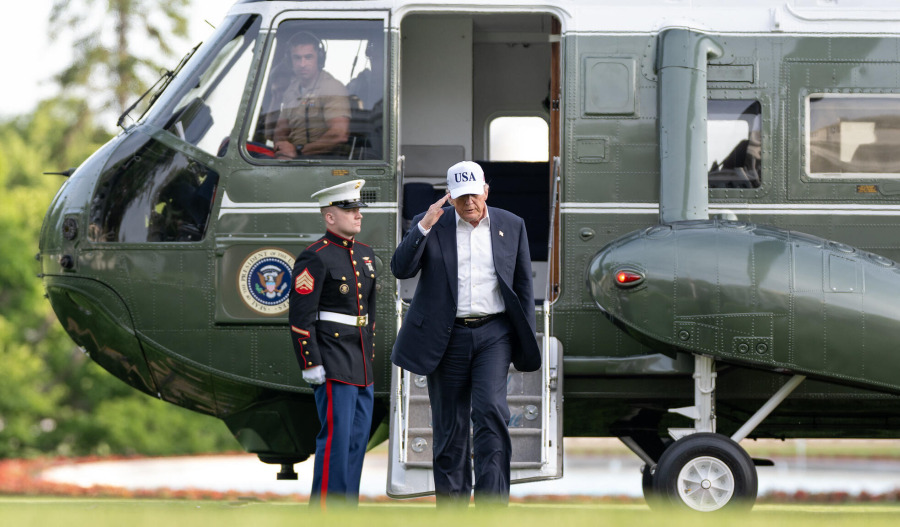
Trump said on Tuesday he was “an hour away” from deciding to attack Iran before being persuaded to postpone the move for several days, adding to uncertainty surrounding the conflict in the Middle East.
Bond markets remained under pressure as investors continued selling Treasurys amid concerns that inflation pressures could be reaccelerating.
The yield on the 30-year U.S. Treasury bond briefly climbed to 5.197% during the U.S. session overnight, marking its highest level since July 2007.
By 11:45 am AEST (1:45 am GMT), Australia’s S&P/ASX 200 had fallen 0.7%, South Korea’s KOSPI 200 dropped 2%, and Japan’s Nikkei 225 declined 1.8%.
In China, the People’s Bank of China left its benchmark loan prime rates unchanged, in line with market expectations.

The one-year loan prime rate remained at 3%, while the five-year rate was held at 3.5%.
The cautious tone followed a weaker session on Wall Street overnight, where all three major U.S. indexes closed lower amid rising bond yields and concerns over inflation and interest rates.
The Dow Jones Industrial Average fell 0.7%, while the S&P 500 lost 0.7% and the Nasdaq Composite declined 0.8%.
Commodity markets were mixed on Tuesday. Brent crude futures eased 0.7% to settle at US$111.28 per barrel, while spot gold dropped 1.9% to US$4,482.10 per ounce.
Elsewhere in the region, mainland Chinese equities finished higher on Tuesday, with the Shanghai Composite Index rising 0.9% to 4,169.5 and the CSI 300 adding 0.4% to 4,852.9.
Hong Kong’s Hang Seng Index advanced 0.5% to close at 25,797.9, while India’s BSE Sensex slipped 0.2% to 75,200.9.
European markets ended mixed overnight. Britain’s FTSE 100 edged 0.1% higher to 10,330.6, Germany’s DAX gained 0.4% to 24,400.7, while France’s CAC 40 fell 0.1% to 7,981.8.