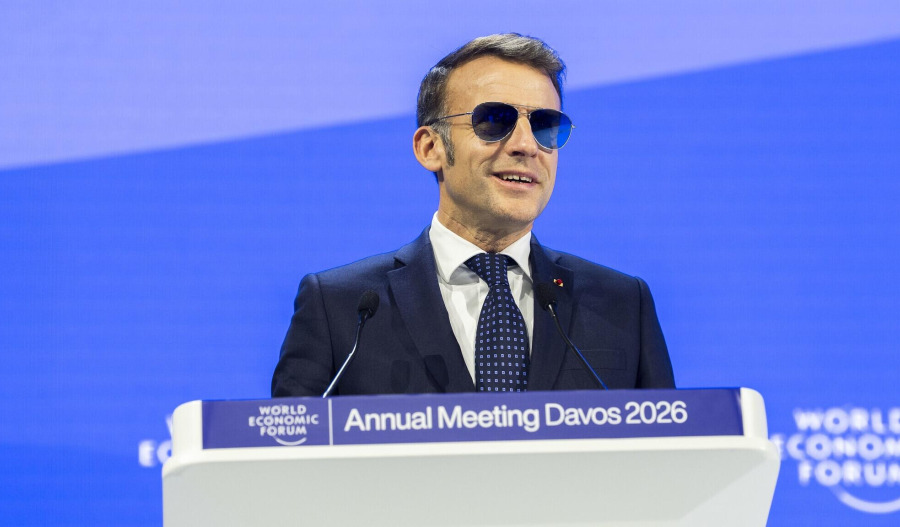
Major United States benchmarks surged on Wednesday (Thursday AEDT) after President Donald Trump called off planned tariffs on European goods linked to tensions over Greenland, easing investor concerns and triggering a broad market rebound.
The Dow Jones Industrial Average lifted 588.6 points or 1.2% to 49,077.2, while the S&P 500 gained 78.7 points or 1.2% to 6,875.6, and the Nasdaq Composite advanced 270.5 points or 1.2% to 23,224.8.
Markets were already trading higher after Trump said earlier at the World Economic Forum in Davos that he would not use force to acquire Greenland.
In a post on his Truth Social platform, Trump said progress had been made towards an agreement. “We have formed the framework of a future deal with respect to Greenland and, in fact, the entire Arctic Region,” he wrote.
“This solution, if consummated, will be a great one for the United States of America, and all NATO Nations.
“Based upon this understanding, I will not be imposing the Tariffs that were scheduled to go into effect on February 1st.”
The move reversed the so-called “sell America” trade that rattled markets on Tuesday, when investors dumped risk assets amid escalating tariff threats.
Technology stocks led Wednesday’s rebound, with Nvidia and AMD among the top performers, adding 2.9% and 7.7%, respectively, as investors rotated back into growth stocks.
Bank shares also moved higher after Trump said in his Davos speech that he would ask Congress to implement a proposed 10% cap on credit card interest rates, although the measure faces uncertain support from lawmakers.

Citigroup lifted 0.9%, and Capital One rose by 1%.
Despite the rally, tensions had remained elevated earlier in the session. European lawmakers on Wednesday suspended the European Union’s trade deal with the United States that was agreed in July.
Over the weekend, Trump announced that goods from eight NATO members would face 10% tariffs from 1 February, escalating to 25% on 1 June, unless a deal to purchase Greenland was reached.
Markets had suffered sharp losses in the previous session after Trump escalated his tariff rhetoric and declined to rule out military action over Greenland.
All three major indexes recorded their worst daily performances since 10 October, pushing both the S&P 500 and the Nasdaq into negative territory for 2026.
U.S. Treasury Secretary Scott Bessent sought to calm investors, telling reporters in Davos that the administration was “not concerned” about the prior day’s sell-off.
In Washington, attention also turned to the Federal Reserve after Supreme Court justices expressed scepticism over whether Trump has the authority to fire Fed governor Lisa Cook.
During oral arguments, Justice Brett Kavanaugh warned that claims the president could remove Cook without judicial review “would weaken, if not shatter, the independence of the Federal Reserve”.
On the bond markets, U.S. Treasury yields moved lower, with the 10-year yield down 1.1% to 4.249% and the 2-year yield slipping 0.3% to 3.589%.