
While gold might be the definitive ‘bet on fear’ again this year, as mum and dad investors buckle in for another rocky ride, some institutional investors see a handful of natural resources as a way to bet on optimism.
When it comes to commodities, the market continues to have an unhealthy preoccupation with gold.
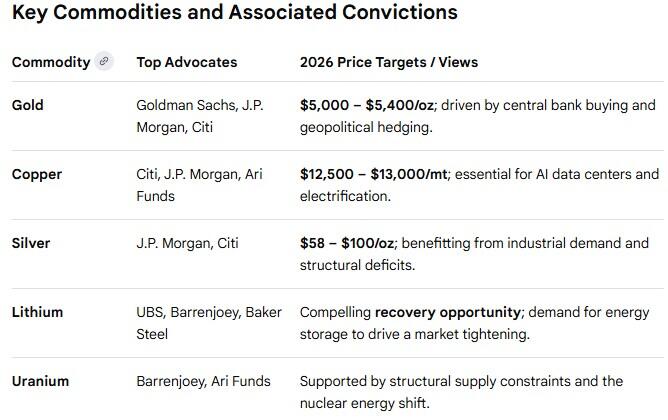
In its 2026 Commodities Outlook, Goldman Sachs identified gold as the "single favourite long commodity" in the commodity complex.
However, if you’re willing to drill down beyond the precious yellow metal, there’s a growing cohort of institutional money willing to place strong bets on pockets of opportunity lurking within a handful of natural resources.
While Ninety One is overweight in precious metals, at-weight in base metals and bulk, it’s underweight in energy and agriculture.
However, the fund manager reminds the market that each segment saw wide variation in asset quality, management strength, operational resilience and political risk.
Overall, the fund manager expects copper to remain another standout this year - after strong gains in 2025 – due to tight supply and with robust demand being linked to its key role in electrification and AI.
“Against that backdrop, we think copper-exposed equities still have an attractive risk-reward profile,” said Ninety One portfolio manager George Cheveley.
Given the historically low inventories and a forecast market deficit that could create a supply squeeze, the fund manager maintained an overweight position in copper-linked equities early this year.
The metal reached a fresh record above US$12,000 per tonne in December to close out the year at US$12,423 per tonne.
However, if low inventories and mine disruptions persist, Citigroup sees copper exceeding $13,000/ton and potentially approaching $15,000/ton in 2026.
Interestingly, since BHP’s 2024 bid for Anglo American, copper M&A activity escalated to frenzy status, while last week’s $300 billion mega-merger proposal between Rio Tinto and Glencore is clearly underpinned by strong future bets on ongoing demand for copper.
Within its recently released Commodity Markets Outlook, the World Bank projected that while most industrial prices will fall, copper and tin could hit record highs in 2026 due to the clean energy transition.
Following an estimated 10% increase in 2025, tin prices are forecast to gain an additional 3% in 2026, averaging approximately US$34,000 per metric ton.
The fund manager also expects aluminium to benefit from higher copper prices as market participants look for substitutes for copper.
But while the aluminium market should start the year solidly supported, the fund manager also warns investors that capacity additions planned in Indonesia from 2027 could weigh on the medium-term picture.
Meantime, the fund manager expects oil to find a bottom during the first half of 2026 and to recover later in the year as it becomes clear that both OPEC and U.S. shale are operating near capacity.
But while oil markets look oversupplied in the first half of 2026, Ninety One sees the U.S. natural gas market as buoyant with demand continuing to grow on the back of increasing energy needs of data centres expended liquefied natural gas (LNG) export capacity along the Gulf Coast.
“Our exposure remains focused on companies positioned to benefit from this structural growth in demand," the fund manager noted.

“Within our energy holdings we have exposure towards companies that are positioned to benefit from this structural growth in gas volumes, and to companies where we are ‘paid to wait’ for the eventual recovery in oil prices."
Meanwhile, when it comes to iron-ore and coal – which experienced flat demand in 2025 – the fund manager expects another underwhelming year in 2026.
These two bulk commodities are expected to continue trading sideways this year as new supply from the Simandou project in Guinea ramps up and China’s centralised buyer, China Mineral Resources Group, takes a more active role in the market.