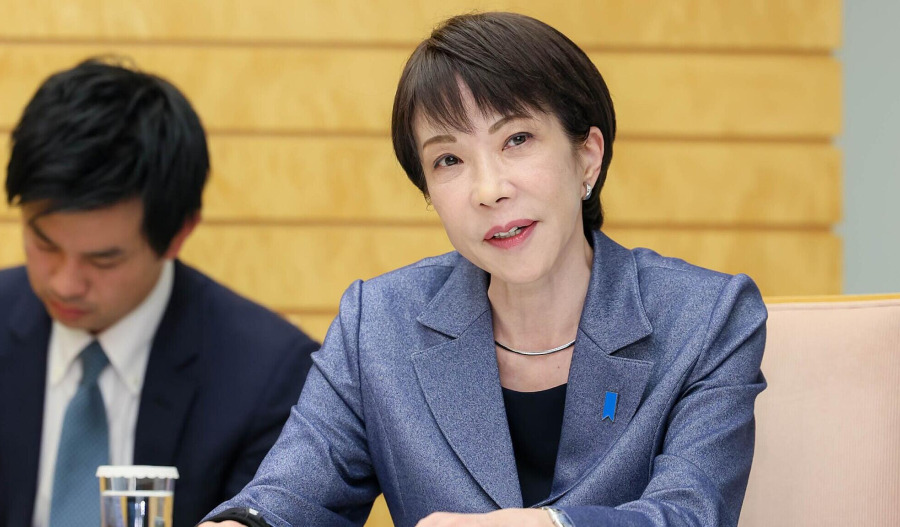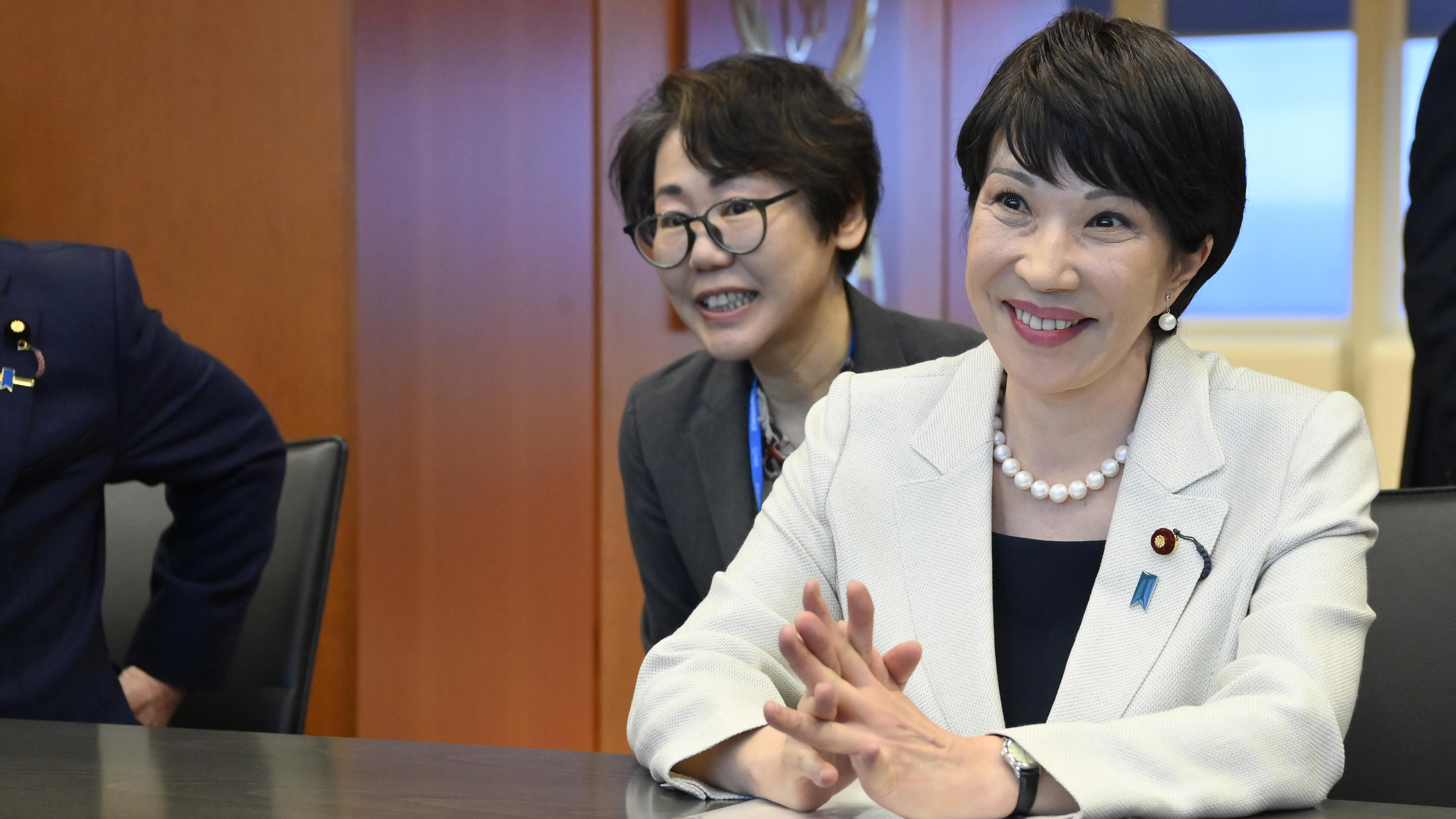
Japan’s biggest postwar landslide has handed Prime Minister Sanae Takaichi an extraordinary mandate to reshape the country’s economic and strategic direction.
Yet even as her sweeping victory energises supporters and unsettles rivals abroad, market analysts caution that financial markets – not political opponents – may prove her toughest constraint.
Takaichi’s Liberal Democratic Party (LDP) secured 316 seats in the Lower House, up from 198, delivering a two-thirds supermajority. Together with coalition partner the Japan Innovation Party (JIP), the ruling bloc now commands 352 seats, compared with 230 before the snap election.
The scale of the win allows Takaichi to pass legislation without negotiating with opposition parties or seeking Upper House approval.
Fiscal ambitions under scrutiny
Ratings agency Fitch Ratings said Takaichi’s emphatic victory points to more expansionary fiscal settings in the coming years.
In its January affirmation of Japan’s A/Stable sovereign rating, Fitch had already assumed post-election fiscal easing and widening deficits.
For now, that baseline remains intact.
However, Fitch warned that risks remain. Should fiscal stimulus measures exceed current assumptions, pressure could build on Japan’s fiscal trajectory and, over time, its credit profile.
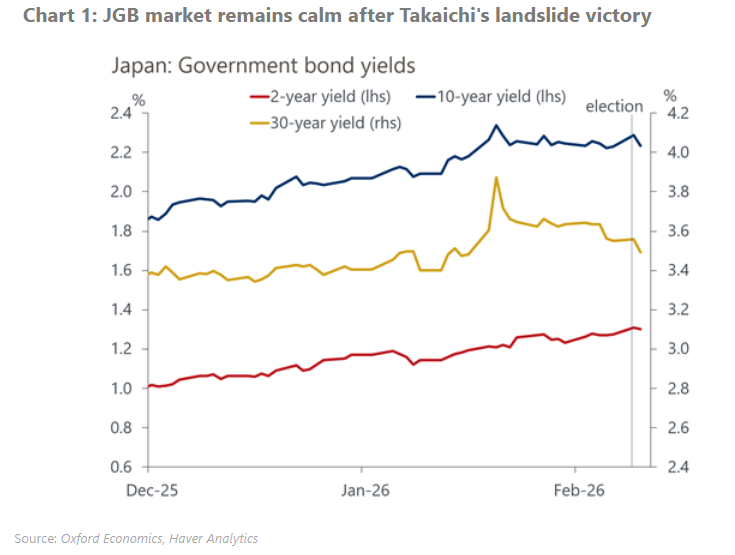
Oxford Economics also maintained its forecast of a primary fiscal deficit of 2%–3% of GDP between FY2026 and FY2028, despite the landslide victory, with consolidation only beginning from FY2029.
It expects the 10-year Japanese government bond yield to reach 2.3% by end-2026 and 2.5% by end-2027 and beyond.
Crucially, economists argue that bond and foreign exchange markets will act as a disciplining force. While Takaichi’s authority within the LDP has strengthened, influential party figures remain committed to fiscal discipline.
Any perception of runaway deficits could quickly feed through to higher yields and renewed yen volatility.

Cost-of-living relief and tax reform
Takaichi called the election shortly after taking office in October, seeking a popular mandate for her agenda. Her campaign centred on easing the cost-of-living burden, accelerating economic growth, tightening immigration controls and strengthening national security.
Among her headline pledges is a two-year cut to the 8% consumption tax on food, reducing it to zero. While she has said she wants the measure implemented “as soon as possible”, analysts believe it may take at least two years to operationalise.
She has also committed to identifying alternative revenue sources to offset the loss in tax receipts.
Takaichi has described the food tax cut as a “temporary bridge” towards a broader overhaul of Japan’s tax and welfare architecture, including the introduction of refundable tax credits aimed at reducing the burden on low-income households.
She has also floated the early cancellation of gasoline and diesel taxes and support for wage increases at struggling small and medium-sized enterprises.
Compared with her predecessor, she has adopted a more openly expansionary fiscal stance, particularly in defence and household support.
Monetary policy tensions ahead
Takaichi has signalled a dovish tone towards the Bank of Japan (BoJ), emphasising that while the central bank determines policy tools, the government bears ultimate responsibility for the direction of economic and monetary policy. This suggests an intention to maintain close coordination.
Asset managers at JPMorgan Asset Management note that concerns over fiscal deterioration and rising inflation could place upward pressure on long-dated bond yields and contribute to yen depreciation.
At the same time, expectations for further BoJ tightening may ease, exerting downward pressure on short-term rates.
Equity markets may prove more forgiving, as expansionary fiscal policy, sustained wage growth and a weaker yen could support corporate earnings, particularly for exporters.
However, investors are likely to adopt a wait-and-see approach as cabinet appointments are finalised and negotiations over the FY2025 supplementary and FY2026 budgets unfold.
Strategic realism, not ideology
Beyond economics, Takaichi’s victory carries significant geopolitical implications.
Dr Michael J. Green, chief executive of the United States Studies Centre, argues that Takaichi is “laser-focused on restoring a stable balance of power in Asia with Japan as the indispensable linchpin for American forward presence”.
Rather than distancing Tokyo from Washington, she aims to deepen alignment.
Her landslide strengthens her position ahead of a 19 March visit to the United States and meetings with U.S. President Donald Trump, who endorsed her candidacy.
The two share a commitment to bolstering Japan’s defence capabilities.
Takaichi has indicated she may revise Japan’s “Three Documents” on security policy and has not ruled out pursuing constitutional revision.
Article 9 of Japan’s 1947 constitution, which restricts military capabilities, has long been a target for conservatives.
In late 2025, Takaichi suggested a Taiwan crisis could constitute a “survival-threatening situation”, potentially justifying mobilisation of Japan’s Self-Defense Forces – comments that triggered diplomatic backlash from Beijing.
Analysts caution, however, against viewing her purely through an ideological lens. Stephen R. Nagy of the Japan Institute of International Affairs describes her approach as “strategic realism”, aligned with calls in Washington for an “allied scale” strategy to offset China’s industrial and manufacturing dominance.
Australia and the Indo-Pacific
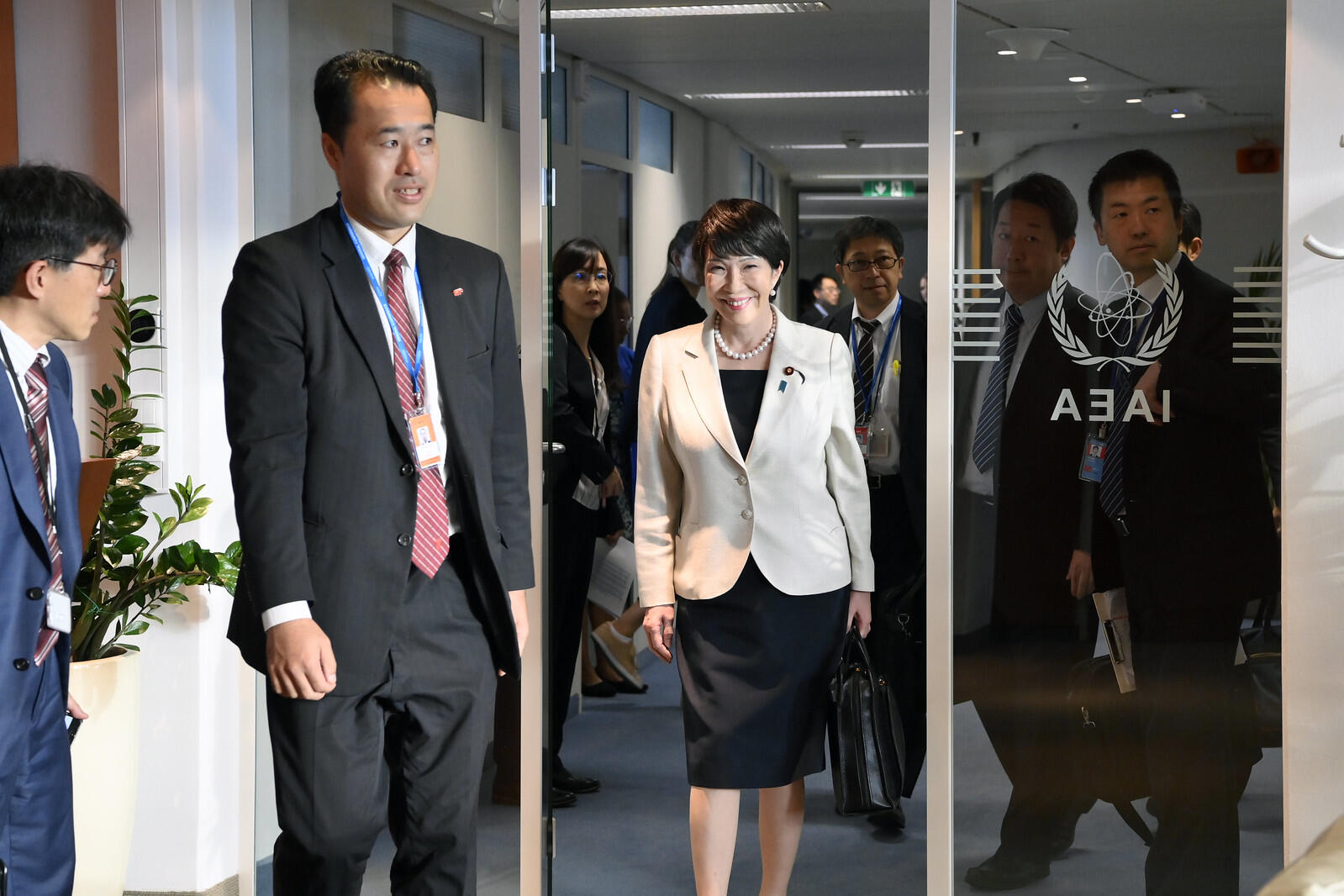
For Australia, the implications are significant. Takaichi is expected to deepen co-operation on critical minerals, natural gas, AUKUS pillar two technologies and defence industrial collaboration, including Japan’s Mogami-class frigate programme.
As with her mentor Shinzo Abe, she is likely to lean heavily on Canberra as a key regional partner.
At the same time, she may take a more explicit stance on Taiwan and Chinese hegemonic ambitions than Australia has publicly adopted.
Markets have so far welcomed her victory. Yet the path ahead is fraught with trade-offs: balancing expansionary fiscal policy with debt sustainability, aligning closely with Washington without alienating domestic voters, and managing relations with Beijing without appearing weak.
The scale of Takaichi’s mandate is historic. Whether she can translate it into durable economic revitalisation without triggering bond market backlash will define not only her premiership, but Japan’s trajectory for a generation.