

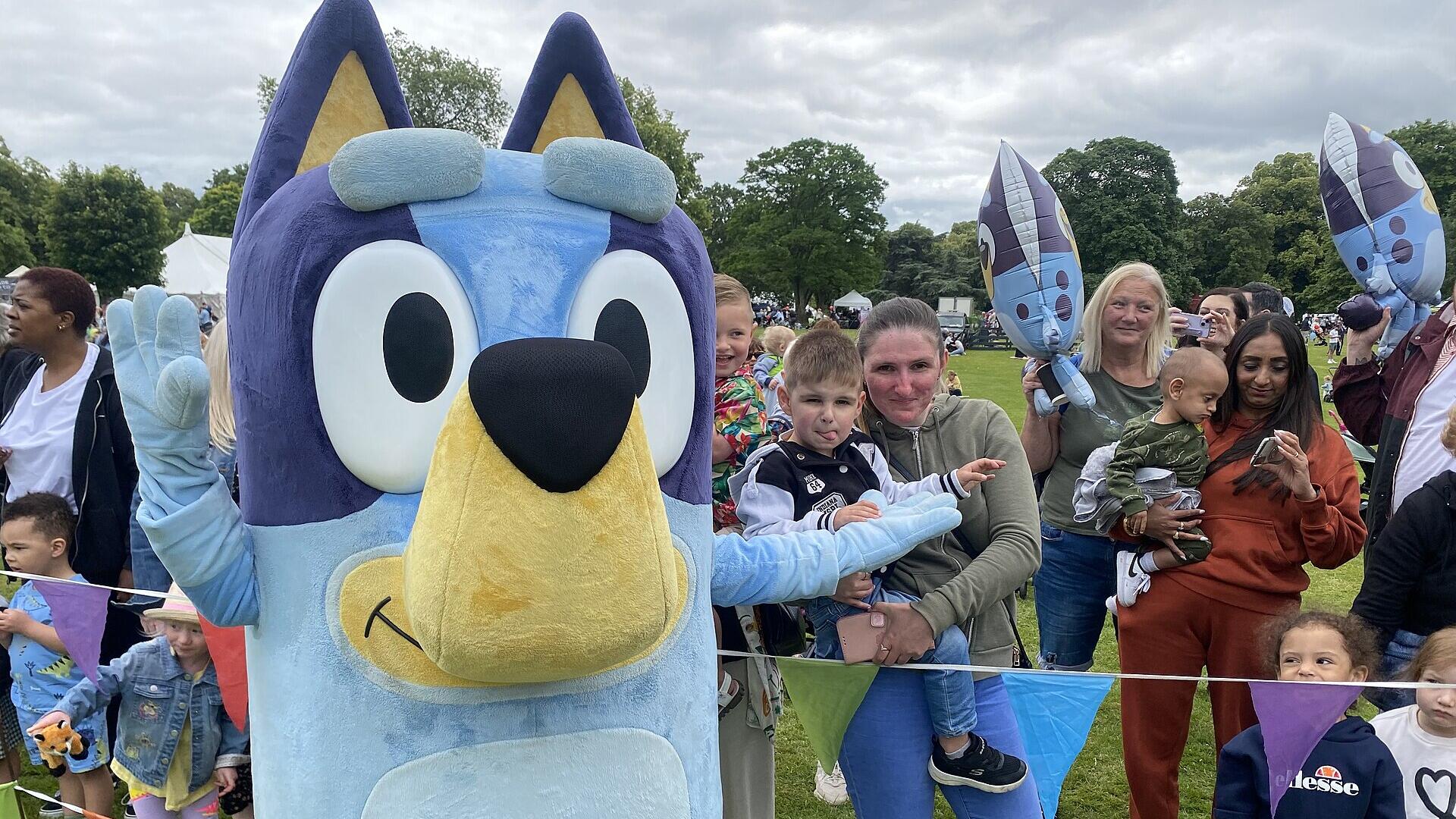
It is a global phenomenon with a level of success that is becoming increasingly embarrassing to Australia’s national broadcaster.
At least that is the perspective of critics of the licensing of the rights to Bluey, the children’s television series created in a studio in Brisbane and which is now shown around the world.
The animated series about a cattle dog and her family is broadcast in more than 140 countries with a commercial footprint spanning but not limited to toys, books, clothing, live shows and mobile games.
Although they vary widely, estimates indicate the show generates annual revenue which could be as high as A$2.5 billion (US$1.7 billion), but little of this is seen by the Australian Broadcasting Corporation (ABC), which jointly produces the hit show.
For perspective, that figure is twice the government-owned broadcaster's annual budget of about $1.3 billion.
It also represents a sizeable part of the global pre-school animated entertainment market valued at between $15 billion and $25 billion.
This includes franchises such as Hasbro Inc’s (NASDAQ: HAS) Peppa Pig, Spinmaster’s (TSE: TOY) Paw Patrol, privately-owned Moonbug Entertainment’s CoComelon, and non-profit Sesame Workshop’s Sesame Street.
BBC cleans up
The reason so much money is flowing overseas is that in 2017 the ABC reached a co-production arrangement with the British Broadcasting Corporation (BBC) through its commercial arm BBC Studios.
BBC Studios contributed about 30% of the initial production budget, with the ABC funding the majority.
Under this deal BBC Studios took global distribution, merchandising and licensing rights, which is where most of the money has been made, and the ABC retained rights to broadcast Bluey in in Australia.
As to how much the British’s public broadcaster garners from the playful pup, BBC Studios’ Senior Vice President (SVP) Global Consumer Products Suzy Raia described it in July 2025 as “a really, really big chunk of” its $3.6bn (£2.7bn) in global retail sales.
“Bluey’s role is quite enormous,” Raia said in this Guardian article.
“We’re just at the beginning of something that I hope will be a generation-defining brand for children and then families today.”
How much Bluey is worth to her home country is difficult to know because no official numbers have been published but ABC Managing Director Hugh Marks has admitted that $300 million of revenue from the series was going to the United Kingdom.
“With hindsight, a different commercial decision would have been made,” Marks was quoted in this Mumbrella article telling the annual conference of Screen Producers Australia in April.
The ABC declined to comment when asked by Azzet about how much money it had spent on and generated from Bluey.
But ABC spokesperson said that when the broadcaster co-commissioned the series, the focus “was acquiring rights for Australian audiences as cost effectively as possible and with minimal risk”.
“With hindsight, a different commercial decision would have been made,“ an ABC spokesperson told Azzet.
“Bluey is an integral and much-loved ABC program for our audiences, especially children.”

Bad deal
Among the harshest critics of this deal is entrepreneur Charlie Gearside who went so far as to describe the arrangement as “one of the all-time s***test deals in history”.
“We’re acting like we’re incredibly proud of Bluey’s success, which we are, but it’s also super embarrassing,” Gearside said in this video entitled How Australia Lost Bluey.
“If the revenue from Bluey merchandise alone stayed in Australia it could fund the Australian film industry for 20 years.”
It was meant to be just another modest commission in the crowded world of children’s television when in 2017 the ABC backed a new animated preschool series from Brisbane studio Ludo Studio and creator Joe Brumm.
The licensing arrangement was not unusual at the time, with international partners typically carrying the finance risk in an industry where costs are high, and success is never guaranteed.
The start of production was announced in July 2017, and less than two years later BBC Studios announced The Walt Disney Company’s (NYSE: DIS) Disney channels would screen it internationally (outside Australia, New Zealand and Greater China including Hong Kong, Macau and Taiwan) from late 2019.
It was the most streamed show in the United State in 2025 with 45.2 billion minutes, according to Nielsen, outstripping shows like Netflix’s Stranger Things.
The monetisation continued with licensing partnerships covering the United States, United Kingdom and Ireland, Mexico, Brazil, Chile, Central and South America, Argentina, Colombia and Ecuador and Canada.
They span a wide array of products in areas like:
- clothing
- arts and crafts
- bath toys and accessories
- bedding and home décor
- books
- dining/melamine
- food and beverage
- greeting cards
- infant and toddler feeding
- lighting
- puzzles and games
- furniture
ABC ‘unlucky’
Monash University lecturer in cultural and creative industries Ben Eltham said although Bluey would have cost at least $1 million for each of its 154 episodes produced over three series, the ABC had forgone “tens to hundreds of millions of dollars” of revenue.
“It was a bad deal, but they only know that with the benefit of hindsight. It was unlucky,” he told Azzet.
Eltham described the entertainment industry as “incredibly risky” because “most shows lose money and fail”.
“I think you need to put it in perspective. The ABC is a public broadcaster. Its job is to produce content to entertain and inform the citizens of this nation. It’s not an entrepreneur,” Eltham said.