Recent comments from United States Federal Reserve officials have raised the prospect of further interest rate increases, even as this week's inflation data pointed to easing price pressures and reduced market expectations for a September hike.
U.S. consumer prices rose 3.4% annually in July, down from 3.5% in June, while core CPI eased to 2.5%.
Producer prices were unchanged during the month, below expectations for a 0.2% increase.
However, inflation remains well above the Fed's 2% target, while the ongoing US-Iran conflict has created uncertainty over the outlook for energy prices and broader inflation.
Markets had initially hoped the increase in energy prices associated with the conflict would prove transient.
However, with the war continuing and the Strait of Hormuz largely closed, the risk of a more persistent inflation shock appears to be rising.
Hammack calls for immediate rate hike
Cleveland Federal Reserve President Beth Hammack reiterated on Thursday that the central bank should raise interest rates to curb inflation and restrain business growth and investment.
"When I'm talking to businesses, I hear that businesses are excited to raise funds, they're excited to borrow so they can continue to invest. They see the growth opportunities, which is great; I want them to continue to see growth opportunities, but if we have too much of that growth.... it could mean that that's putting additional pressure on price increases and that puts more of that inflationary pressure out there," Hammack said at the Dayton Area Chamber of Commerce in Dayton, Ohio.
"We need to make sure that we've got some amount of restraint coming from policy so that we can get inflation from this above-3% number back down to that 2% objective."
Hammack was one of three Fed officials who dissented from last month's decision to keep the federal funds rate in a 3.50%-3.75% range.
She said the improvement in inflation over the past two months was insufficient to convince her that price pressures were sustainably easing, noting that the Fed has not reached its 2% inflation target in more than five years.
"I don't have confidence that we're going to continue to see that or that we're going to see them low enough that it's going to bring us back down to that 2%," she said. "The job is to make sure that we are making progress towards that 2%. And then the question is how quickly do we need to deliver on that 2% objective and maybe we'd get there, but if it takes us another three or four years to get there, is that OK?"
Hammack said businesses and households were already feeling the effects of elevated prices, including higher fuel and food costs.
"I think that we need to act now because I think we need to bring inflation back down to that 2% objective faster than what a longer-term glide path would say with interest rates at this level," she said.

Kashkari backs gradual tightening
Minneapolis Federal Reserve President Neel Kashkari also argued that higher rates are needed to bring inflation down and avoid more aggressive tightening later.
Speaking to CNBC, Kashkari said policymakers could begin moving rates higher as early as September, although he stopped short of committing to a specific timetable.
Kashkari was another of the three dissenters who supported a 25-basis-point rate increase at last month's Federal Open Market Committee (FOMC) meeting.
“Corporate earnings are through the roof. They’re doing great. The consumer is hanging in there. The labour market is hanging in there. I look at this constellation and I say, what evidence do I have that monetary policy is particularly restrictive right now?” he told CNBC’s Andrew Ross Sorkin in a live “Squawk Box” interview from the Aspen Ideas Festival in Colorado.
“So, I argued now is the time to start slowly moving up as we get more data in,” he said.
Kashkari said he was not advocating a sharp increase in borrowing costs, but preferred taking small steps now rather than waiting until inflation becomes entrenched.
“I’m not calling for a dramatic increase in interest rates,” he said. “I’m simply saying I don’t see evidence of monetary policy [being] marginally restrictive right now, and I think we have more work to do to get inflation back down.
"And I would rather get going now in small steps than wait till later, then we have a really entrenched inflation problem and have to raise rates aggressively.”
Cook also warns of possible hike
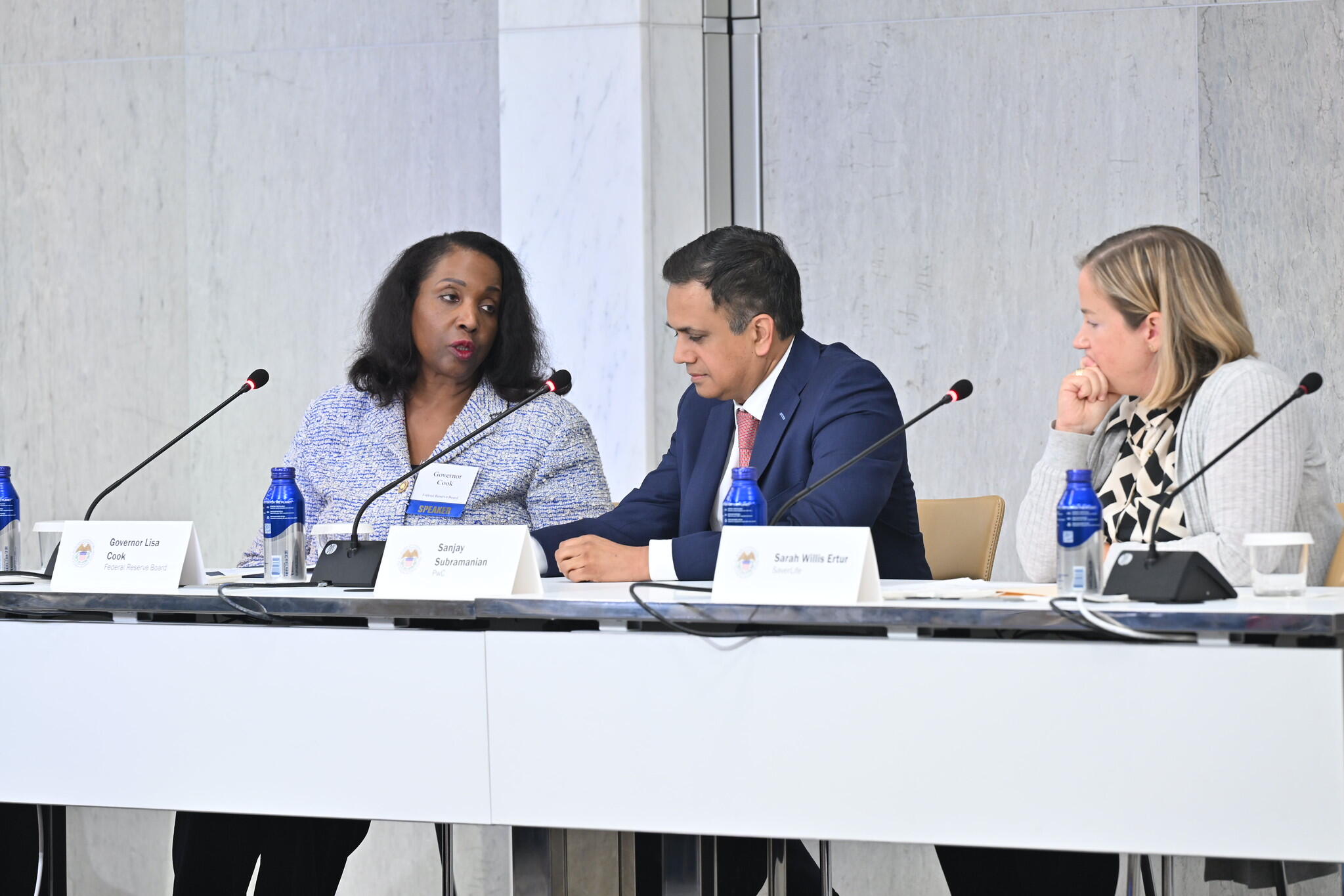
Fed Governor Lisa Cook said she was prepared to support an interest rate increase if inflation fails to continue easing.
“Inflation is too high, and I consider the risks to the inflation side of the dual mandate higher than the risks to the employment side at this point,” Cook said during a speech in Anchorage, Alaska.
“As such, I am prepared to act by raising rates, if necessary.”
Cook acknowledged that June inflation data had improved, partly because of a sharp decline in energy prices, but cautioned against drawing conclusions from a single report.
“If I do not see signs of continued disinflation soon, I am prepared to act,” Cook said. “With five years of above-target inflation, the risk grows that higher inflation may become entrenched in price- and wage-setting behavior, leading to persistence that would be much harder for us to attack. The longer inflation is above target, the more likely this scenario becomes.”
Cook was part of the nine-member majority that voted to leave rates unchanged last month. She said policymakers needed to assess the effects of tariffs, the energy shock associated with the Iran war and increased demand linked to the artificial intelligence investment boom.
“We do not have that luxury in this one,” she said, arguing that the Fed may not be able to wait indefinitely for inflation to ease.
Warsh's communication strategy raises volatility concerns
The debate over rates comes as Warsh reshapes how the Fed communicates with financial markets.
Since taking office in May, Warsh has reduced the central bank's use of forward guidance, shortened its post-meeting statement and provided relatively limited signals about his own policy preferences.
The Fed is also considering whether to reduce the number of scheduled FOMC meetings from the traditional eight per year.
The potential reduction in meetings could further limit the flow of information to investors and increase market volatility.
The Fed historically moved to an eight-meeting annual schedule under former Chairman Paul Volcker in the early 1980s. Officials retain the ability to call emergency meetings when necessary.
Minneapolis Fed President Neel Kashkari said he was open to reviewing the schedule, while Philadelphia Fed President Anna Paulson also backed a discussion about the issue.
Markets face a new era of uncertainty
Financial markets have so far shown a relatively muted response to Warsh's reduced communication strategy, with investors focusing heavily on incoming economic data and geopolitical developments.
However, there is a risk that guidance could lead to more frequent repricing across equities and fixed income.
“Market participants are learning to play the ball, not the referee - and market prices will continue to respond in the direction and magnitude they see fit,” Warsh said during a recent news conference. “This is, in my view, a change for the better - and we are just getting started.”
A reduction in the number of meetings could amplify concerns around the Fed's already limited forward guidance and its less clearly defined reaction function. Investors could be forced to rely more heavily on inflation, employment and growth data to determine the likely direction of monetary policy.
One potential consequence could be a steeper Treasury yield curve if long-term yields rise faster than short-term rates, increasing borrowing costs for the U.S. government and private sector.
The U.S. Treasury already faces substantial financing costs, with interest payments on public debt estimated at around $1.3 trillion this year.
Treasury Secretary Scott Bessent has described Warsh's approach as a "detox" for financial markets.
Whether the strategy ultimately improves monetary policy communication or instead creates greater volatility remains uncertain.
Investors will be watching closely for further clues when Warsh addresses the Federal Reserve's annual Jackson Hole symposium in Wyoming later this month, where previous Fed chairs have used the gathering to outline major policy priorities.