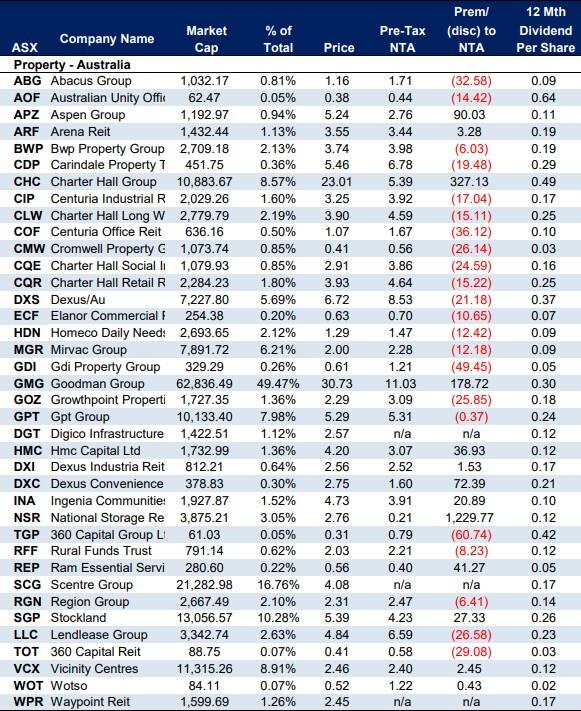

Yesterday’s decision by the Reserve Bank of Australia (RBA) to raise the cash rate by 25 basis points to 3.85% places greater pressure on Australia’s struggling listed property sector – aka Australian Real Estate Investment Trusts (A-REITs), with the broader benchmark – the S&P/ASX 200 Financials Ex-A-REIT (XXJ) index currently treading water.
Admittedly, not all A-REITs are of the rent-collecting variety, but those that are can expect to face more immediate downward pressure due to increased borrowing costs and heightened concerns over property valuations.
More specifically, it's residential A-REITs – like Mirvac (ASX: MGR) and Stockland (ASX: SGP) - that are considered the most sensitive to rate hikes because rising borrowing costs deter home buyers and increase mortgage repayments for existing owners.
Indirectly, retail A-REITs - landlords of shopping centres - are also exposed as higher rates squeeze household budgets, leading to lower consumer confidence and discretionary spending.
This typically translates into weaker rental growth and increased margin pressure for retail property owners.
Discount to NTA to widen
Unsurprisingly, the average discount to net tangible assets (NTA) – currently averaging between 15% - 25% can be expected to widen.
A-REITs typically get overlooked post hikes, and a widening discount to NTA typically reflects market scepticism over valuation accuracy.
It’s likely that the RBA’s return to tightening - after a period of rate cuts in 2025 - will only ignite already lofty fears of further falls to property values, with rising interest rates clearly weighing on market sentiment towards the sector.
Adding to investor wariness towards the A-REIT sector is the RBA's "hawkish" stance today, which has left the door wide open for further increases.
But despite the RBA's “hawkish” turn, the central bank’s governor, Michele Bullock, emphasised that the board is not committed to a specific path and will remain data-dependent, noting that today's hike does not necessarily signal the start of a series of increases.

Investors may favour risk-free returns
Meanwhile, with risk-free returns on savings accounts and term deposits - some now offering over 4% - becoming more attractive relative to A-REIT dividend yields, investors may also choose to direct capital away from this sector.
With inflation-linked bond yields also near 15-year highs at around 2.4%, these combined pressures continue to weigh on property pricing and are typically unfavourable for A-REIT investment.
Based on the likelihood rate increases this year, Wilson Asset Management moved early to reduce its overweight position in the A-REITs sector last year.
This gave the fund manager’s deputy portfolio manager, Anna Milne, the potential to carefully re-enter stocks like Mirvac - a major player in apartment development - which had been “sold off too aggressively” as the interest rate outlook switched.
“Clearly, the A-REIT sector is very highly correlated as a bit of a bond proxy and is therefore impacted by any changes in the long end of the curve,” Milne said.
“Looking forward into 2026, the A-REITs might be slightly on the nose, but I believe this will be outweighed by the positive fundamental story that we see in the A-REIT sector.”
Residential developers aside, Milne still believes global logistics giant Goodman (ASX: GMG) can deliver promising returns as it continues to roll out an ambitious global roll-out of data centres.
Don’t write-off the entire A-REIT sector
However, since the A-REIT sector reduced its historically higher levels of gearing in line with the broader equities market, Pengana Capital portfolio manager Amy Pham warns investors that the sector’s exposure to interest rate movements can be overstated.
She also reminds the market that many A-REITs capitalised on lower rates last year to offset their debt and extend maturities, reducing their exposure to any rise in borrowing costs.
Having “locked in” their obligations, many A-REITs can also count their earnings growth with “high visibility”, where their revenue derives from rents that include contracted increases, such as shopping centre owners, said Pham.
“We certainly don’t invest based on whether there’s going to be a rate cut or rate hike,” she said.
We invest through the cycle, and we look at the fundamentals. Where’s the gearing at, where’s the visibility of earnings? What is the economy doing to generate our valuation?”
Valuation-led opportunities
Sharing a similar sentiment, SG Hiscock portfolio manager, Grant Berry, believes valuation-led opportunities remain in the A-REITs regardless of the RBA’s hawkish turn on rates.
While sentiment often swings with short-term rate moves, he also reminds investors that long-term fundamentals for some parts of this asset class remain intact.
“While market sentiment often reacts to short-term rate expectations, the fundamentals driving property values remain anchored in long-term yields and structural demand factors,” said Berry, who believes the sector demands a different investment approach.
“We can’t rely on a return to the ultra-low cap rates of the past, which is why disciplined, valuation-led investing is critical and patient capital is more likely to be rewarded over the medium to long term.”
Despite the outlook for Australia’s cash rate, Berry urges investors to remember:
Residential demand is usually shaped by current mortgage rates, population growth, supply limits, and government support, supporting long-term fundamentals.
Institutional-grade real estate investors tend to anchor valuations to long-term real rates, such as those reflected in inflation-linked bonds.
Based on his reading of the market’s tea leaves, these factors are pushing some A-REITs into deep value territory, especially in office and residential segments.
“Currently priced well below both market transaction values and replacement costs, office A-REITs provide investors access to institutional-quality assets at historically attractive entry points,” Grant said.