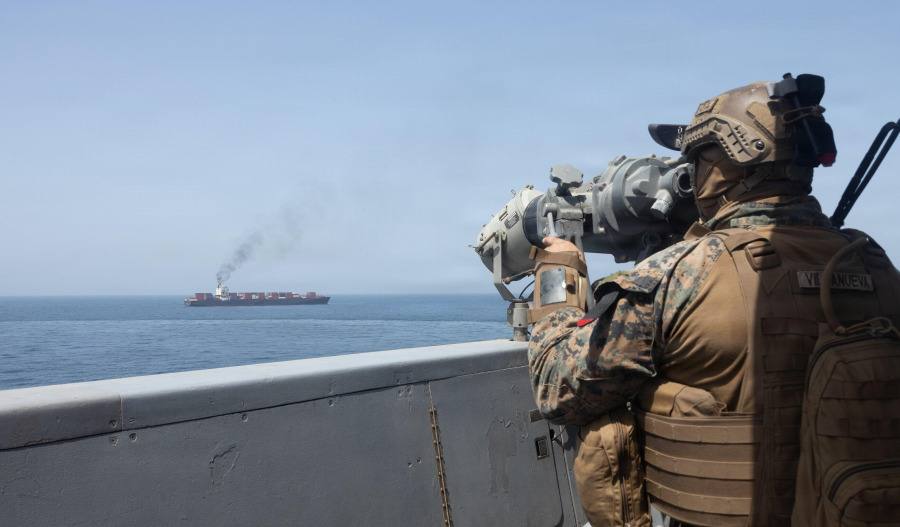
An Iranian cargo vessel was struck early Sunday off Qeshm Island in the Strait of Hormuz, Iranian state media reported, as Tehran postponed plans to brief neighbouring countries on its contested efforts to manage shipping through the strategic waterway.
The attack, which reports said killed one person and wounded four, renewed attention on the Strait of Hormuz after threats to shipping in the region intensified last week, when Iran-backed Houthi rebels captured an island in the Bab el-Mandeb Strait in the Red Sea.
Iran's state-run IRNA news agency quoted the Qeshm governor as blaming a "terrorist enemy" for Sunday's attack. There was no immediate comment from the U.S. military, which has struck Iranian-flagged vessels during its blockade of Iranian ports and faces a new threat from Iranian ballistic missiles launched at its warships.
Qeshm Island, located about 14 miles from the port city of Bandar Abbas, is central to Iran's efforts to assert control over the Strait of Hormuz.
Hours before the attack, Iran's government remained defiant. "Our people can't be bullied into submission. Iran won't surrender," President Masoud Pezeshkian said in a social media post.
Explosions were heard Saturday off the coast of an island located in the Strait of Hormuz, Iranian state media reported.
"A few minutes ago, the sound of two explosions was heard on Qeshm Island, coming from the direction of the sea," the official IRNA news agency said.
In recent weeks, Iran has targeted oil tankers passing through the strategic waterway, as well as United States bases in Gulf countries, in retaliation for attacks carried out by the U.S. military against Iranian targets.

The U.S. has also targeted ships attempting to break its own counterblockade of Iranian ports.
The U.S. blockade of the Strait of Hormuz has now redirected 100 ships attempting to enter or leave Iranian ports, according to the U.S. Central Command (CENTCOM).
Central Command said on Friday that the total stood at 99, with 96 vessels having been redirected through Thursday.
"ZERO ships have passed through the blockade without U.S. forces allowing. American service members remain laser focused on this mission," CENTCOM said in a post on X.
The blockade was reinstated on 14 July after a memorandum of understanding between the U.S. and Iran fell apart.
Iran believed the language of the MOU determined that it would control the flow of shipping through the Strait of Hormuz, while the U.S. said that was not the intent.
Iran subsequently targeted ships travelling along the Oman coast, the U.S.-sanctioned route, and the blockade was reinstated shortly afterwards.
The first blockade, which was in place from 13 April to 18 June, redirected about 140 ships.