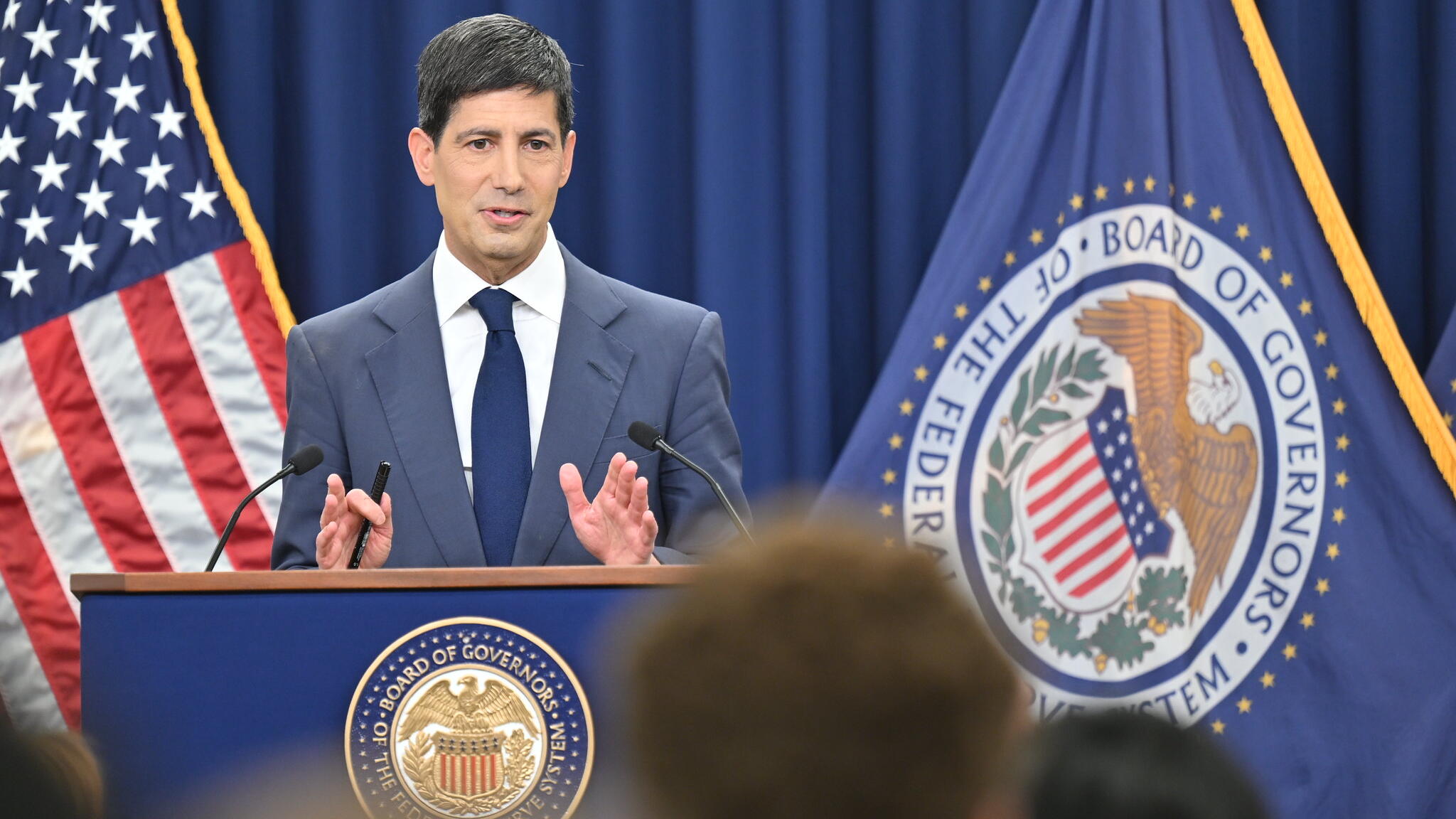
The Federal Reserve left interest rates unchanged on Wednesday (Thursday AEST) while signalling that further tightening may be required to contain inflation, marking a significant shift in tone at the first policy meeting chaired by Kevin Warsh.
The Federal Open Market Committee unanimously voted to maintain its benchmark federal funds rate within a target range of 3.50% to 3.75%, where it has remained since a series of rate cuts in late 2025.
While the decision itself was widely expected, policymakers delivered a more hawkish message through updated economic projections and a streamlined policy statement that removed language previously interpreted as favouring future rate cuts.
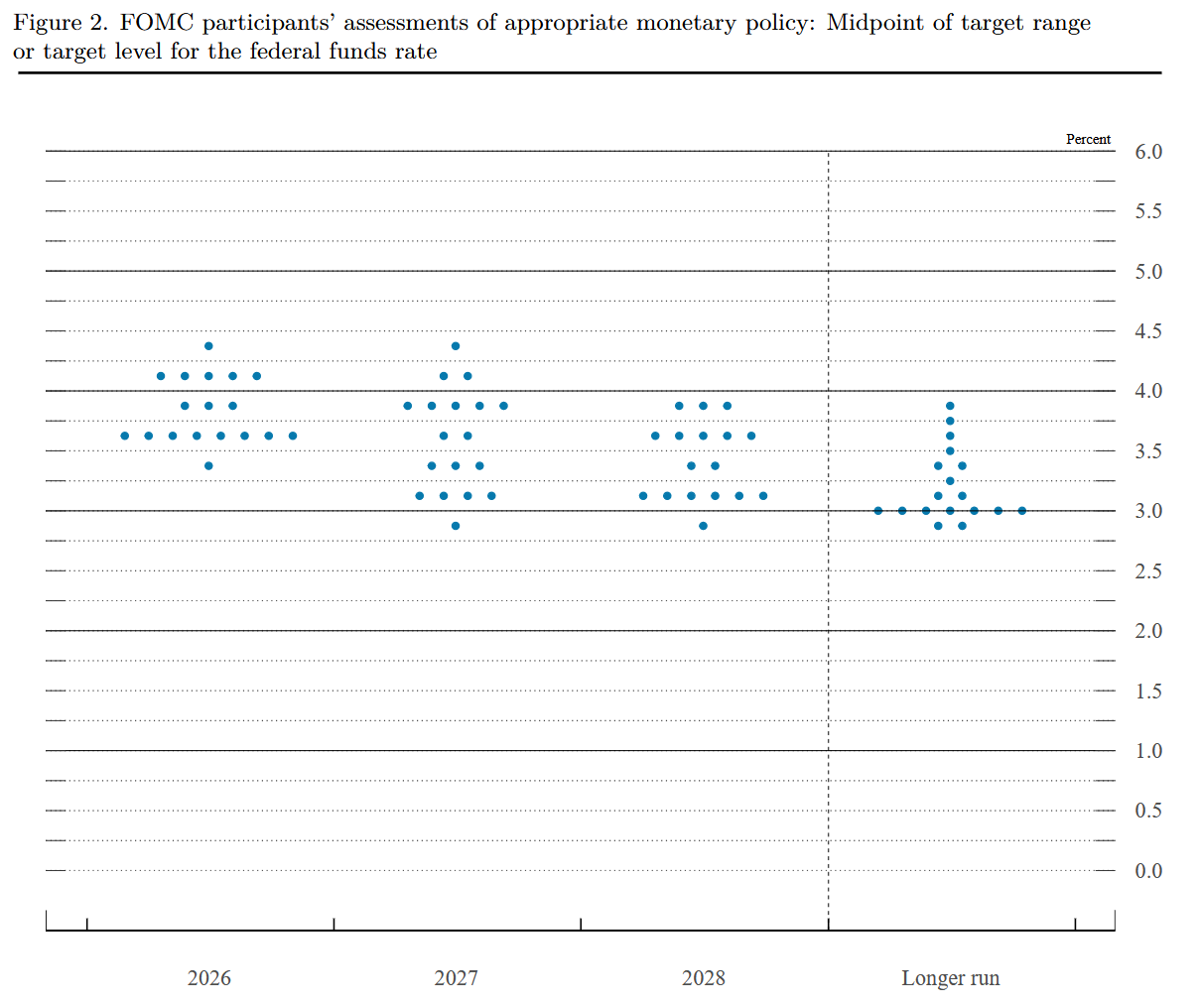
The central bank's closely watched Summary of Economic Projections (SEP) showed officials no longer expect a rate cut this year. Instead, the median projection now implies at least one interest rate increase before the end of 2026.
Notably, Warsh did not submit an individual interest rate forecast as part of the Fed's "dot plot", continuing his long-standing criticism of the forecasting tool and other forms of forward guidance.
"I did not submit a dot for me," Warsh said during a press conference following the decision. "It’s not helpful in the conduct of policy. I suspect by year-end, as I mentioned in my opening statements, there’ll be a review about communication broadly, press conferences, dots, meetings, and the like, transcripts, minutes. This will be part of that. I don’t want to prejudge the outcomes there, but I’m pretty open-minded about what they could be."
Based on the 18 submitted forecasts, the median projection for the federal funds rate at the end of 2026 rose to 3.8% from 3.4% in March. Of the participating officials, eight expected rates to remain unchanged, one anticipated a rate cut and nine projected at least one rate increase.
An additional projection was also absent from the committee's 2028 outlook.
Warsh acknowledged the substantial changes to the post-meeting statement, which was dramatically shortened compared with previous releases.
"It’s a bit shorter, a bit simpler and it dispenses with some older language," he said. "That statement just gives you the facts, as best we can judge it."
The latest statement contained only 130 words, down from 341 words in April.
The statement offered a concise assessment of economic conditions while emphasising the Federal Reserve's commitment to restoring price stability.
Additionally, Warsh announced the creation of five task forces to review key areas of monetary policy, including Fed communications, balance sheet policy, data collection, productivity and employment trends in the age of artificial intelligence, and inflation frameworks, as part of a broader effort to modernise the central bank's operations and improve policy effectiveness.
"Since last summer, my colleagues discussed possible improvements in the form and function of Fed communications.
"This new task force will build on that effort—and, I expect, propose some well-considered changes, including to the SEP I mentioned a few moments ago.
"The second task force, the one on balance sheet policy, will review the benefits and risks of the current ample reserves regime, and the composition of the Fed’s balance sheet. They will assess alternative frameworks for the conduct and operation of monetary policy.

"The third task force, the one on data, will evaluate new information sources and consider methodological changes to improve data gathering, with the aim of giving policy makers more accurate, relevant, contemporaneous, and perhaps most important actionable information on the state of our economy.
"Fourth, the task force on productivity and jobs. It will survey the pace, the reach, and economic impact of new general-purpose technologies, including AI, and explore the implications for the Fed in pursuit of our employment and inflation mandates.
"The last task force, the one on inflation frameworks, will examine the drivers of inflation, first principles, and weigh the full range of ideas for delivering price stability in a changing economy."
The statement noted that "economic activity is expanding at a solid pace despite elevated uncertainty that owes, in part, to the conflict in the Middle East. Productivity growth and capital investment are strong".
"Job gains have kept pace with the workforce, and the unemployment rate has changed little.
"Inflation remains elevated relative to the Committee’s 2 percent goal, in part reflecting supply shocks that have driven price increases in certain sectors, including energy. The Committee will deliver price stability," policymakers added.
The statement also confirmed that the Federal Reserve would maintain its policy of ample reserves within the banking system, suggesting no immediate plans to reduce its US$6.7 trillion balance sheet despite Warsh's previous support for a more aggressive reduction strategy.
Updated economic forecasts highlighted the committee's growing concern over inflation pressures linked to the Iran conflict and higher energy prices.
Officials increased their 2026 inflation forecast to 3.6% for headline inflation and 3.3% for core inflation, excluding food and energy. In March, both measures had been projected at 2.7%.
At the same time, policymakers slightly reduced their economic growth forecast. Gross domestic product is now expected to expand by 2.2% in 2026, down from the previous estimate of 2.4%.
The unemployment rate forecast was lowered to 4.3% from 4.4%, reflecting continued resilience in the labour market.
Recent economic data have complicated the outlook for monetary policy. The consumer price index rose 4.2% in May from a year earlier, while core inflation stood at 2.9%. Inflation has remained above the Federal Reserve's 2% target for the past five years.
Warsh reiterated the central bank's determination to restore price stability.
"The commitment to deliver is strong, unanimous, and unambiguous, and that’s I think an important message we’ve missed for five years, and we’re going to fix that," Warsh said.
Although Warsh has argued that policymakers should generally look through temporary supply-driven inflation shocks, he acknowledged that current price pressures require vigilance. He has also suggested that advances in artificial intelligence could ultimately help reduce inflation by boosting productivity and lowering costs across the economy.
Meanwhile, the labour market continues to show surprising strength. Nonfarm payrolls increased by 172,000 in May, exceeding expectations, while the unemployment rate remained steady at 4.3%.
Financial markets interpreted the Federal Reserve's updated projections and Warsh's comments as signalling a greater likelihood of tighter policy. Prior to the meeting, traders had already priced out rate cuts for 2026 and expected a quarter-point increase by year-end.
Following the announcement, futures markets increased the probability that the Federal Reserve could raise rates as early as October.