Unprecedented upstream throughput propelled Chevron past analyst earnings projections for the fourth quarter, insulating the United States supermajor against a steep deterioration in crude markers, though top-line revenue succumbed to the bearish pricing environment.
Adjusted earnings of US$3.0 billion, or $1.52 per share, outpaced the $1.45 consensus forecast, fuelled by robust flows from the Permian Basin and the newly consolidated Hess portfolio.
However, revenue for Q4 slipped to $46.87 billion, missing street expectations of $47.15 billion, as the company grappled with lower realisations that weighed on the broader sector.
Reported net income dipped to $2.8 billion ($1.39 per share), retreating from $3.2 billion in the prior-year period, as foreign exchange headwinds and weaker refining margins in the chemicals sub-segment squeezed netbacks.
Permian and TCO drive operational alpha
Chevron’s “higher volume, lower cost” mantra appears to be bearing fruit, with worldwide net liftings striking a peak of 4.05 million barrels of oil equivalent per day (mmboe/d) in the fourth quarter - a 20.7% vault from the previous year.
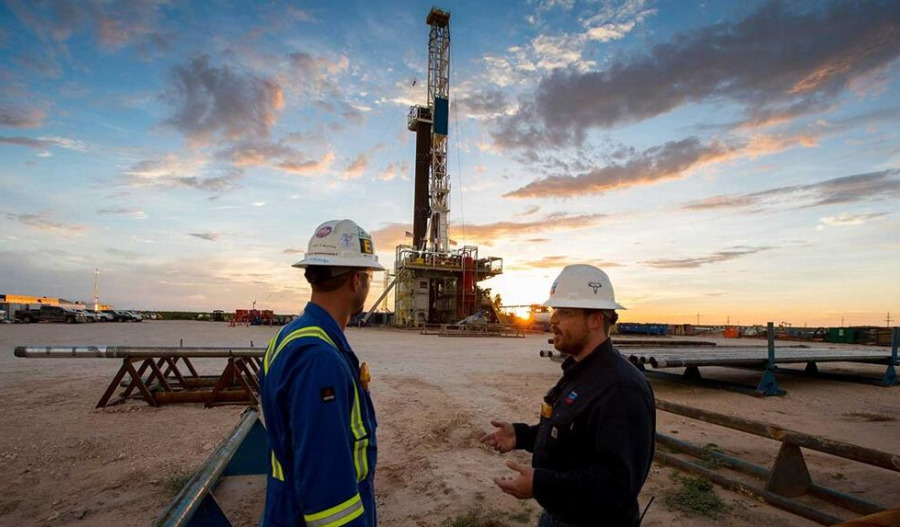
This expansion was anchored by the acquisition of Hess, which injected 261,000 boe/d, alongside a landmark showing in the Permian where extraction eclipsed 1 million boe/d for the first time.
Crucially, the long-awaited Future Growth Project at the Tengiz field in Kazakhstan has reached full commerciality, adding significant high-margin barrels to the mix.

Venezuela and the Med
Beyond the core basins, the major touted significant progress in its international growth engines, themes largely overlooked in initial reaction notes.
Production in Venezuela has swelled by over 200,000 barrels per day since 2022, with management signalling potential for a further 50% uplift over the next 18-24 months as it leverages existing infrastructure.
In the Eastern Mediterranean, the firm has taken Final Investment Decision (FID) on the Leviathan reservoir expansion project, a move CEO Mike Wirth claims will contribute to a “doubling of current earnings” from the region by the end of the decade.
While chemical margins softened, the refining arm demonstrated remarkable resilience, delivering the highest U.S. refinery throughput in twenty years.
On the energy transition front, the Geismar renewable diesel facility in Louisiana has successfully ramped to its expanded capacity of 22,000 barrels per day, validating the company's strategy of executing "new energy" projects that leverage existing value chains.
Stakeholder distributions remain paramount
Operational resilience empowered Chevron to channel a record $27.1 billion back to investors in 2025, bifurcating capital between dividends and an aggressive $3 billion quarterly equity buyback scheme.
“2025 was a year of significant achievement. We successfully assimilated Hess, brought major assets online, and streamlined our organisation,” Wirth said.
The directorate ratified a 4% hike in the quarterly distribution to $1.78 per share, extending a 39-year streak of payout growth.
Looking to the horizon, leadership anticipates liftings to swell another 7-10% in 2026, spurred by a full annual contribution from Hess and a raised structural cost savings target of $3-4 billion.