

While the spot price of gold grabs the headlines, the underlying sentiment among institutional heavyweights suggests the commodity supercycle is far from exhausted. With the official sector aggressively accumulating reserves and sovereign debt swelling, a new Goldman Sachs poll reveals a high-conviction bet among allocators: the yellow metal is poised to shatter the US$5,000 per troy ounce (oz) ceiling by the end of next year.
As bullion touched a two-week high on Friday, climbing 0.45% to $4,175.50/oz, market makers are wagering that a deteriorating, or at least shifting global fiscal outlook, will ensure further upside.
The shiny stuff has been on a tear for months now, logging a blistering 58.6% YTD return and piercing the psychological $4,000/oz barrier on October 8th.
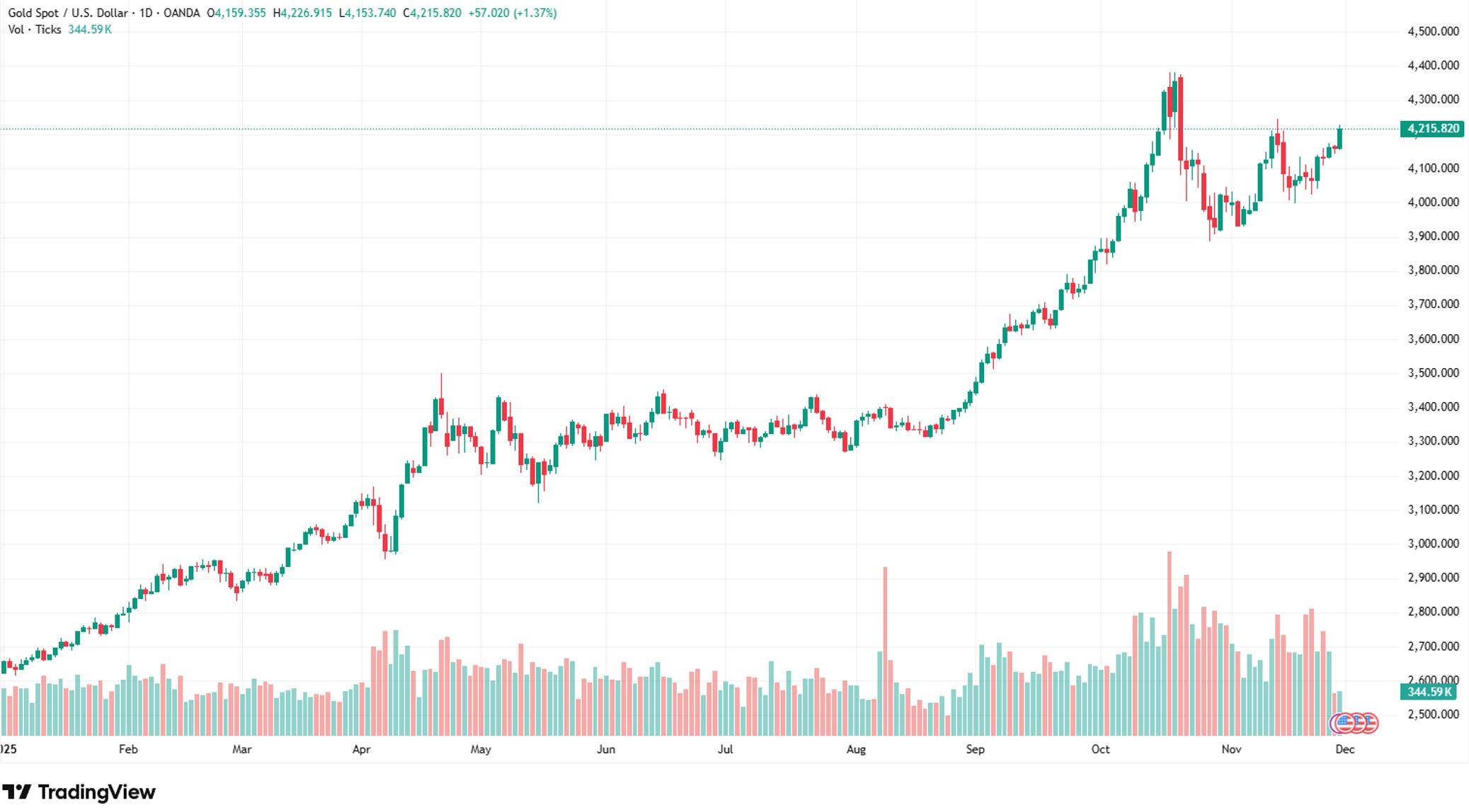
Now, the "smart money" is positioning for the next leg higher.
Allocators position for the breakout
In a survey of over 900 institutional clients via Goldman Sachs’ Marquee program, 36% of respondents model gold maintaining its velocity to exceed $5,000/oz by the close of 2026.
A further 33% forecast the metal settling between $4,500-$5,000/oz, according to the data gathered between November 12-14. Conversely, bearish sentiment has all but evaporated - as barely 5% of those surveyed anticipate a retracement to the $3,500-$4,000/oz range over the next 12 months.
When pressed on catalysts, 38% of respondents identified central bank buying as the primary engine of capital appreciation, while 27% cited entrenched fiscal deficits.

Street consensus stiffens
Goldman isn’t the only institution pivoting to an aggressive bull case. Bank of America (BofA) recently upgraded its 2026 forecast to the $5K target, driven by what it says is an "unorthodox" United States monetary policy.
BofA strategists contend that spiralling debt-to-GDP ratios force allocators into non-yielding stores of value, particularly as the Fed eases rates.
Similarly, J.P. Morgan has designated bullion its highest conviction long, projecting a climb to $5,055/oz by Q4 2026. The bank’s commodities desk points to a structural "debasement trade," where exposure to fiat currency is reduced in favour of hard assets amid stagflationary risks.
The structural tailwinds propelling the sector show no signs of abating, according to Sprott Asset Management. In recent commentary, the firm highlighted that the sheer velocity of U.S. Treasury issuance is compelling funds to diversify reserves.
This thesis is corroborated by the World Gold Council, noting that 95% of central banks intend to expand their gold holdings over the coming year.
And that sovereign demand, Sprott says, creates a hard floor under valuations, squeezing physical liquidity just as Western ETFs aggressively re-enter the fray.
Chart: 100-Year Historical Gold Price Trends (Inflation Adjusted)
Yet despite the euphoria, some analysts such as Citi, maintain a more nuanced outlook. While their bullish scenario - assigned a 30% probability - envisions gold breaching $6,000/oz on the back of a rapid wealth transfer to real assets, their base case is tempered.
Citi cautions that if the US executes a perfect "soft landing" and real yields stabilise, the metal could consolidate near $3,650/oz in 2026.
However, even this conservative model acknowledges that the asymmetry of risk is heavily skewed to the upside.