The latest round of Big Tech earnings this week reinforced a widening divide in the artificial intelligence race, with Microsoft and Amazon benefiting from strong cloud demand while Meta faced questions over the returns from its massive AI spending programme.
Microsoft: Azure growth fuels AI optimism
Microsoft shares jumped 18.2% for the week after the software giant reported stronger-than-expected fiscal fourth-quarter results, with growth in its Azure cloud business and gains from its Anthropic investment supporting results.
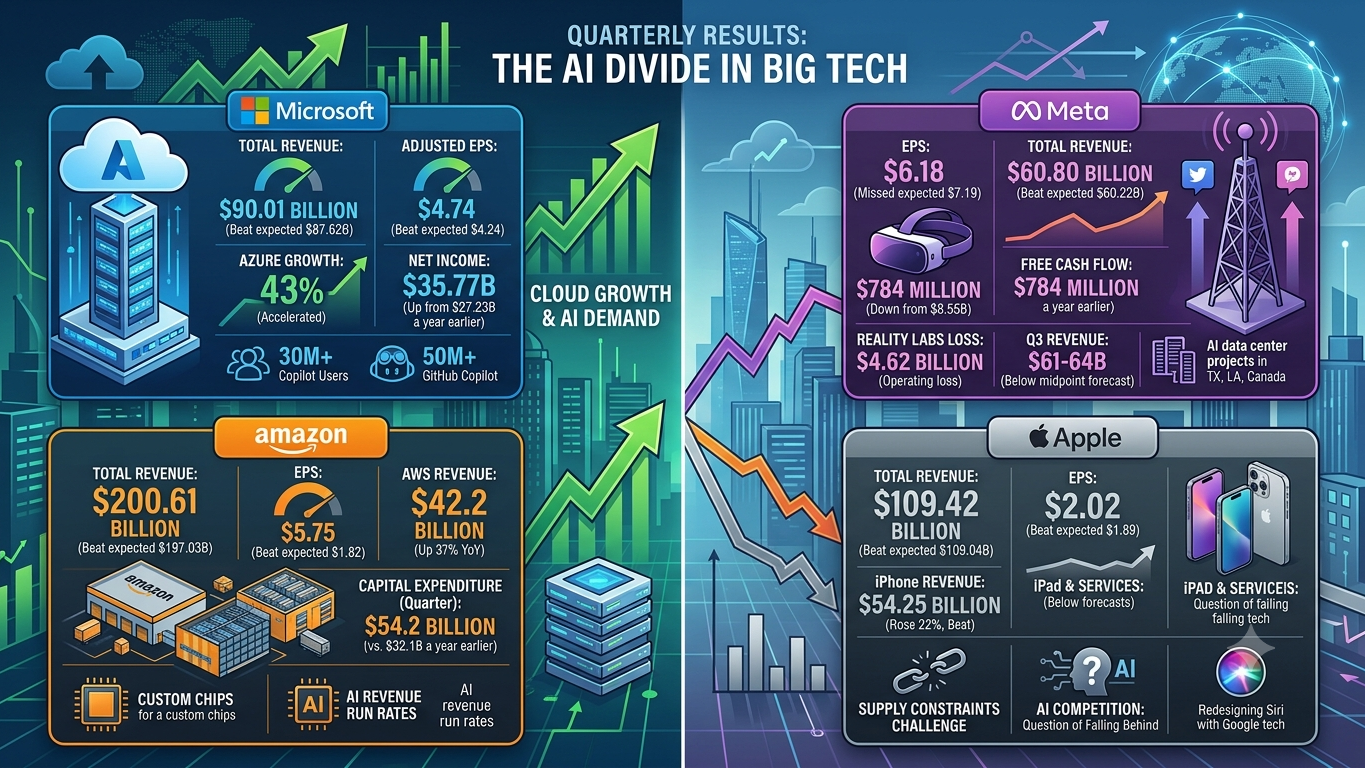
The company reported adjusted earnings per share (EPS) of US$4.74, beating expectations of $4.24, while revenue came in at $90.01 billion compared with forecasts of $87.62 billion.
Revenue increased approximately 18% year over year in the quarter ended 30 June, while net income rose to $35.77 billion from $27.23 billion a year earlier.
Microsoft said results included a $3.2 billion gain from its investment in artificial intelligence company Anthropic, while lower-than-expected costs from its first voluntary retirement programme also boosted earnings.
The company maintained its 2026 capital spending plans but indicated investment would continue rising as demand for AI infrastructure remains strong.
Microsoft finance chief Amy Hood said future capital expenditure growth would be driven by "demand signals across our portfolio" and forecast approximately $175 billion in capital expenditure and finance leases.
Azure remained the key growth driver, with Intelligent Cloud revenue reaching $39.31 billion, up 31.6% year over year. Azure growth accelerated to 43%, exceeding analyst expectations.
Microsoft said Azure revenue surpassed $100 billion for the first time in fiscal 2026, with the business continuing to trail Amazon Web Services while remaining ahead of Alphabet’s Google Cloud.
The company also highlighted growing adoption of AI products, with more than 30 million paid Microsoft 365 Copilot seats and 50 million GitHub Copilot users.
However, free cash flow declined 23% to $19.64 billion. Hood said Microsoft expects to remain free cash flow positive in fiscal 2027.

Meta: AI spending weighs on cash flow
Meta Platforms shares shed 9.4% over the week after the company issued weaker-than-expected revenue guidance and reported a sharp decline in free cash flow.
Meta delivered EPS of $6.18, below analyst expectations of $7.19, while revenue came in at $60.80 billion, ahead of forecasts of $60.22 billion.
The company expects third-quarter revenue between $61 billion and $64 billion, below the midpoint forecast from analysts.
Meta increased its annual capital expenditure outlook to between $130 billion and $145 billion as it accelerates investment in AI infrastructure.
The spending push significantly affected cash generation, with free cash flow falling to $784 million during the quarter from $8.55 billion a year earlier.
Meta CEO Mark Zuckerberg defended the investment strategy, saying: "Overall, we expect that a significant portion of our compute is going to go towards training our models, growing our core business, and delivering personal agents and new products. But we also expect to grow a large business serving large customers as well."
The company is expanding its AI infrastructure footprint, including major data centre projects in Texas, Louisiana and Canada.
Meta’s Reality Labs division, which develops virtual reality devices and AI-powered wearables, continued to generate heavy losses. The unit recorded a second-quarter operating loss of $4.62 billion despite revenue rising to $431 million.
The division has accumulated more than $80 billion in operating losses since late 2020.

Apple: Strong sales overshadow AI concerns
Apple reported better-than-expected fiscal third-quarter earnings, but shares finished the week just 0.1% higher as investors focused on weaker guidance and supply concerns.
Apple reported EPS of $2.02 versus $1.89 expected on revenue of $109.42 billion versus $109.04 billion expected.
iPhone revenue rose 22% to $54.25 billion, beating estimates, while Mac revenue also exceeded expectations. However, iPad revenue and services revenue came in below forecasts.
Net income increased to $29.79 billion from $23.43 billion a year earlier.
Apple warned that supply constraints remain a challenge amid a global memory shortage and increased competition for chip manufacturing capacity.
The company is also preparing a redesigned Siri powered by Google technology alongside new iPhone hardware launches, as investors question whether Apple has fallen behind competitors in artificial intelligence.
The earnings report marked CEO Tim Cook’s final earnings call before leadership transitions to John Ternus, Apple’s current head of hardware.
Amazon: AWS boom drives record AI investment
Amazon delivered one of the strongest AI-related earnings reports of the quarter, with shares up 1.5% after the company reported stronger-than-expected cloud growth and lifted its capital spending forecast.
The company reported earnings per share of $5.75, well above expectations of $1.82. Revenue came in at $200.61 billion, ahead of the consensus estimate of $197.03 billion.
Amazon Web Services revenue increased 37% year over year to $42.2 billion, significantly above analyst expectations and marking the division’s fastest growth since 2021.
CEO Andy Jassy said the company expects capital expenditure to reach $220 billion this year, up from its previous $200 billion forecast, citing higher memory costs.
"But even at that amount, we will still not have enough capacity to meet all the demand we have in 2026, and I believe this dynamic will also be true in 2027 too," Jassy said. "In fact, the demand we already have for 2028 is striking."
Amazon’s AI investment push came at a cost, with capital expenditure reaching $54.2 billion during the quarter, compared with $32.1 billion a year earlier.
Free cash flow turned negative, with trailing 12-month free cash flow showing an outflow of $7.6 billion compared with an inflow of $18.2 billion a year earlier.
Despite the spending pressure, Amazon highlighted strong demand for AWS, with backlog reaching $496 billion.
Jassy said AWS continues to benefit from AI demand, noting that the company’s artificial intelligence and custom chip businesses each exceeded a $25 billion annual revenue run rate.
AI investment remains the key market theme
The latest earnings season showed that artificial intelligence remains the dominant investment theme across the technology sector.
Microsoft and Amazon demonstrated that cloud demand is accelerating, while Meta’s results showed the challenge of converting AI spending into immediate returns.
Apple’s results highlighted the pressure facing companies attempting to compete in AI while managing supply chain constraints.
As technology giants continue committing hundreds of billions of dollars towards AI infrastructure, investors are increasingly focused on whether the spending boom will translate into sustainable revenue growth and stronger cash flows.