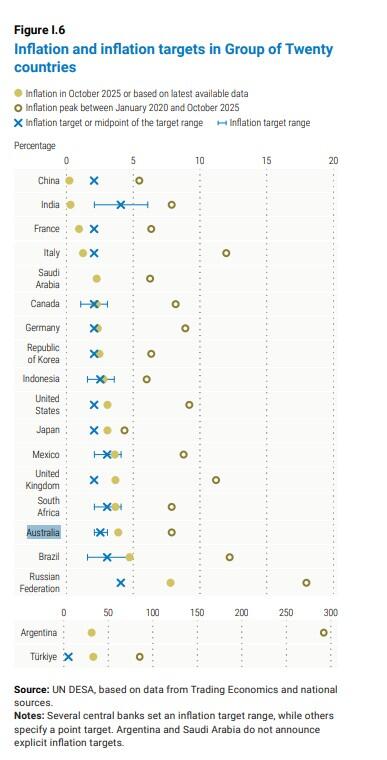

While Australia has surfaced reasonably unscathed from recent United States tariff shocks, this soft landing relative to other countries has come at a price. At least, that’s the conclusion of the United Nations' latest World Economic Situation and Prospects 2026 report, which has a fairly sobering outlook for local inflation.
The estimated average tariff rate for Australia stood at 8.9% — reflecting a low International Emergency Economic Powers Act reciprocal tariff baseline rate of 10% — with the country’s exports to the U.S., like precious metals and gold, being exempt from tariffs.
Beyond the relatively benign tariff impact, the UN report also highlighted easing of monetary policies and "expansionary" fiscal measures in Australia, which have contributed to an economic rebound amid heightened uncertainty and persistent global trade tensions.
According to the UN, the Australian economy is expected to experience GDP growth of 2.2% in 2026 — after nudging 1.8% in 2025 — and 2.4% in 2027.
While that’s encouraging, consumer price inflation — which slowed to an estimated 2.6% in 2025 from 3.2% in 2024 — is projected to rise to 3.0% in 2026, reflecting higher expected services inflation following persistently strong wage growth.
Australia’s fiscal policy is also expected to remain expansionary, with a new round of personal income tax cuts scheduled to be phased in over two years starting in July 2026.
Overall, the UN report expects Australia’s inflation to rise by 3% in 2026, which could present a policy challenge for the Reserve Bank of Australia (RBA) in determining the appropriate pace of further interest rate cuts in 2026.
To further complicate matters, inflation has increased in recent months, as reflected in the Australian Bureau of Statistics data published earlier this month, which revealed that the CPI rose 3.4% in the 12 months to November 2025.
This was a decline from October's figure, but the latest figure is still expected to push the RBA to either hold or hike the interest rate.
The report attributes the inflation drivers to a perfect storm of global supply-and demand-side disturbances, plus abrupt shifts in consumption patterns during the pandemic, widespread supply-chain bottlenecks and sharp increases in energy and food prices.
"The extent to which these global shocks were translated into domestic price pressures depended on country-specific factors such as exchange rate regimes, fiscal responses, labour market tightness and market structures, highlighting the importance of domestic vulnerabilities and policy settings in shaping inflation outcomes and persistence," the report highlighted.
However, not everyone is convinced that inflation will move higher from here.
Shane Oliver, chief economist at AMP, expects interest rates to remain on hold this year as the recent pickup in inflation reverses somewhat and unemployment rises a bit, heading off the need for rates hikes.
“However, given the recent run of data showing rising inflation, still low unemployment and strengthening private sector economic growth, we are not particularly confident, and the risks are skewed to the upside on rates,” says Oliver.
Meanwhile, many analysts and major banks expect the RBA to implement one or more interest rate hikes in early 2026, potentially starting as soon as the February 3rd meeting.
While the money market is currently split on near-term RBA interest rate movements, overall market pricing implies an expectation of one or two rate increases during the year.