Asia-Pacific markets traded mixed on Wednesday, with investor sentiment weighed down by uncertainty surrounding United States-Iran negotiations after President Donald Trump extended the ceasefire while maintaining pressure on Tehran.
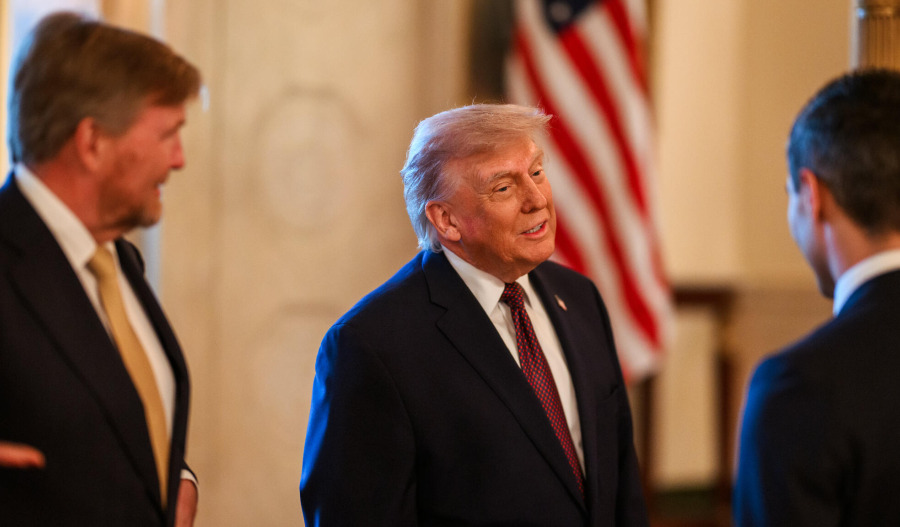
“Based on the fact that the Government of Iran is seriously fractured, not unexpectedly so and, upon the request of Field Marshal Asim Munir, and Prime Minister Shehbaz Sharif, of Pakistan, we have been asked to hold our Attack on the Country of Iran until such time as their leaders and representatives can come up with a unified proposal,” Trump said in a Truth Social post.
He added that the ceasefire would remain in place until Iran submits a proposal or talks conclude, while confirming that U.S. forces would continue the blockade of Iranian ports.
In a separate post on Truth Social, Trump noted: “Iran doesn’t want the Strait of Hormuz closed, they want it open so they can make $500 Million Dollars a day (which is, therefore, what they are losing if it is closed!). They only say they want it closed because I have it totally BLOCKADED (CLOSED!), so they merely want to ‘save face’.”
Despite the extension, the outlook for negotiations remains uncertain. Iranian state media reported that Tehran’s negotiators would not attend talks with the United States, describing them as a “waste of time”.
The lack of progress has also delayed Vice President JD Vance’s planned trip for further discussions, according to reports citing U.S. officials.
By 11:00 am AEST (1:00 am GMT), Australia’s S&P/ASX 200 had fallen 0.7%, Japan’s Nikkei 225 edged 0.1% higher, while South Korea’s KOSPI 200 slipped 0.3%.
Economic data across the region painted a mixed picture. In Australia, the latest leading index from Westpac and the Melbourne Institute showed the six-month annualised growth rate fell to –0.13% in March from +0.05% in February, pointing to below-trend growth in the months ahead.

The deterioration reflects the impact of higher interest rates and the global energy shock linked to the Middle East conflict.
In South Korea, producer prices rose at their fastest monthly pace in nearly four years, driven by higher petroleum and chemical costs amid rising global oil prices.
Data from the Bank of Korea showed the producer price index increased 1.6% month-on-month in March, with annual growth accelerating to 4.1%.
Japan’s trade data offered a more resilient signal. Exports rose for a seventh consecutive month, increasing 11.7% year-on-year in March, supported by firm global demand and higher prices. Imports climbed 10.9%, resulting in a trade surplus of ¥667 billion.
Overnight in the United States, major equity benchmarks closed lower, with the Dow Jones Industrial Average, S&P 500 and Nasdaq Composite each declining 0.6%, as investors assessed geopolitical risks.
Commodity markets reflected the heightened uncertainty. Brent crude rose 3.1% to US$98.48 per barrel, while spot gold fell 2.1% to US$4,719.80 per ounce.
Elsewhere, Chinese equities ended slightly higher on Tuesday, with the Shanghai Composite Index gaining 0.1% and the CSI 300 rising 0.2%.
Hong Kong’s Hang Seng Index advanced 0.5% to its highest level since late February, while India’s BSE Sensex climbed 1% to a six-week high.
European markets, however, closed broadly lower. The UK’s FTSE 100 declined 1.1%, Germany’s DAX fell 0.6%, and France’s CAC 40 dropped 1.1%.