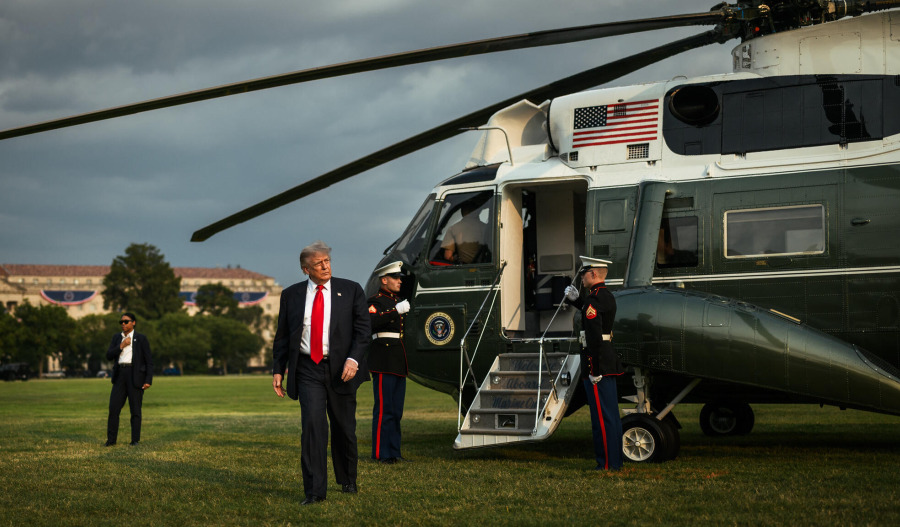
Asian-Pacific markets opened lower on Monday despite falling oil prices after United States President Donald Trump cancelled a planned attack on Iran.
By 11:50 am AEST (1:50 am GMT), Australia's S&P/ASX 200 was down 0.2%, Japan's Nikkei 225 had declined 1.9%, and South Korea's KOSPI 200 had fallen 4.6%.
Japan's Finance Ministry said on Monday it had carried out a coordinated yen-buying intervention with the US Treasury on Friday, marking a rare joint effort by the two allies to curb sharp fluctuations in the Japanese currency.
According to a statement by Minister of Finance Ms Satsuki Katayama:
"On Friday 31st, July (U.S. Eastern Time), Japan's Ministry of Finance purchased the Japanese yen in coordination with the U.S. Department of the Treasury.
"This joint action was taken pursuant to the U.S.-Japan Finance Ministers' Joint Statement issued in September 2025 and countered excessive volatility and disorderly movements in the Japanese yen in recent months.

"The Japanese Ministry of Finance remains attentive and in close communication with our counterparts at the U.S. Treasury. We will not hesitate to conduct further joint intervention.
"Japan also plans to utilise the Federal Reserve's Foreign and International Monetary Authorities (FIMA) Repo Facility in the future."
In the U.S. on Friday, major benchmarks finished higher, with the Dow Jones Industrial Average gaining 0.5%, the S&P 500 rising 0.7%, and the Nasdaq advancing 1.0%.
In commodities, ICE Brent crude rose 1.2% to US$87.93 a barrel, while spot gold declined 1.3% to settle at US$4,050.83 an ounce.
Chinese markets ended higher on Friday, with the SSE Composite Index gaining 0.7% to 3,832.3, while the CSI 300 added 0.9% to 4,588.2.
Hong Kong's Hang Seng Index edged 0.1% higher to 25,884.3, while India's BSE Sensex climbed 0.2% to 78,094.6.
European markets delivered a mixed performance on Friday. The UK's FTSE 100 fell 0.3% to 10,868.1, Germany's DAX gained 0.1% to 25,629.2, and France's CAC 40 advanced 0.3% to 8,509.6.