
If you want to understand why your SaaS (software as a service) portfolio is currently bleeding out on the pavement, stop looking at interest rates and start observing the quiet, teetotal siblings commanding the world’s fourth-most valuable private entity.
Anthropic was supposed to be the "good guy" research lab, serving as the ethical handbrake and the designated driver at the OpenAI frat party.
But as of this week - with a fresh US$30 billion Series G in the bank and an eye-whopping $380 billion valuation - the "safety" outfit has effectively morphed into the most dangerous force in enterprise software.
Instead of just engineering a superior chatbot, the company has perhaps rung in the death knell for the per-seat subscription model, fundamentally altering the economics of the industry.
From Chatbot to Co-Worker
How? with a seismic update to Claude, Anthropic has shifted from generative to agentic AI with its computer use capabilities.
Its ‘Claude Cowork’ doesn't just offer advice; it navigates operating systems and executes tasks across apps like the widely adopted Salesforce. Crucially, it creates a "Constitutional" audit trail - satisfying the compliance demands of risk-averse CIOs.
The AI disruptor removes the human bottleneck the industry has been fearing.
By allowing AI to execute complex workflows autonomously, companies can decouple output from headcount. We are moving to "Service-as-Software" instead of SaaS - paying for the completed legal contract, not the tool used to draft it.
This destroys the "per-seat" revenue model, creating a massive sector headwind.
- Volume Collapse: If one AI agent handles the work of five juniors, companies cancel four licences.
- UI Redundancy: Agents interact directly with APIs, rendering expensive human interfaces obsolete.
- The Utility Play: Why pay for niche SaaS tools when Claude is already integrated and "good enough" to replace them all?

Morality checks
Valley scripture now dictates the origin story, recounting how founders Dario Amodei (VP of Research) and Daniela Amodei (VP of Safety) walked out of OpenAI in late 2020.
A team of top researchers followed - the heavy lifters who built GPT-3 - slamming the door on Sam Altman’s aggressive commercialisation to pursue a different path.
Their pitch was simple: a Public Benefit Corporation (PBC) with a mandate to prioritise protection over profit.
"We fundamentally believe that AI should be a force for human progress, not peril," Dario Amodei wrote in the company's founding statement.
Investors heard "non-profit academic lab," yet the market was profoundly mistaken about the company's trajectory.
In reality, the Amodeis were assembling Constitutional AI - a system that adheres to a strict code rather than merely mimicking human feedback which is prone to sucking up to the user.
OpenAI spent those years dazzling consumers with a chatty, creative, and occasionally lying bot; conversely, Anthropic was refining the one attribute Fortune 500 CIOs actually crave: predictability.
Caretaker to assassin
Early on, Anthropic played the dark horse, producing models like Claude 1 and 2 that were serviceable but lacked the "magic" of GPT-4.
Everything changed in 2025, starting with the May debut of Claude Code.
Rather than just offering snippets, the tool rewrote entire codebases, driving revenue past $2.5 billion in a matter of months.
January 31, 2026 marked the knockout blow with the release of Claude Cowork, bolting on legal, finance, and product marketing abilities to replace the worker rather than just the software.
The aftermath was a $285 billion mess across the software terrain in a single session, forcing investors to ask why anyone would pay $30/month for a seat on a CRM platform when Claude can moonlight as the CRM, the analyst, and the data entry clerk for a fraction of the cost.
"Is AI a headwind in the near-term for software? YES! However, the magnitude of this software sell-off is a major head scratcher and is factoring in an Armageddon scenario for the sector that is far from reality in our view," Wedbush Securities analyst Dan Ives wrote in a note.
“Enterprises won't completely overhaul tens of billions of dollars of prior software infrastructure investments to migrate over to Anthropic, OpenAI, and others.”
Billions
Figures from this month's Series G are, frankly, ridiculous, with a post-money valuation of $380 billion and a capital injection of $30 billion led by GIC and Coatue.
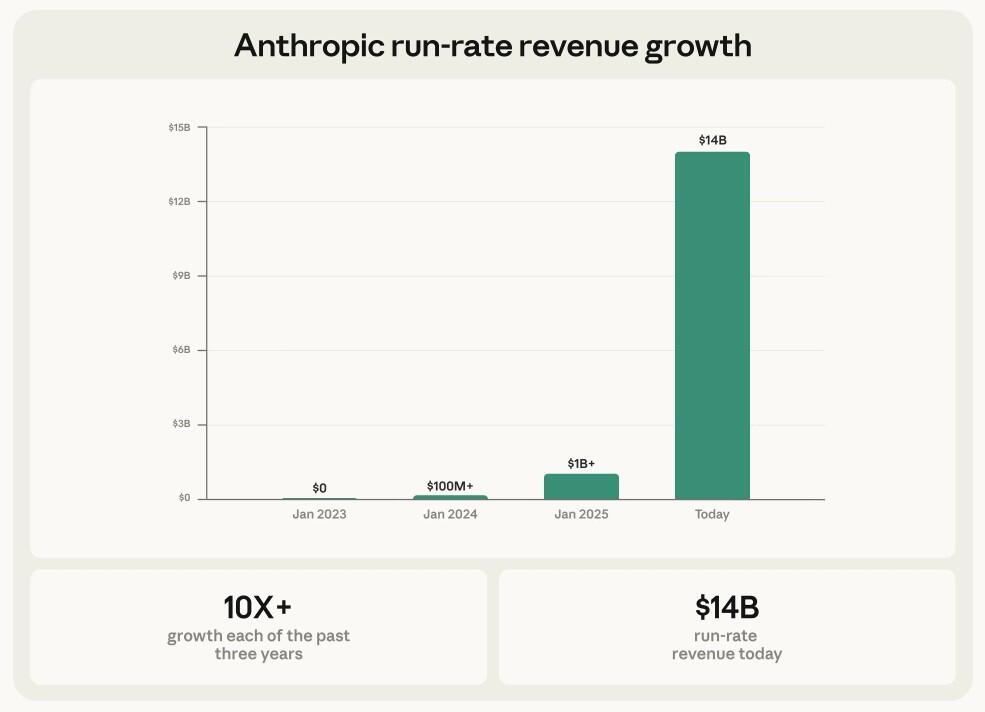
Anthropic now captures 40% of enterprise LLM spend, up from 12% two years ago, and with a revenue speed of ~$14 billion - up from one billion in late 2024 - the momentum is undeniable.
"Anthropic is the clear category leader in enterprise AI, demonstrating breakthrough capabilities and setting a new standard for safety, performance, and scale that will drive their long-term success," GIC Private Equity CIO Choo Yong Cheen said in the company's press release.
That's banker-speak for "we are betting the house on this," and the cap table is a roster of investors hedging their bets.
Amazon has funnelled in over $8 billion historically and Google is in for $2 billion+, while the sovereign wealth funds have arrived to essentially own the plumbing of intelligence.
Software sector in freefall
Investors are jumping ship from the once invincible software sector that brought in the age of the internet.
The iShares Expanded Tech-Software Sector ETF (IGV) has fallen more than 23% YTD, dropping from ATH's of $117 to around $82, and heading downward.
The latest headline figure is roughly US$2 trillion wiped from software market caps since the selloff began, according to J.P. Morgan - up from the $1 trillion figure that was widely cited in early February.
Once sector outperformers, companies the likes of ServiceNow are down 28% year-to-date, Salesforce off about 26%, and Intuit down more than 34%.
Young vs old
As the SaaS sector crumbles, Dario Amodei is writing philosophy, and his recent essay, The Adolescence of Technology, is a scary read for anyone hoping for a soft landing.
The argument? We're entering a "stormy and inevitable" rite of passage.
Forget better email sorting; Amodei's warning about biological weapons and state-level cyber warfare.
"Humanity is about to be handed almost unimaginable power, and it is deeply unclear whether our social, political, and technological systems possess the wisdom to wield it," Amodei wrote.
It's a hell of a sales pitch to suggest the world might end, implying you should procure the safety-compliant model while you still can.
And it's not raw horsepower that provides Anthropic's edge, distinguishing them from OpenAI - which wants to be your friend, your lover, and your creative muse.
In contrast, the Amodeis sell insurance, aiming to be your lawyer, your programmer, and your compliance officer.
Auditability has allowed them to capture the enterprise market, because if you're a bank, you can't tolerate a model that "makes things up" about a credit score.
You need a model that shows where it got the info, and that model is Claude.
2026
The gossip circuit is running hot that Wilson Sonsini - the heavyweight tech law firm - has been hired to prepare the paperwork.
With a $380bn valuation, an IPO is the only way out left, but don't expect a standard roadshow.
Anthropic will likely position itself not as a tech stock, but as critical infrastructure - a utility company for the cognitive age.