

Artificial intelligence (AI) is reshaping job functions rather than eliminating employment at scale - though whether the resulting productivity gains are broadly distributed will depend on workforce adaptability, skills investment and policy design, according to a Bank of America Institute analysis published this week.
Roughly one in four jobs globally - up to 840 million positions - are exposed to generative AI in some form, the International Labour Organisation's 2025 research finds, a dataset that forms the backbone of Bank of America's latest labour market assessment.
That average, though, masks a wider gap: high-income economies sit at one in three, where cognitive work dominates, while lower-income countries come in at around 11%.
BofA's analysts are careful to draw a line between exposure and outcome, making the case that what happens to workers depends less on how many jobs face AI pressure and more on whether an economy has the skills, infrastructure, retraining capacity and institutions to absorb it.
Redesigned, not replaced
On that front, the research leans toward a more measured reading.
Rather than a sector-specific automation wave, the Bank of America Institute frames AI as a broad shock to cognitive work generally, with the central question being how it changes what people do each day rather than whether it clears out entire occupations.
BofA reaches for the ATM as a historical anchor: Those machines took over routine cash-handling but allowed banks to open more branches and move tellers into sales and service, with overall teller employment rising rather than falling.
The bank expects genAI to follow a similar two-stage path - first layering on top of existing workflows to reduce friction in documentation, data entry and coordination, then driving a larger productivity step-up as firms eventually redesign how roles and teams are structured around the technology.
Survey data from the ECB across 11 EU countries supports that framing, with managers, professionals and technicians reporting the heaviest daily AI use and the most positive outlook on what it means for their work - more than half of managers expecting it to improve their roles rather than reduce them.

Agentic AI raises the stakes
Where BofA's analysis breaks new ground is on agentic AI, which the bank treats as a meaningful step beyond the genAI frameworks built in 2023 and 2024.
Earlier models assumed AI as a tool that workers direct; agentic systems are capable of running multi-step workflows, monitoring processes and making execution decisions with little or no human involvement - what BofA calls scalable "digital labour supply".
That shift has gathered pace since 2025, feeding the rise of what analysts are calling the "one person company", where a single operator can run processes that previously required a team.
The Yale Budget Lab's May 2026 research adds an important counterweight here, finding that while AI-driven productivity growth could lift long-run economic and fiscal outcomes, falling labour force participation could erode a meaningful portion of those gains, keeping the net impact genuinely difficult to forecast.
Who bears the cost
The exposure data also breaks unevenly across demographics, and the pattern is fairly consistent across the research.
Asia-Pacific's overall exposure rate of 22% trails Europe's 31.7%, but the ILO estimates the region still accounts for around 442 million exposed jobs - roughly equal to all other regions combined, purely by virtue of workforce size.
Women face higher-than-average exposure in advanced economies, BofA notes, largely because administrative roles with routine, language-based tasks are overrepresented in female employment - exactly where genAI performs most capably.
Younger workers are feeling the pressure in a different way: Unemployment among 25-34 year-olds with tertiary qualifications remained elevated into 2026, which BofA connects to weaker demand for early-to-mid-career positions in sectors where AI efficiency gains are running ahead of hiring.
Research by Dallas Fed economist J. Scott Davis, tracking wages across 205 occupations since late 2022, adds further texture - wages in AI-exposed industries grew faster even as hiring slowed, with Davis finding AI is complementing experienced workers while substituting for entry-level employees doing the same types of tasks.
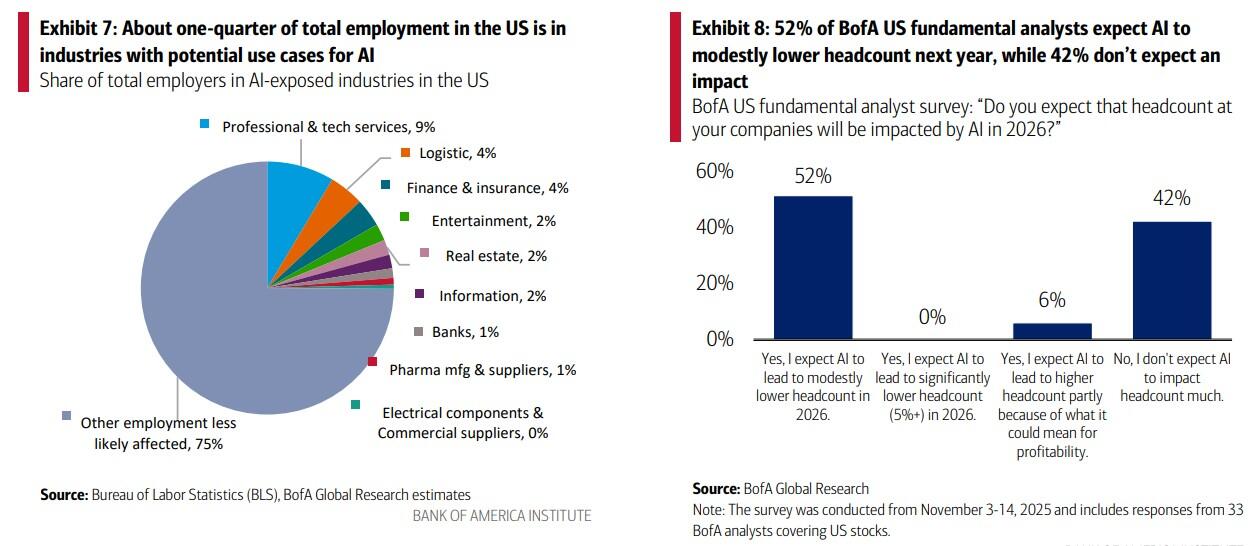
BofA's own internal survey of U.S. equity analysts put 52% expecting modest headcount reductions across covered companies in 2026, with 42% anticipating no change.
On policy, BofA concludes that governments need to move faster on guidance for private companies, pushing AI deployment toward workforce capability rather than headcount reduction, and that fiscal frameworks need to ensure productivity gains are shared between labour and capital rather than flowing predominantly to the latter.