New data shows that women are slower to adopt the EV trend than men.
According to Smart’s latest quarterly report, leases on new EVs have doubled since the start of the year, but the gender gap has widened.
Smart had 80,000 novated leases under management at the end of June 2025, an increase of 15,400 from the same time in 2024.
During the third quarter of 2025, 53.3% of males who took out a SmartTM lease on a new vehicle opted for an EV, compared to 38.8% of women.
“Based on some of the conversations we've had with customers, common trends tend to be things like upfront costs, access to charging infrastructure, range anxiety and knowledge gaps,” Smart customer education specialist Sophie Mussared tells Azzet.
Mussared also says perceptions of a higher entry cost have also turned women off buying EVs.
“Sometimes true, but that's not always necessarily the case,” she says.
“Government incentives and discounts via innovative leasing can make it more accessible for all different people.”
This is despite the sale of BEVs growing again in Australia during the third quarter.
In the three months to 30 September, the number of BEV sales jumped to 29,298 from 29,244, marking five consecutive quarters and the highest number of BEVs sold since Q1 2024, according to the Australian Automotive Association (AAA).
The AAA data also reported that BEVs had a market share of 9.70%.
This trend can also be seen in other parts of the world.
According to research and data organisation Escalent, men make up 71% of owners and 74% of shoppers for BEVs in the United States.
This research also found that women start with lower familiarity of BEVs, with only 30% of women familiar compared to 55% of men.
Senior insights manager for Escalent’s Automotive & Mobility Team, Nikki Stern, echoed some of Mussared’s reasons for why women have been slower to jump into the EV market.
“Women are not only less familiar with BEVs and complete fewer research activities, but they are also less likely to know someone who owns a BEV,” Stern said in a media release.

“This limits their ability to hear about positive experiences, further slowing their consideration of BEV powertrains.”
Studies from the U.K. also found that while a third of men considered an electric car, compared to a fifth of women.
This research also showed that 16% of men own EVs compared to 7% of women.
Women are continually less likely to switch vehicles, as Smart’s data found that there are six petrol or diesel vehicles in the top 20 vehicles purchased by women during Q3 compared to just four in the top 20 for men.
The only petrol vehicle that scraped in at 20th place on the men's list was the Mitsubishi Outlander.
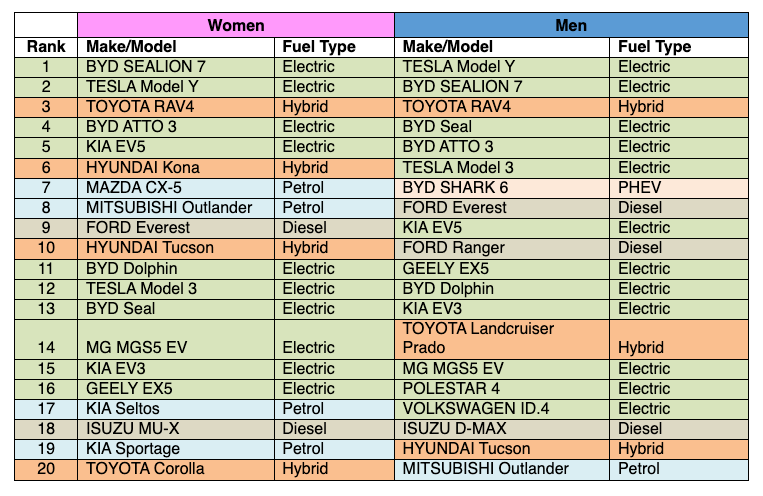
In the latest quarter, 36.9% of women purchasing a new vehicle on a lease chose a petrol or diesel model, compared to 28.2% of men.
According to AAA, the number of wholly petrol vehicles has been on a steady decline since Q4 2023.
These vehicles now only take up 69.65% of the market share, down from 72.03% in the previous quarter and 81.20% two years ago.
According the Smart’s data, novated leases for plug-in hybrid electric vehicles (PHEVs) have fallen significantly over the past six months, after the Federal Government removed the Fringe Benefits Tax exemption for hybrids.
However, this change in legislation has deterred women more than men.
“Interestingly, our data shows that male car buyers seemed to switch fairly quickly from those vehicles to full EVs after the PHEV discount ended, while women were more likely to switch from PHEVs to a conventional petrol or diesel-powered car,” Mussared said.
The AAA data found that sales of PHEVs and Hybrids were both on the rise during the September quarter of 2025, taking up 4.12% and 16.52% of the market share, respectively.
Mussared says a reason why PHEVs and Hybrids are a more popular option is that they balance familiar petrol features with unfamiliar EV features.
“It's an easier option to dip your toes in the water if you are looking at going into that market,” she says.
“Having the combination of it being a hybrid, sometimes, can be a little bit more digestible for customers.”