
Azzet reports on three stocks that were sold off following price moving updates today.

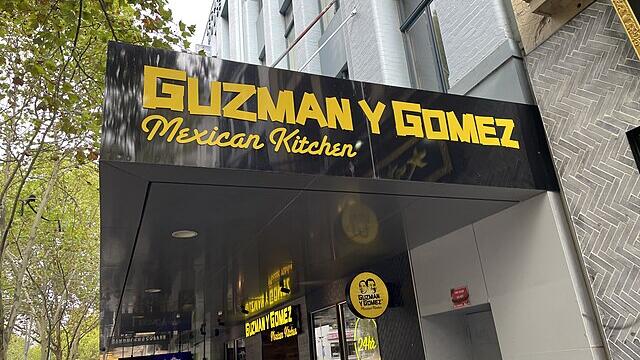
Guzman y Gomez plunges on soft 1H FY26 result ~
Shares in Guzman y Gomez (ASX: GYG) were trading 10.2% lower by 1:50 pm AEDT (2:50 am GMT) after the Mexican fast food chain revealed that 1H FY26 network sales (up 18%) – those generated by both company-owned and franchisees across Australia, Singapore, Japan, and the United States – failed to beat analysts’ expectations of 19% growth.
Despite a strong underlying profit beat embedded within today’s result, investors continue to dish out the tough love at the stock with a softer-than-expected result, leaving the current loftier valuation looking harder to justify.
While the Australian segment remains the company's powerhouse, with network sales reaching $673.6 million and earnings growing by 30%, the U.S. division continues to weigh on the group.
Underpinning lower than expected growth were comparable sales growth in Australia, at 4.4% versus the 5.2% consensus, and a weaker corporate margin at 17.6% (Visible Alpha consensus 18.1 per cent), partly due to underperformance in strip restaurants and delivery.
Revenue from corporate sites and royalties gained 23% to $261 million - lower than the 27% analysts expected - while net profit of $10.6 million was 45% higher than a year ago.
Driven by new restaurant openings and continued positive like-for-like sales momentum - especially in breakfast and late-night trading – the group grew strongly in Australia, with local network sales up 17.5% to $673.6 million.
Meanwhile, expansion remains the group’s primary focus, adding 33 new restaurants to its Australian pipeline for a total of 108 in development, most of which will be drive-thrus.
The group’s balance sheet remains robust, with $236.4 million in cash and no debt, supporting both a fully franked interim dividend of 7.4¢ cents per share to be paid on March 31 - and an ongoing $100 million on-market share buyback.
Other Key numbers announced today include:
- Global network sales rose 18.0% to $681.8 million.
- Group segment underlying earnings jumped 23.3% to $33.0 million.
- NPAT climbed 44.9% to $10.6 million (underlying NPAT: $16.9 million).
- Australia segment underlying earnings soared 30.0% to $41.3 million.
- Seventeen new restaurants opened globally, bringing the total to 272.
Commenting on today’s announcement, Steven Marks, founder and Co-CEO told the market that the 1H FY26 result centred around culinary excellence, real estate and technology.
“Australia and Asia continued to deliver, achieving $674 million in network sales for the half, up 17.5%, demonstrating the strength of our brand and the obsession our teams have with delivering the best guest experience,” said Marks.
“This growth translated to strong earnings growth, with Australia Segment underlying EBITDA growing 30.0%, demonstrating strong operating leverage in the business model.”
While Marks also reminded the market that the group has extremely healthy restaurant economics, investors clearly want to see those economics reflected in better growth, especially in the U.S.
The group continues to expect U.S. losses to increase slightly in the year to June, compared with an $13.2 million loss in FY25.
Guzman y Gomez has a market cap of $1.9 billion; the share price is down 59% in one year and down 18% in the last month.
The stock’s shares appear to be weak with little demand from investors.
Consensus is Hold.
Peter Warren tanks on mixed 1H FY26 result
Shares in Peter Warren Automotive (ASX: PWR) were trading 7.5% lower, with investors focussing more on the Australian automotive dealership group’s cautious stance on the full-year outlook than its reasonably good 1H FY26 interim result.
Despite reporting a 98.3% surge in net profit to $11.9 million and a 3.2% increase in revenue to $1.26 billion, the market appears to have fixated on management’s cautious stance on the full-year outlook, citing subdued consumer sentiment and ongoing industry-wide headwinds.
Commenting on the result, Andrew Doyle, CEO, reminded the market that the new car market remained fragmented and highly competitive, with several new brands entering the market.
While gross margins were disappointing - consistent at 16.2% - Chinese brands have almost doubled their market share over the past four years and now represent 16.9% of the market in new vehicles.
The group now has relationships with seven of the top eight best-selling Chinese brands.
Other key numbers announced today:
- Operating expenses were up 2.4% which included increases in award-based labour costs of 3.5%.
- New vehicle inventory reduced to $332.3 million.
- Inventory has been reduced by $50 million over an 18-month period, and this has lowered our interest expense significantly.
- Fully franked interim dividend of 3.0 cents to be paid on 26 March 2026.
In December, the group announced the acquisition of Wakeling Automotive - a large multi-franchised dealership group based in Western Sydney – which is expected to lift revenue by 20% and be immediately EPS accretive.
However, given that the $28 million acquisition is being funded by existing debt, this has raised concerns over leverage within a high-interest environment.
While the group’s net debt to equity remains high, at around 93.3%, it has dropped significantly from over 200% in previous years.
Looking forward, the group expects to benefit from Chinese brands achieving further market share growth and told the market it is well positioned to acquire further dealerships given its strong property-backed balance sheet.
Peter Warren Automotive has a market cap of $266 million; the share price is trading flat on one year and is down 13% in the last month.
The stock’s shares appear to be in a near-term downtrend, confirmed by its 20-day moving average.
Consensus is Moderate Buy.
Inghams Group tumbles on FY26 earnings downgrade
Shares in Inghams Group (ASX: ING) were trading 15.8% lower this afternoon after the poultry producer took a scalpel to its FY26 guidance during today’s 1H FY26 update.
Citing excess inventory, supply chain issues and cost associated with bringing on new customers – after losing the Woolworths business last year – Ingham’s cut its FY26 earnings guidance to between $180 million and $200 million, down from the previous forecast of $215 million to $230 million.
At the midpoint, the figure represents a 15% downgrade.
After posting 1H FY26 revenue of $1.61 billion for the 26 weeks to 27 December 2025, broadly flat year on year, the board declared a fully-franked interim dividend of 4 cents per share, down from 11 cents in the prior period.
While earnings fell 33.8% to $139.2 million, net profit after tax (NPAT) slumped 64.9% to $18.1 million.
While net selling prices increased 1.4%, core poultry volumes declined 0.7% year on year.
Higher operating costs in Australia included excess inventory management ($19 million), incremental supply chain and logistics costs ($6.7 million), lower farming performance ($3.8 million), and transition inefficiencies at Ingleburn ($1.8 million).
Reflecting both these operational pressures and broader inflation increases, total costs were up 5% on the previous period.
However, on a more encouraging note, inventory levels declined by $24.3 million during the half, while cash conversion expanded to 113.1%, due to working capital improvements.
Commenting on today’s update, Inghams’ CEO Ed Alexander, reminded the market that despite current headwinds, the fundamentals of the business continue to strengthen.
He pointed to Ingram’s return to volume growth in the second quarter, with price growth across Australia and NZ being supported by improved Wholesale market fundamentals.
“Measures are in place to restore operational performance and unit costs in the second half, including improved planning, supply chain stabilisation and targeted operational initiatives across farming and processing,” he said.
“With improved inventory levels and momentum returning across the core business, earnings are expected to improve through the second half and into FY27.”
Inghams Group has a market cap of $769 million; the share price is down 35% in one year and down 22% in the last month.
The stock’s shares appear to be in a near-term rally within a longer-term bearish trend.
Consensus is Hold.
This article does not constitute financial or product advice. You should consider independent advice before making financial decisions.