While United States electric vehicle (EV) manufacturer, Rivian Automotive (NASDAQ: RIVN) has taken a bold step into the next era of autonomous driving, unveiling its own custom AI chip, a fresh suite of self-driving software and long-term robotaxi ambitions, the market’s initial reaction was far from enthusiastic.
Rivian used its first Autonomy and AI Day to outline a sweeping plan: replace Nvidia chips with an in-house processor, roll out a more affordable driver-assistance package, and eventually introduce Level 4 autonomous vehicles capable of operating without human input in certain conditions.
CEO RJ Scaringe positioned the new chip as a multi-year commitment aimed at boosting performance while cutting costs by several hundred dollars per vehicle.

That combination, he stressed, is “rare” in the industry.
The custom silicon, manufactured by TSMC, uses multi-chip module packaging and delivers extremely high memory bandwidth, which is essential for real-time AI processing of data from cameras, radar and, soon, lidar sensors.
But despite the technical promise, Rivian’s shares slid sharply during and after the event.
The stock initially ticked upward when the chip was announced, but finished the day down more than 6%, later dipping further as competing AI news stole the spotlight.
In the broader picture, Rivian shares remain up about 25% for the year, but still down over 80% from the company’s 2021 IPO.
A centrepiece of Rivian’s announcement was Autonomy+, a new paid driver-assistance package priced at US$2,500 upfront or US$49.99 per month.
It significantly undercuts Tesla’s premium offering, which currently costs US$8,000 outright or US$99 per month.
The package will debut with the company’s next-generation vehicles in 2026 and includes a “Universal Hands-Free” mode covering more than 3.5 million miles of marked roads across North America.
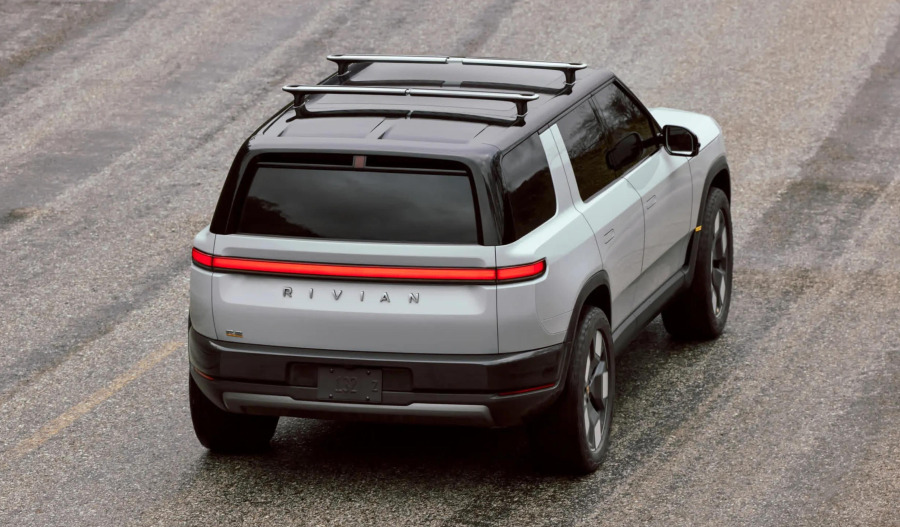
Rivian’s approach to autonomy also sets it apart from Tesla in another key way, including plans to integrate lidar alongside cameras and radar in its upcoming R2 models.
Lidar provides detailed 3D mapping essential for higher-level autonomy, and its use places Rivian closer to companies like Waymo—widely seen as the most advanced player in robotaxis today.
Scaringe told the market he expects the system to get smarter through reinforcement learning as owners rack up more miles.
While Scaringe declined to set a firm timeline for full autonomy, he confirmed that the groundwork being laid now opens the door to a future robotaxi service.
The company’s initial focus, however, remains vehicles for personal ownership—the largest share of road miles today.
Powering these ambitions is Rivian’s new foundational AI architecture, including a “Large Driving Model” trained on vast amounts of real and simulated roads.
Executives described this as the next evolution beyond software-defined vehicles: an AI-defined vehicle, capable of handling far more complex driving environments than today’s systems.
Rivian also revealed a next-generation voice interface, the Rivian Assistant, due in early 2026.
The tool will manage some vehicle functions, coordinate with apps and even flag potential maintenance issues, further integrating AI into the driving experience.
The company is juggling these technological leaps alongside a difficult market environment.
U.S. sales of fully electric vehicles have slowed, worsened by the early end of a federal EV tax credit last autumn.
Competition from Chinese automakers is also intensifying, while established brands such as Tesla, GM, Honda and Nissan continue to invest heavily in autonomous systems - either developed internally or through tech-startup partnerships.
Rivian’s deep vertical integration from designing its own chip to building its own sensors and software carries high upfront costs.
However, Scaringe insists it will become a major advantage as production scales, reducing dependency on suppliers and giving the company more control over performance and pricing.
But for now, the company faces the challenge of proving to investors that this long-term AI strategy will pay off.
If Rivian can execute on its 2026 roadmap and bring true hands-free - then eyes-off driving to market - it could position itself as a serious rival in the next frontier of autonomous mobility.